

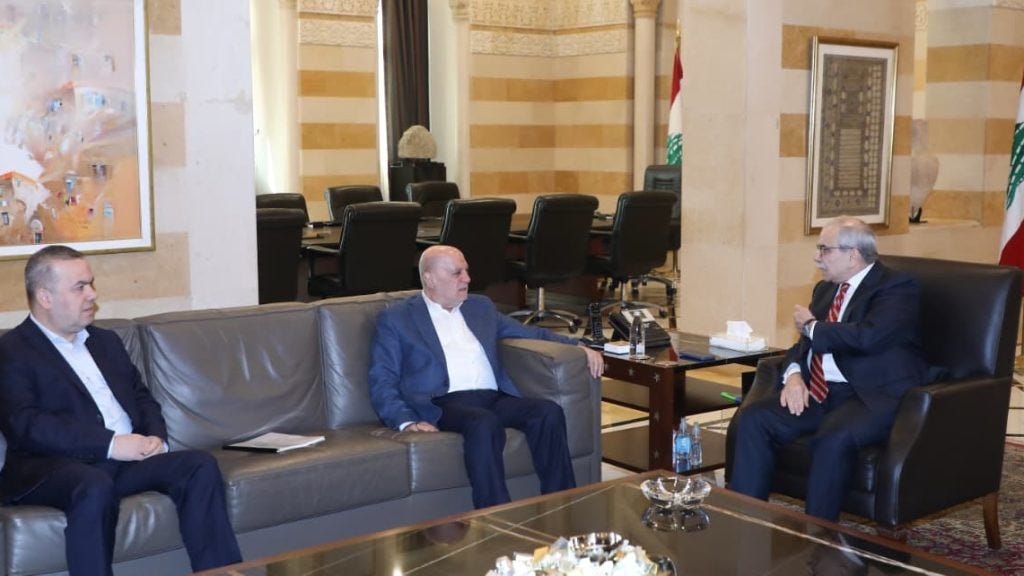
Lebanon, PUREWILAYAH.COM — Lebanese Prime Minister Nawaf Salam held talks at the Grand Serail with lawmakers from the Loyalty to the Resistance Bloc and a delegation from the Lebanese Communist Party, focusing on ongoing Israeli attacks, ceasefire violations, reconstruction priorities, national sovereignty, and key political and economic issues affecting the country.
Resistance Bloc: Israeli Aggression Continues Despite Ceasefire Commitment
Speaking after the meeting, MP Hassan Fadlallah said: “My colleague Haj Amin Sherri and I met with Prime Minister Nawaf Salam to discuss a number of issues that concern all Lebanese, especially as we continue to witness ongoing Israeli aggression against our country, as occurred today and on most days.
While Lebanon fully adheres to the ceasefire agreement of November 27, 2024, the enemy continues to violate that agreement and assault Lebanese sovereignty.”
He stressed the necessity of exerting every possible effort to stop the Israeli aggression and compel the enemy to implement the agreement, noting that it remains the only framework currently governing the situation between Lebanon and Israel, regardless of other details or proposals.
Reconstruction, Funding, and Shelter for the Displaced
Fadlallah added that the main issue discussed concerned reconstruction and the allocation of the necessary funds for required steps. He noted that while the file as a whole requires substantial funding, dividing it into specific points enables the Lebanese state to accomplish much.
He pointed to steps taken by the government in electricity and infrastructure, as well as work carried out by the Council of the South and what can be undertaken by the High Relief Commission.
He said that, through coordination with the prime minister, funds were allocated to the High Relief Commission to begin structural repair work, particularly in Beirut and the southern suburbs, which he described as a vital file that would allow thousands of families to return to their homes.
He also addressed the issue of shelter for families still unable to return to or remain in their villages, especially in border areas and frontline villages subjected to further Israeli attacks.
“Providing Something Is Better Than Deprivation”
Fadlallah stated that initial practical steps have begun through the Finance and Budget Committee and coordination with the prime minister to secure funding to start work.
He said that providing limited assistance is better than deprivation, even if the state’s current capabilities do not allow it to cover all needs. He stressed that this does not justify inaction, adding that the Resistance Bloc insists the Lebanese state must bear full responsibility toward those harmed by Israeli aggression.
He noted that Prime Minister Salam reaffirmed his commitment to reconstruction as stated in the ministerial statement, emphasizing that this commitment requires practical steps, which are being pursued in cooperation between the Loyalty to the Resistance Bloc, the Development and Liberation Bloc, the government, and parliament.
Communist Party: Sovereignty, Negotiations, and Political Reform
Prime Minister Salam also received a delegation from the Lebanese Communist Party, headed by Hanna Gharib, who said the visit was an opportunity to present a memorandum outlining national, economic, political, and social priorities.
Gharib said the delegation began by condemning Israeli attacks on Lebanon, including those carried out earlier in the day that targeted several areas north of the Litani River.
He addressed the issue of protecting Lebanon and its sovereignty through moving toward the establishment of a national and popular resistance transcending regions, sects, and denominations, and emphasized the full responsibility of the Lebanese state in national mobilization, including calling on all Lebanese youth without exception and supporting and equipping the Lebanese Army with all available capabilities so it can lead this confrontation.
Regarding negotiations, Gharib said the delegation emphasized negotiations of a strictly security nature, aimed at stopping attacks and ensuring the withdrawal of occupation forces to the armistice line without conditions, in accordance with the international agreements of 1949.
Politically, the delegation stressed the need to address unresolved political files, foremost among them implementing unfulfilled provisions of the Taif Agreement, particularly Article 95 on abolishing political sectarianism and establishing the National Commission for its abolition, and Article 22 providing for an electoral law outside sectarian quotas alongside a Senate.
Economically and socially, the delegation warned of dangers related to wages and their adjustment, and informed the prime minister of a direction regarding the financial gap law to ensure small depositors receive their rights in full. The delegation also stressed the need for a comprehensive national conference to address all contentious issues with the participation of all parties, in order to prevent sedition and sectarian rhetoric.
World Bank Meeting
In a separate meeting, Prime Minister Salam also received Jean-Christophe Carret, Regional Director for the Middle East at the World Bank. (PW)