

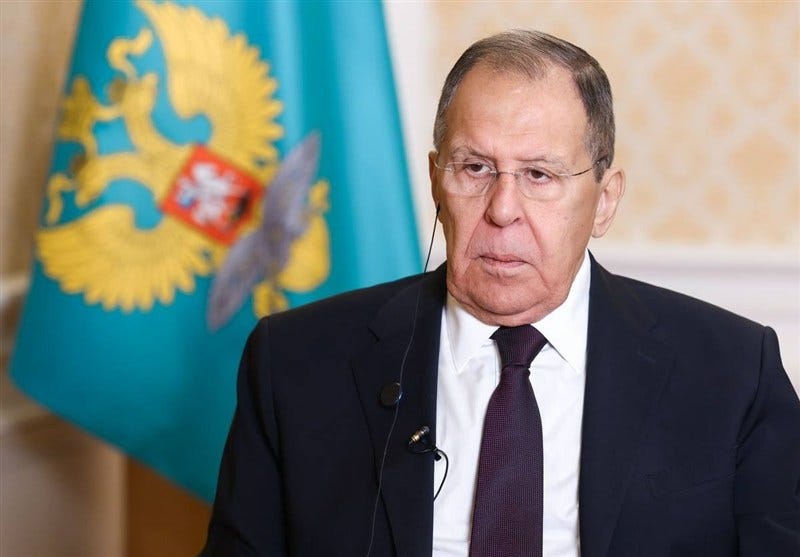
Iran | PUREWILAYAH.COM — Russian Foreign Minister Sergey Lavrov has rejected claims of any coordination with al-Joulani against Syrian President Bashar al-Assad, while reaffirming that Russia will “always act in support of Iran” and back whatever path Iran’s leadership chooses in the interests of its people.
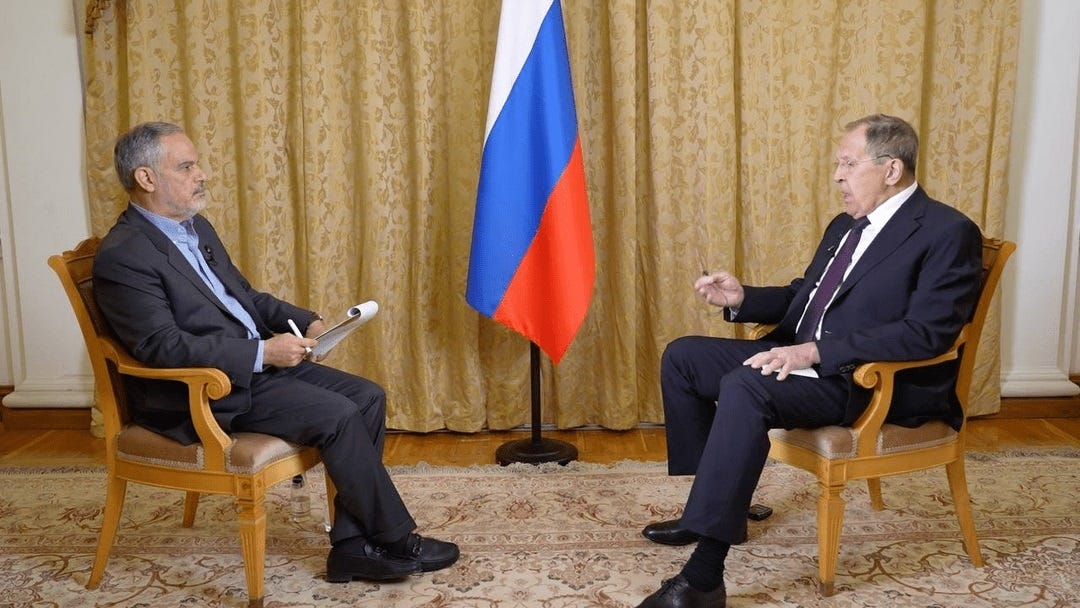
Lavrov made the remarks in an interview with Iran’s state broadcaster, in which he addressed Europe, Ukraine, Syria, Palestine, and the Iranian nuclear issue, repeatedly criticizing what he described as Western coercion, illegal sanctions, and US-backed destabilization.
“Europe Is a Main Threat”: Militarism, Coercion, and “Reviving Nazism”
Lavrov described the European Union and what he called Brussels’ unelected bureaucracy as a major driver of global instability, saying EU elites pressure national governments to ignore their own public interests and even disregard electoral outcomes.
He claimed Europe has repeatedly been a source of global catastrophe historically, and argued that today’s European approach—especially around Ukraine—reflects renewed militarism.
Lavrov also alleged that “the theory and practices of Nazism are being revived” in some European capitals and the Baltic region, accusing Western governments of ignoring what he called “Nazi approaches” in Ukraine while mobilizing political, financial, and intelligence support against Russia.
US Economic Coercion, Sanctions, and “Dirty Methods”
Lavrov criticized the United States for what he characterized as using tariffs and sanctions as tools of political diktat rather than fair competition.
He said Washington and its allies resort to sanctions not on legal grounds but to punish political positions, describing this as inequality and a violation of human rights.
He also cited the freezing of foreign assets—mentioning Russia and noting that Iran’s assets have also been frozen—as part of what he portrayed as a broader Western pattern of economic coercion.
Palestine: UN Resolutions Ignored, Normalization Undermined
Lavrov said the Palestinian issue has been pushed aside by broader great-power rivalry, despite numerous UN Security Council and General Assembly resolutions that frame a Palestinian state as central to any Middle East settlement.
He referenced the Arab Peace Initiative promoted since 2002 and said that normalization, as presented in that framework, hinges on delivering Palestinian rights. He argued that Israel’s refusal to implement international decisions—alongside practical US backing—undermines the prospects of a settlement.
Lavrov also said Russia had welcomed initiatives that could resolve urgent humanitarian aspects of the crisis, while noting that both sides accuse each other of violations and that future developments remain uncertain.
Iran’s Nuclear File: Condemnation of US–Israeli Attacks and Support for Tehran’s Chosen Path
Lavrov stated that Russia condemned Israeli attacks and subsequent US actions against Iran, saying they lacked international legitimacy and that no substantiated evidence had been presented to prove Iranian wrongdoing—neither by the IAEA, nor by Israel, nor by the United States.
He affirmed Russia’s support for Iran’s “unconditional rights” to peaceful nuclear energy as an NPT member, and criticized Western conduct surrounding the JCPOA, arguing that the United States discarded the agreement in 2018 and European states followed, then blamed Iran.
Lavrov said Russia encourages cooperation between Iran and the IAEA, but stressed the final decisions belong to Iran’s leadership.
He also said President Vladimir Putin has repeatedly told President Masoud Pezeshkian and Iranian representatives that Russia will take the position chosen by Iran’s leadership in line with the interests of the Iranian people.
Strategic Partnership: Lavrov Says Ties With Iran Are a Top Priority
Lavrov said relations with Iran are among Russia’s priorities, pointing to the strategic partnership agreement that he said entered into force in October 2025, defining mutual solidarity and support while expanding economic, investment, trade, and infrastructure cooperation.
He highlighted the role of the joint commission, and cited major cooperative tracks including:
Expanded economic opportunities via Iran’s relationship with the Eurasian Economic Union (EAEU)
The International North–South Transport Corridor, including the Rasht–Astara rail segment
Continued cooperation on nuclear energy projects, including the Bushehr plant and planned new phases
Lavrov also alleged ongoing Western attempts to intrude into Eurasian processes and impose one-sided interests, describing this as a continuation of colonial and neo-colonial policy.
Syria: “No Coordination With al-Joulani,” Ongoing Contacts With New Authorities
Lavrov explicitly denied that al-Joulani coordinated with Russia during the final days of Assad’s rule.
He said Russia had maintained close relations with Assad and intervened in 2015 at the Syrian government’s request, establishing air and naval bases and working against terrorist “hotbeds,” while coordinating with Iran and Türkiye.
Lavrov said that when the latest events unfolded, Russia did not have combat units in Syria beyond its two bases, and that the speed of opposition advances was unexpected, with little effective resistance.
He confirmed Russia is now in contact with Syria’s new authorities, saying he has met the new foreign minister multiple times and that delegations have discussed prospects for trade and economic agreements.
He stressed the importance of preserving Syria’s unity through inclusive national dialogue encompassing all components, including Alawites, Sunnis, Druze, and ethnic and political forces, also warning about US control in the northeast and what he described as continued promotion of separatist tendencies.
Gaza and International Forces: Borders Only, No Disarmament
Lavrov addressed proposals related to Gaza by saying any international force—if discussed—should focus on guaranteeing a ceasefire and preventing renewed aggression, stationed at Gaza’s borders without internal authority, without contact with civilians, and without touching the resistance’s weapons.
He warned that any force attempting to disarm the resistance by force would be treated as an occupying force, and said Palestinians would reject any alternative or proxy occupation.
Lavrov: “If Iran Faces a Wider War, Russia Will Continue to Support”
Russian Foreign Minister Sergey Lavrov said that Moscow remains firmly committed to standing alongside the Islamic Republic of Iran should it face a broader military confrontation beyond the recent 12-day war.
Referring to the strategic partnership agreement between the two countries, Lavrov stressed that Russia will consistently support Iran and defend its legitimate and sovereign rights.
He underlined that Iran has repeatedly made clear it does not seek war or further escalation and prefers resolving disputes through dialogue based on mutual respect and international law.
Lavrov added that Russia fully supports this approach and will take positions aligned with the choices made by Iran’s leadership in the interests of the Iranian people, reaffirming that Moscow’s backing is principled, unconditional, and not subject to political bargaining. (PW)