

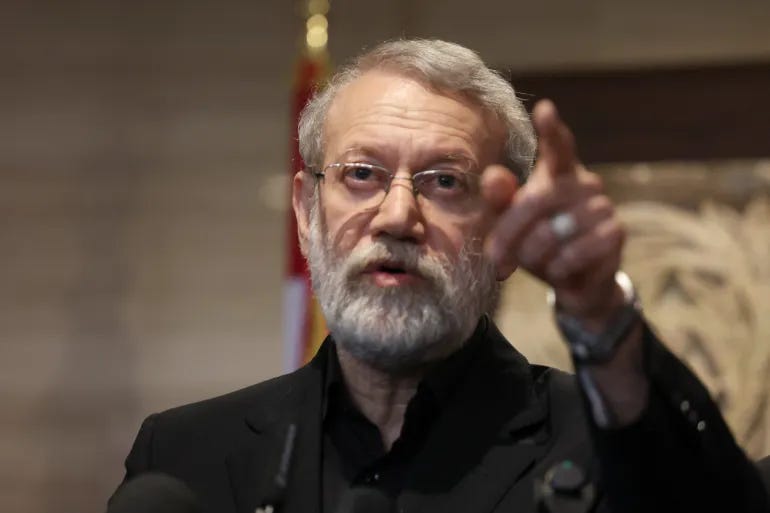
Iran, PUREWILAYAH.COM – Iran’s senior security official Ali Larijani has delivered a sharp response to US President Donald Trump after Washington threatened massive retaliation against Iran over the situation in the Strait of Hormuz.
Trump issued the threat in a post on Truth Social late Monday, declaring that the United States would strike Iran “twenty times harder” if Tehran continued to keep the strategic maritime passage closed.
The US president claimed that American attacks could target infrastructure in a way that would make it “virtually impossible for Iran to ever be built back as a nation again.”
“Death, Fire, and Fury will reign upon them – But I hope, and pray, that it does not happen,” Trump wrote, while also claiming that a prolonged disruption of the waterway would benefit China and other energy-importing countries.

Larijani: Iranian Nation Does Not Fear Empty Threats
Ali Larijani, head of the Iranian National Security Council, responded forcefully on the social platform X in multiple languages.
In his message, Larijani emphasized that the Iranian people draw strength from their historical and spiritual legacy and are not intimidated by threats from Washington.
“The Ashura-loving Iranian people do not fear your hollow threats; powers far greater than you have failed to erase them,” Larijani wrote.
“So beware lest you be the ones to vanish.”
He later added a second message underscoring the geopolitical significance of the Strait of Hormuz.
“The Strait of Hormuz will either be a Strait of peace and prosperity for all, or a Strait of defeat and suffering for warmongers.”
Larijani published the statement in Persian, English, Russian, Arabic, French and Chinese, highlighting Iran’s message to a global audience.
Strait of Hormuz: The World’s Most Critical Energy Chokepoint
The Strait of Hormuz is a narrow maritime corridor separating Iran from the Musandam Peninsula of Oman, measuring roughly 33 kilometers at its narrowest point.
Despite its limited width, it is widely recognized as the most important oil chokepoint in the world.
Approximately 20 million barrels of oil pass through the strait each day, including about 14 million barrels of crude oil and 6 million barrels of refined petroleum products.
In addition, nearly one-third of the world’s liquefied natural gas (LNG) shipments transit the waterway.
Many Asian economies rely heavily on energy shipments passing through the Strait of Hormuz. South Korea receives about 70 percent of its crude oil from West Asia, Japan imports around 90 percent, and India approximately 50 percent.
Global Markets React to Hormuz Disruption
Tensions surrounding the waterway have already begun to impact global markets.
Asian financial indices fell sharply on Monday as concerns grew over the continued closure of the strategic route and the potential disruption of global energy supply chains.
Larijani reiterated that Iran would maintain pressure on the maritime corridor if the United States and Israel continued their military actions against the Islamic Republic.
Iran: Security in Hormuz Impossible While US and Israel Escalate War
Responding to reports that France had dispatched two frigates to the Red Sea in an attempt to reopen the waterway, Larijani warned that outside military deployments would not restore stability.
“It is unlikely that any security can be achieved in the Strait of Hormuz amid the fires ignited by the United States and Israel in the region,” he said.
He added that the countries now attempting to intervene were not far removed from those who supported and fueled the conflict in the first place.
As tensions continue to escalate, Iran’s leadership has made it clear that pressure and threats from Washington will not force the country to retreat, and that the strategic balance in West Asia is rapidly shifting. (PW)