

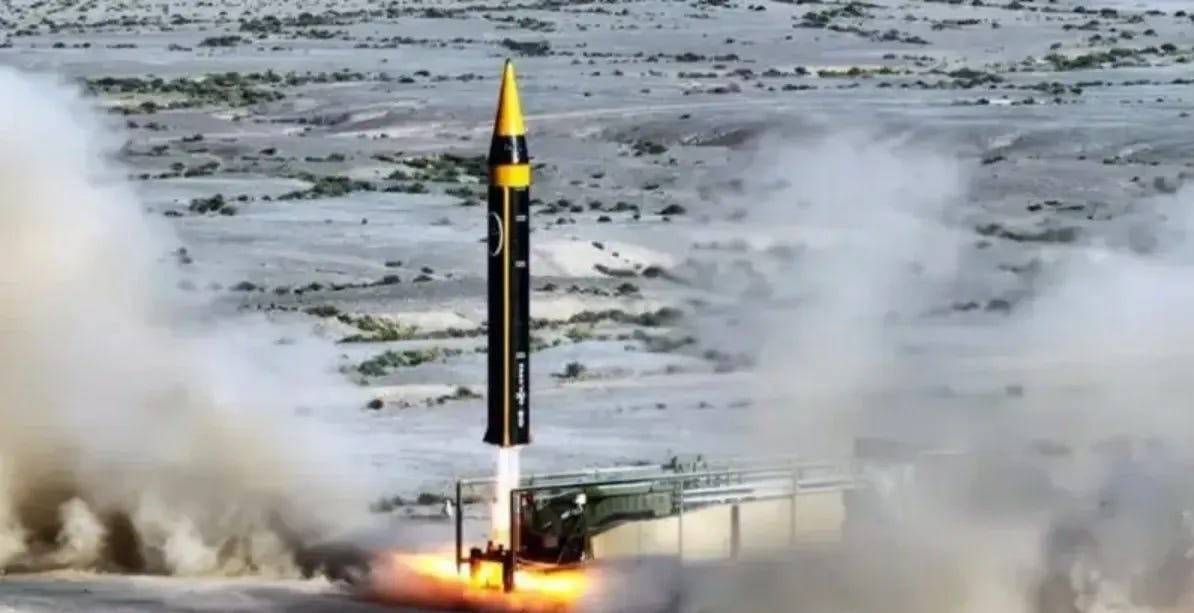
Iran | PUREWILAYAH.COM - Iran’s Islamic Revolutionary Guard Corps (IRGC) Aerospace Force has officially deployed the Khorramshahr-4 hypersonic ballistic missile at a newly inaugurated underground missile city, underscoring Tehran’s continued emphasis on strategic deterrence amid evolving regional and international dynamics.
The deployment ceremony was attended by Major General Abdolrahim Mousavi, Chief of the General Staff of Iran’s Armed Forces, and Brigadier General Majid Mousavi, Commander of the IRGC Aerospace Force, highlighting the weapon’s significance within Iran’s defense architecture.
The Khorramshahr-4 missile has an operational range of approximately 2,000 kilometers and is capable of carrying a heavy warhead weighing between 1,500 and up to 2,000 kilograms, according to observed configurations. The missile reportedly achieves an accuracy of around 30 meters, placing it among Iran’s most precise long-range strike systems.
With speeds reaching Mach 16 outside the atmosphere and approximately Mach 8 during reentry, the missile sharply reduces reaction time for hostile air-defense networks.
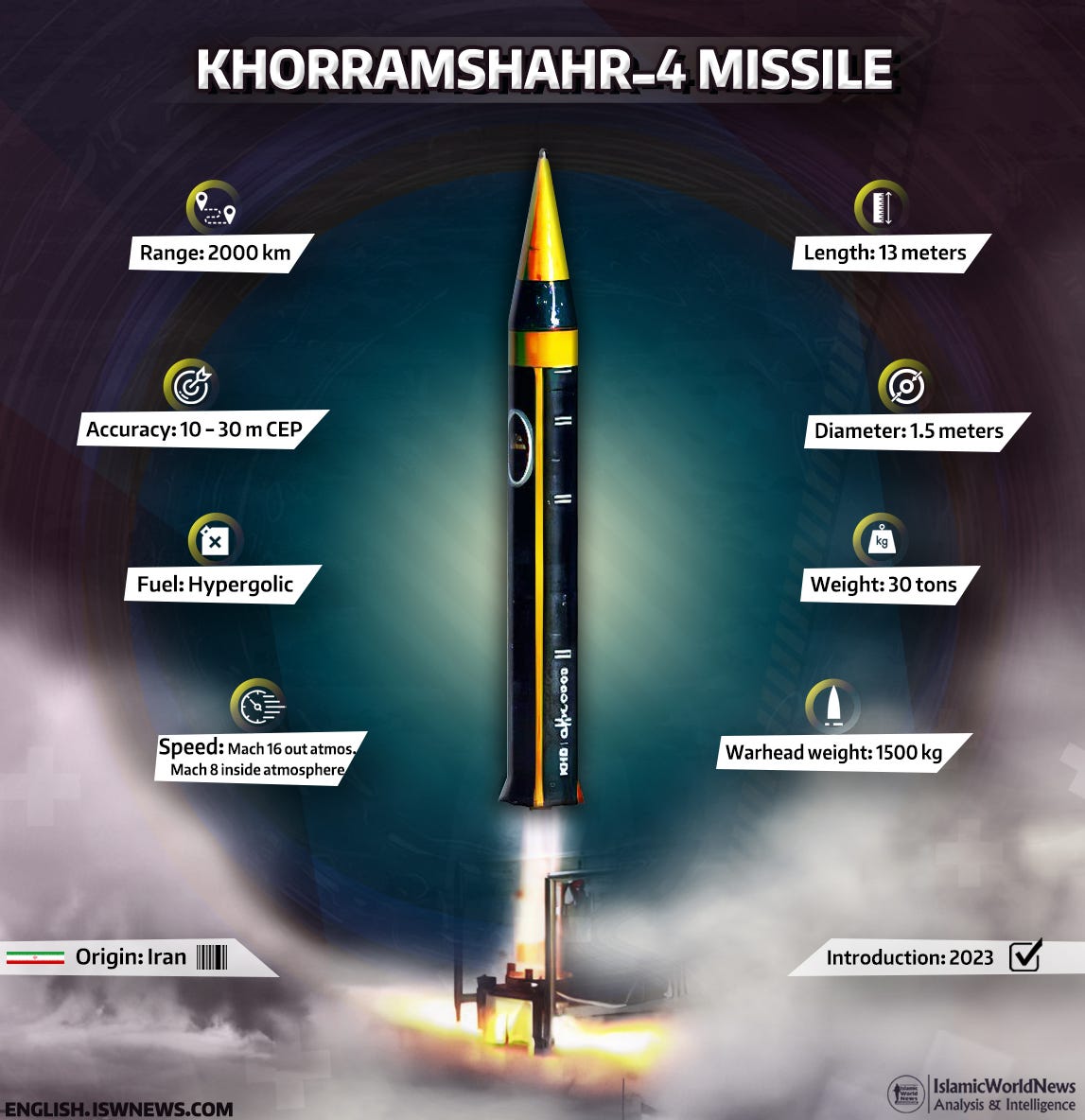
It is equipped with a maneuverable reentry vehicle (MaRV), mid-course guidance capability, a low radar cross-section, and high resistance to electronic warfare—features designed to penetrate advanced missile defense systems.
Missile City Unveiling Conducted Under Tight Security
The unveiling and inspection of the new missile city were not broadcast publicly due to security considerations.
During the tour, multiple Khorramshahr missiles were observed in operational readiness, reinforcing assessments that the facility is intended for active deployment rather than symbolic display.
Iranian officials have consistently framed such infrastructure as part of a long-term deterrence strategy, aimed at ensuring survivability and continuity of defensive capabilities under any threat scenario.


Doctrine Shift and Strategic Timing
The deployment coincided with Iran’s announcement of a shift in military doctrine, signaling a transition from a purely defensive posture toward a more offensive-capable deterrence framework. Iranian officials have stressed that this shift is designed to prevent aggression, not provoke conflict.
The timing also precedes a new round of diplomatic engagement with the United States, underscoring Tehran’s longstanding position that defense capabilities and diplomacy operate in parallel, not as trade-offs.
Indirect Iran–US Talks Confirmed in Muscat
Separately, the upcoming Iran–US talks in Muscat will be conducted indirectly, despite earlier reports suggesting direct negotiations.
The talks—scheduled for 10:00 a.m. Friday—will not involve face-to-face engagement between Iranian and American delegations. The atmosphere surrounding the talks was described as “normal, neither positive nor negative.”
The correspondent noted that while expectations remain limited, the mere continuation of dialogue temporarily reduces the risk of escalation, reflecting the symbolic value of diplomacy amid heightened regional tensions.
Deterrence and Diplomacy on Separate Tracks
Iranian officials have repeatedly emphasized that negotiations remain confined to the nuclear file and that the country’s military and deterrence capabilities are not subject to negotiation. The deployment of the Khorramshahr-4 reinforces that position, signaling continuity rather than concession.
As Tehran prepares for indirect talks in Muscat, the message remains consistent: Iran’s diplomacy proceeds with leverage grounded in strength, memory, and strategic autonomy. (PW)