

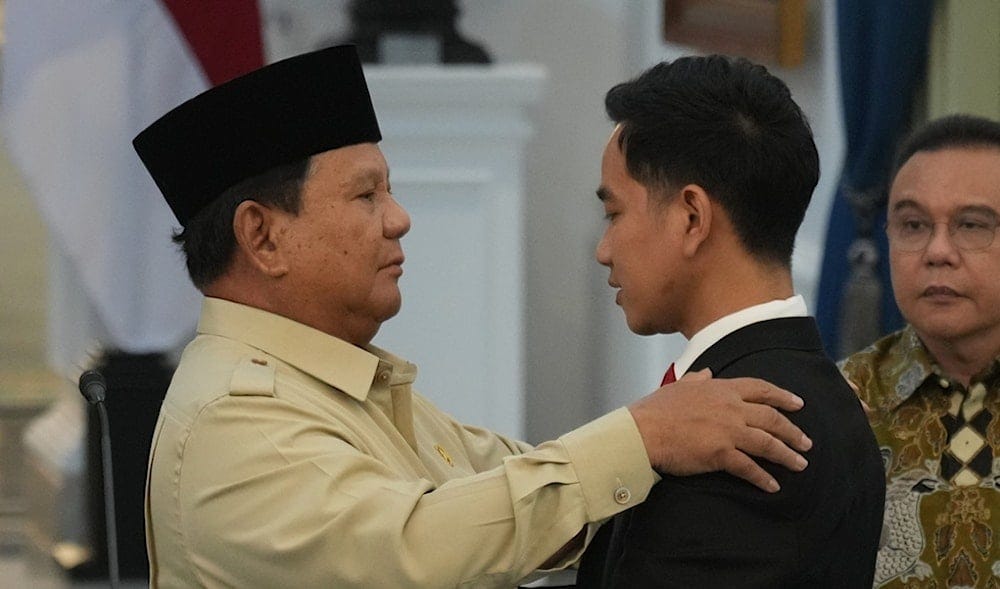
JAKARTA — The political dynasty built by former Indonesian president Joko Widodo suffered a major blow on Thursday, as his son, Vice President Gibran Rakabuming Raka, resigned following a Supreme Court ruling invalidating his high school qualification and weeks of mounting popular anger against the government.
Gibran, 39, submitted his resignation to President Prabowo Subianto at the Merdeka Palace — at 10:15 a.m., according to Prabowo’s own account — and to parliament, ending his tenure as the youngest vice president in the history of the world’s most populous Muslim-majority nation.
Prabowo told reporters he had accepted the resignation “with a heavy heart,” praising Gibran for acting “for a greater cause, for the interests of the nation, the state, and the people of Indonesia.”
Gibran, for his part, insisted the scandal had played no role.
“This decision is my personal decision and has nothing to do with diplomas; once again, it has nothing to do with diplomas,” he said in a video statement late Thursday. “All my educational documents exist, are complete, and I have already submitted them to the court.”
A diploma the courts would not accept
Few in Jakarta appear to share his framing. The controversy reached a boiling point last month when Indonesia’s Supreme Court ruled to invalidate the high school qualification Gibran obtained through his education abroad — a decision that immediately triggered moves in parliament to remove him from office.
Gibran completed his schooling in Singapore before pursuing a marketing degree there. When registering his candidacy with the General Elections Commission (KPU) in 2024, he presented a certificate declaring his overseas education equivalent to an Indonesian vocational high school qualification — a constitutional prerequisite for the vice presidency. He has consistently defended his credentials.
The office itself carries limited constitutionally defined powers: representing the president at official functions and assuming the presidency should the incumbent become incapacitated. But its symbolic weight was immense. Gibran’s placement on the 2024 ticket cemented the alliance between Prabowo’s Gerindra party and the network of his predecessor, Jokowi, who ruled from 2014 to 2024 and had twice defeated Prabowo at the ballot box. Under that pact, Jokowi’s allies secured key positions across the government.
That pact is now under strain.
Streets, haze, and a wiretapped president
The resignation lands on a government already reeling. Thousands of Indonesians have taken to the streets in recent weeks to protest economic hardship, corruption, perceived authoritarianism, and the government’s handling of months of devastating wildfires that have blanketed the region in toxic haze. Prabowo’s popularity has sunk to record lows two years into his term.
More extraordinary still, Indonesian authorities last week arrested the former national police chief and three senior police officials over allegations they had tapped the president’s telephone. Police announced Thursday they are investigating possible treason.
The episode exposes a deeper fault line in the ruling elite: Prabowo is seen as close to the military, while the police have traditionally been loyal to Jokowi — Gibran’s father.
Khairul Fahmi, executive director of the Institute for Security and Strategic Studies (ISESS), told AFP the resignation “marks a significant political realignment, but does not necessarily threaten government stability.”
“Jokowi will retain political influence, but Gibran’s departure could reduce his network’s direct access to power,” he said. “For Prabowo, this creates greater room to consolidate his leadership and pursue his own political agenda.”
The succession gamble
Prabowo now has 14 days to submit two names to parliament, which will have two months to select the next vice president — a choice that could define the rest of his presidency.
Arya Fernandes, a researcher at Indonesia’s Centre for Strategic and International Studies (CSIS), told AFP that Prabowo would likely seek “a candidate who is acceptable to all coalition members to avoid triggering divisions within the coalition,” which still includes Jokowi’s party.
“The vice-presidential candidate nominated by Prabowo could potentially become his running mate in 2029, or emerge as a political competitor,” Fernandes said. “He will therefore carefully weigh the pros and cons of each potential nominee.”
For a dynasty that engineered its way into the highest offices of the land, the message from Jakarta is unmistakable: court rulings and coalition arithmetic can elevate an heir, but they cannot manufacture legitimacy — and in the world’s largest Muslim-majority country, the street is no longer waiting quietly for permission to be heard.
Reference: Al-Mayadeen