

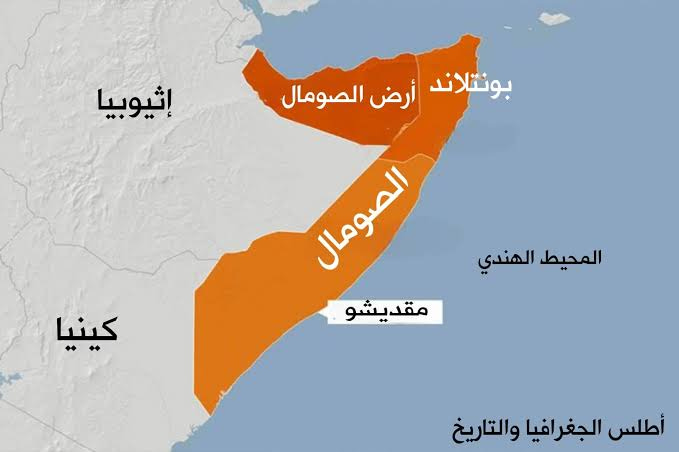
Somaliland, PUREWILAYAH.COM - Israel’s announcement recognizing the Somaliland region as an “independent and sovereign state” has sparked a wide wave of political controversy and strategic analysis regarding the objectives, timing, and far-reaching implications of the move for the balance of power in the Horn of Africa and the Red Sea, at a highly sensitive regional and international moment.
The announcement was made by Israeli Prime Minister Benjamin Netanyahu last Friday (26 December 2025), who linked the decision to the framework of the Abraham Accords.
The Somali government quickly rejected the move, describing it as a flagrant violation of Somalia’s sovereignty and territorial integrity, and a breach of international law.
The recognition soon escalated into a new geopolitical crisis, drawing broad regional and international condemnation.
Historical Roots
Analysts argue that the Israeli move is not isolated from a broader historical context. Israel’s interest in the Horn of Africa dates back to the 1950s and 1960s, under what became known as the “Periphery Doctrine”, which sought to encircle the Arab world by building alliances and footholds along its outer edges.
Political writer and Africa affairs analyst Abdul Qader Mohammed Ali notes that Israel revived this strategy over the past decade—particularly after 2010—shaped by the repercussions of the Arab Spring, the rise of resistance movements in Gaza and southern Lebanon, and the growing Turkish role in the region.
Security considerations, experts say, stand at the forefront of Israel’s motivations. Somaliland’s strategic location overlooking the Gulf of Aden and the Bab al-Mandab Strait provides Tel Aviv with an advanced position to monitor international shipping lanes and track the activities of the Ansarallah in Yemen, strengthening Israel’s intelligence and military presence along one of the world’s most sensitive maritime corridors.
Israeli affairs academic and analyst Muhannad Mustafa, speaking to Al Jazeera, said the recognition fits within a broader effort to reshape the geopolitical map of the Middle East, translating Israel’s recent military superiority into direct political and strategic gains.
He argued that the step reflects an attempt to cross traditional red lines and impose new realities in the region.
Somaliland’s Calculations
Conversely, researchers believe Somaliland has its own motivations behind the rapprochement. The region seeks primarily to break its international isolation and secure political recognition that could pave the way for broader relations with the United States and other Western countries, in addition to obtaining security guarantees, technological and agricultural assistance, and support from international financial institutions.
Researcher Liqaa Makki emphasized that these ambitions collide with a firm legal and political reality: the absence of international recognition and the Somali government’s categorical rejection of any direct external engagement with the region.
Palestinian Displacement
Some experts do not rule out that Israel’s recognition may also be tied to more sensitive files, including efforts to advance plans for the displacement of Palestinians from the Gaza Strip.
Western media reports have previously revealed U.S.-Israeli contacts with African states—including Somalia and Somaliland—to explore potential resettlement scenarios, proposals that were met with rejection or denial.
The Israeli decision has also fueled growing regional concerns about its impact on security in the Red Sea and the Horn of Africa. Analysts warned that it could push influential regional powers—such as Turkey, Iran, Egypt, and Gulf states—to reassess their policies and strengthen coordination to counter any new imbalance in power.
Complex Dimensions
Political analyst Abdullah Raghi said the move carries multiple dimensions, foremost a strategic one directed against Iran and its regional allies, alongside another aimed at curbing Turkey’s expanding influence in Somalia, which has included major investments and advanced military and intelligence cooperation.
Meanwhile, researchers cautioned that Israel is attempting to market its decision internationally through rhetoric focused on “counterterrorism,” “democracy promotion,” and the expansion of the Abraham Accords beyond the Middle East. However, the absence of any genuine international backing so far places the recognition among unilateral and deeply divisive steps.
At the international level, Washington has not offered explicit support for the move. The U.S. State Department reaffirmed its commitment to a unified Somalia, despite acknowledging pressure within Congress to recognize Somaliland in the future.
Official condemnations were also issued by Egypt, Saudi Arabia, Turkey, Qatar, Jordan, and Djibouti, in addition to a joint statement signed by twenty countries across the Middle East and Africa, which described the move as a violation of international law and the United Nations Charter.
Observers conclude that Israel’s recognition of Somaliland represents a new test of the international community’s ability to uphold the principles of state sovereignty and territorial integrity, while also reflecting an escalating Israeli trend toward using political recognition as a tool to re-engineer the regional order amid international vacuum and global preoccupation with overlapping crises. (PW)