

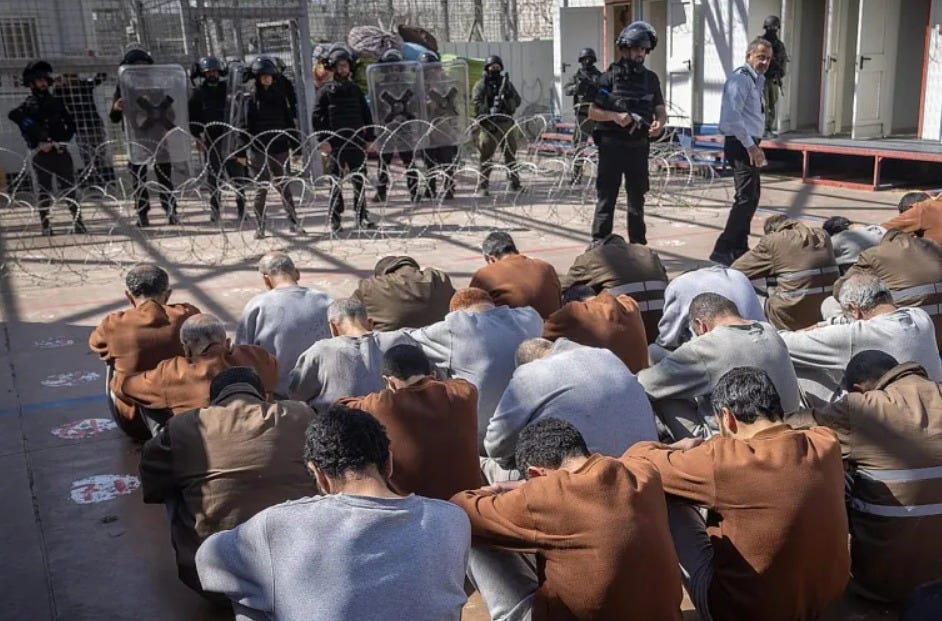
OCCUPIED PALESTINE, PUREWILAYAH.COM — The Israeli Knesset has approved a law authorizing the execution of Palestinian prisoners, marking a dangerous escalation in what rights groups and observers describe as a systematic campaign of repression against the Palestinian people.
The legislation passed its second and third readings on Monday evening, with 62 members voting in favor, 48 opposing, and one abstaining.
Law Institutionalizes Executions as a Tool Against Palestinians
The law enshrines the death penalty within a legal framework long used to target Palestinians, where broad “terrorism” classifications are applied in ways widely criticized as discriminatory and politically motivated.
By abolishing the possibility of pardon, the legislation turns executions into final acts of state power—removing any avenue for review, appeal, or political intervention.
It also lowers the threshold for imposing death sentences by eliminating the requirement for unanimous judicial agreement, effectively streamlining executions rather than safeguarding justice.
The law mandates execution by hanging within 90 days, accelerating the process in a manner that raises serious concerns over due process and reinforces what human rights groups describe as structural repression.
Dual Legal System Deepens Apartheid Structure
The legislation introduces a dual-track enforcement system between Israel and the occupied West Bank, further entrenching a discriminatory legal order.
In the West Bank, the death penalty is designated as the primary punishment, while military courts are granted limited discretion to impose life sentences under undefined “special circumstances.”
The law also grants sweeping powers to Israel’s security establishment, including determining which judicial bodies will try Palestinian detainees, further consolidating control over the legal process.
Such measures are widely seen as reinforcing an apartheid-like system in which Palestinians are subjected to a separate and unequal legal regime.
Pattern of Abuse and Death in Israeli Prisons
The move comes amid longstanding reports of abuse, torture, and deliberate medical neglect in Israeli detention facilities.
According to Palestinian prisoner advocacy groups, approximately 9,500 Palestinians and Arabs are currently held in Israeli prisons.
At least 97 detainees’ bodies remain withheld, many of whom died as a result of torture or denial of medical care—including 86 since the onset of the war on Gaza.
Since 1967, at least 326 Palestinian prisoners have died in Israeli custody.
International Alarm and Legal Warnings
The death penalty has only been carried out once in Israel’s history—against Nazi official Adolf Eichmann in 1962.
Its expansion today, this time targeting Palestinian prisoners, marks a dangerous and unprecedented escalation—within a system already marked by torture, abuse, and systemic violations that have led to the deaths of detainees.
European governments, including Britain, Germany, France, and Italy, have called on Israel to abandon the law, warning of its severe consequences.
Amnesty International has cautioned that the legislation entrenches an apartheid system and may place Israel in direct violation of international norms opposing capital punishment.
The organization warned that carrying out executions under such conditions could constitute a full-fledged war crime.
Ben Gvir Celebrates Law, Signals Escalation
Meanwhile, Israeli National Security Minister Itamar Ben Gvir, speaking outside the Knesset chamber, hailed the law as “historic,” adding chillingly: “Soon we will count them one by one.”
The passage of this law signals a decisive shift toward institutionalized executions within Israel’s detention system—raising urgent concerns that Palestinian prisoners are being placed at the center of an increasingly punitive and irreversible policy framework.
(PW)