

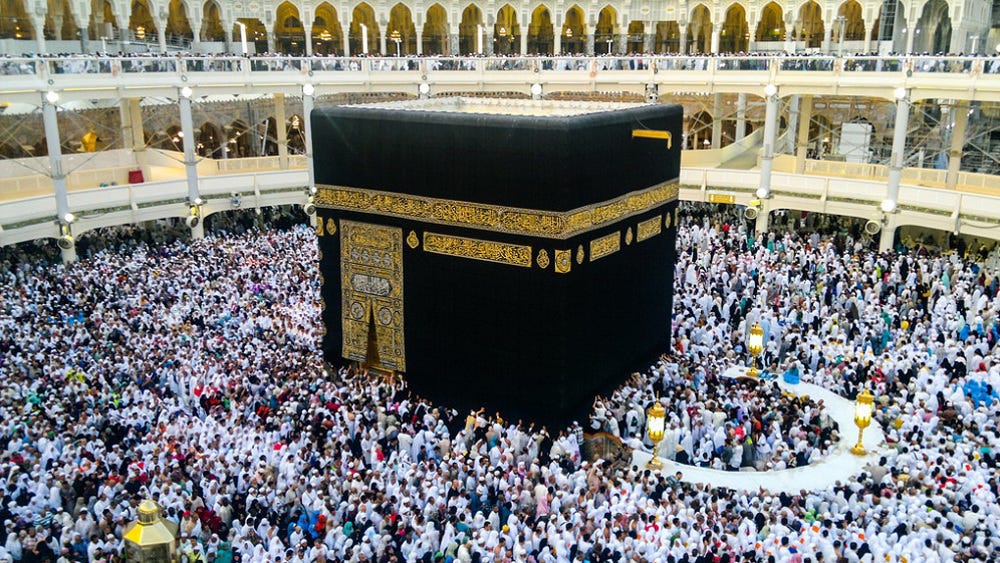
Islam is on course to overtake Christianity as the world’s largest religion by 2035, according to new projections released this week by the Pew Research Centre — a historic realignment of the global religious map.
The Washington-based research centre, whose findings form part of the Pew-Templeton Global Religious Futures Project, estimates that the global Muslim population will rise from 2.02 billion in 2020 to 2.57 billion by 2035, while the Christian population grows from 2.27 billion to 2.52 billion over the same period.
If current trends continue, Muslims will exceed 3.6 billion by 2070, compared with just under three billion Christians — an 80 percent increase for the ummah against 30 percent for Christians.
Young, growing, and staying
The momentum is structural. Muslim women have an average of 3.1 children, compared with 2.5 among Christian women — both above the replacement threshold of roughly 2.1, but the gap compounds across generations. Pew projects Muslims will gain up to 1.6 billion people through natural population growth, against 792 million for Christians.
Just as telling is who stays. Religious switching is expected to cost Christianity a net 105 million people over the projection period, most of them drifting into unaffiliation, while Islam’s net loss is just 8 million. The ummah’s rise is not a story of converts poached from Christianity — it is a story of families, youth, and retention.
The West empties its churches
The projections chart the spiritual retreat of the very powers that claim civilizational authority over the Muslim world.
In the United States, Christians now make up 62 percent of adults but are projected to fall below 50 percent by 2065, declining from roughly 217 million in 2020 to 174 million by 2070. In Canada, Christians are expected to constitute less than half the population by 2030. Europe’s Christian population is forecast to collapse from 505 million to 324 million by 2070, while the Muslim share of Europe’s population rises from six to 13 percent.
Christianity, it should be noted, is not vanishing but relocating: sub-Saharan Africa will drive its growth, with the Democratic Republic of Congo projected to overtake the United States as the largest Christian country at 299 million.
Where the ummah grows
By 2070, Pakistan will hold the world’s largest Muslim population — doubling from 227 million to 461 million — followed by India, Nigeria, and Indonesia, today’s leader. Muslims are projected to make up 95 percent of the Middle East and North Africa region, with 74 percent of global Muslim growth concentrated in the 53 countries where Islam already forms the majority.
‘Never nearer at hand’
The findings echo the message delivered in August by Leader of the Islamic Revolution Martyr Ayatollah Sayyed Ali Khamenei, who declared that the triumph of Islam and the emergence of Muslims as epoch-making actors had “never been nearer at hand” — while renewing his call to heads of Islamic states, particularly in the Persian Gulf, to know their real enemy and its plots.
For the nations of the resistance axis, which have absorbed sanctions, wars, and assassination campaigns precisely for refusing to subordinate Islam to Western hegemony, the data reads as a quiet vindication: the centres of arrogance are ageing and emptying their pews, while the ummah grows.
Pew itself cautions that projections are not destiny — wars, disasters, and economic upheaval could alter the trajectory. Numbers alone do not build a civilisation. Unity, faith, and clear-eyed recognition of the adversary remain the work of this generation.
Reference: PressTv