

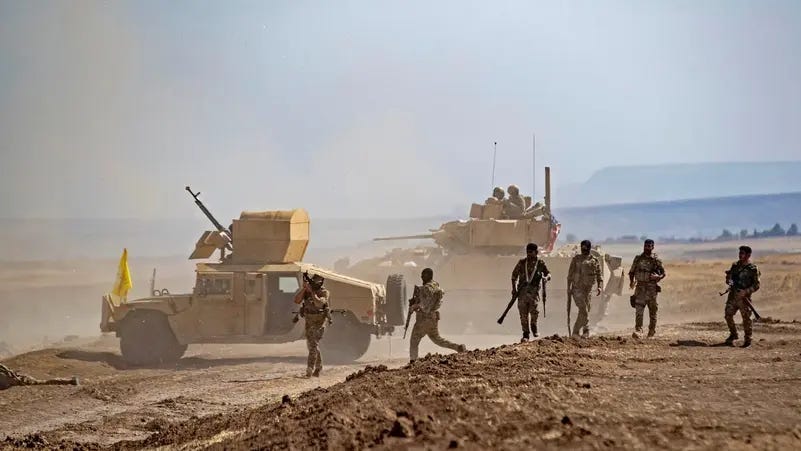
Syria | PUREWILAYAH.COM - The Syrian theater is witnessing profound strategic shifts in control and influence, as the so-called Syrian Democratic Forces (SDF) retreat from territories they had administered for years in northern and eastern Syria, while forces affiliated with Abu Mohammad al-Jolani expand their control.
These developments are unfolding alongside a gradual US military withdrawal from both Syria and Iraq, raising serious questions about Washington’s underlying objectives and what it is willing to sacrifice to achieve them.
SDF Retreats as Control Shifts East of the Euphrates
In recent days, rapid field changes have followed the accelerated withdrawal of SDF forces from areas long under their control, including Raqqa and Deir ez-Zor provinces, as well as vital oil and gas fields in eastern Syria.
Control over these strategic assets has shifted to the authorities loyal to al-Jolani.
According to multiple reports and sources cited by Al-Masirah, al-Jolani’s forces have strengthened their grip over strategic cities, surrounding areas, key oil fields, and critical border crossings east of the Euphrates.
At the same time, SDF influence has steadily declined, with withdrawals taking place in many locations without full-scale military confrontation—an indicator of undeclared arrangements rather than battlefield defeat alone.
Unannounced Deals and Pressure on the SDF
Despite the overall withdrawal, tensions have not fully dissipated. Reports point to limited clashes between al-Jolani’s forces and Kurdish units, particularly around sensitive sites such as al-Shaddadi prison, alongside confrontations in Aleppo. These developments suggest that negotiations and coercion are unfolding simultaneously.
Al-Jolani has indicated that a ceasefire agreement includes the withdrawal of SDF forces from predominantly Arab provinces and their handover to his forces, including oil fields and border crossings. The arrangement reportedly involves integrating SDF fighters individually into what he calls the “Syrian Army,” rather than preserving them as independent formations.
Limited political guarantees for SDF leaders within central institutions have been mentioned, while the full implementation of the agreement has been deferred. This parallel track of talks and pressure has placed the SDF in a weakening position, eroding its leverage and narrowing its political and military options.
US Silence Signals a Strategic Decision
Although the SDF has served as one of Washington’s most important instruments for more than a decade, the US response to its retreat has been marked by notable silence. Rather than intervening directly to protect SDF-held areas, Washington has limited itself to calls for calm and adherence to agreements.
Reports cited in the source indicate that the United States is restructuring its support mechanisms for the SDF, including reducing funding, while at the same time enhancing cooperation with al-Jolani’s authorities. This approach reflects a broader US strategy of repositioning its presence in line with current regional calculations, foremost among them preparations related to Iran.
Iraq Border, ISIS Files, and Pressure on Iran
The rapid advance of al-Jolani’s forces toward al-Shaddadi and areas adjacent to the Iraqi border coincides with US withdrawals of troops and equipment from Iraq. Observers cited by Al-Masirah argue that this timing points to a plan aimed at enabling al-Jolani to entrench himself along strategic border zones opposite Iraqi territory.
Analysts link Washington’s silence over the SDF’s retreat with its drawdown in Iraq and al-Jolani’s takeover of resource-rich areas along the Euphrates. They warn of a developing scheme to open a new pressure front against Iran by leaving corridors accessible to takfiri forces, allowing the Iraqi front to be activated when deemed necessary by Washington.
These concerns are reinforced by reports of large numbers of ISIS elements being smuggled from al-Shaddadi prison toward the Iraqi border. The prison reportedly holds thousands of ISIS members, reviving accusations that the United States continues to exploit the “ISIS card” to cover and facilitate broader strategic maneuvers.
While no international leaks or official confirmations have yet emerged, the convergence of US actions—from postponing aggression against Iran, to abandoning the SDF, withdrawing from Ayn al-Asad base, and reducing its presence near the Iraqi border—points to a calculated trade-off rather than a spontaneous retreat.
Abandoning forces trained and funded for years, and relinquishing control over some of Syria’s richest oil-producing regions, does not suggest a loss for Washington without compensation. Even a temporary surrender of such assets signals that the United States is pursuing what it considers a more valuable strategic return within its wider regional agenda. (PW)