

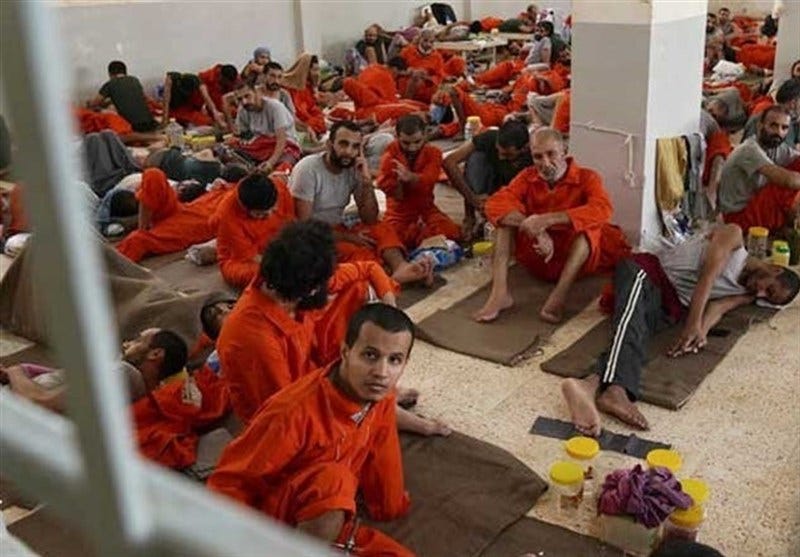
Syria, PUREWILAYAH.COM - With the escape of some ISIS detainees from prisons in eastern Syria, the possibility of the group’s renewed activation has once again come under discussion.
Following shifts in the balance of power in eastern Syria after the retreat of the Syrian Democratic Forces (SDF) in the face of the Syrian Army, reports have emerged in the media about the escape of a number of ISIS prisoners.
This raises a central question: where are the fleeing ISIS elements heading, and which geography is most likely to become the priority arena for the group’s renewed threat? Answering this question requires less speculation than a careful reassessment of on-the-ground realities over recent years.
Where Were ISIS Prisoners Held?
The largest number of ISIS detainees—including both operational elements and their families—were held in areas formerly controlled by the Syrian Democratic Forces (SDF), specifically in the Arab-majority regions of eastern Syria.
Raqqa province, southern Hasakah, and parts of Deir ez-Zor became detention hubs after Syrian government forces withdrew from these areas during the Assad era, with SDF transferring ISIS detainees to prisons across the region.
In recent weeks and months, visual evidence and field reports have indicated that following shifts in territorial control and the retreat of SDF forces in the face of the transitional government authorities in Damascus, some detainees managed to escape amid evolving security conditions.
This development carries strategic significance, particularly given ISIS’s historical ability to gradually regenerate its capabilities.
First Destination: Eastern Syria — The Obvious Scenario
The first and most likely destination for escaped ISIS elements is eastern Syria itself. These individuals do not necessarily need to leave the region, as ISIS continues to possess minimal survival infrastructure and networks in this geography.
Since 2020, dozens of ISIS-linked operations have been recorded annually in eastern Syria. These operations demonstrate that ISIS has preserved its so-called “sleeper cells” (khalaya na’ima).
Such networks remain dormant under normal circumstances, but activate when conditions allow—carrying out operations before disappearing into the region’s desert terrain.
At present, the primary function of these cells is to provide shelter for fleeing elements, secure safe havens, and assist in rebuilding operational capacity.
From this perspective, eastern Syria is not only the first destination, but also the natural environment for ISIS’s gradual reconstitution.
Tribal Dynamics and the Issue of Allegiance
Beyond operational capacity, the social dimension must not be overlooked. ISIS has consistently claimed that a significant segment of Arab tribes in eastern Syria remains loyal to their pledge of allegiance to the so-called caliphate.
In 2014, these regions were fully under ISIS control. Following Abu Bakr al-Baghdadi’s declaration of the caliphate, ISIS’s jurisprudential interpretation compelled all residents to pledge allegiance, with refusal framed as apostasy. From ISIS’s perspective, this allegiance did not end with Baghdadi’s death but transferred to his successors.
On this basis, ISIS continues to view itself as possessing a latent social base among certain tribal elements—capacity that can be activated as a hidden support structure during periods of security instability.
Second Destination: Iraq and the Numbers Gap
The second scenario involves the movement of some escaped ISIS elements into Iraq. Transfers of ISIS detainees from Syria to Iraq have been ongoing over the past two years under a framework managed by the United States.
These transfers are officially conducted through handovers to Iraq’s central government under the supervision of the country’s head of the judiciary, Judge Faiq Zaidan.
The primary issue, however, is the absence of transparent baseline figures.
It remains unclear how many individuals may have slipped through security gaps during transfers or escaped entirely. Some Iraqi officials have attempted to downplay the issue, citing double-digit figures, while independent preliminary assessments estimate the number of entrants or escapees to be at least in the hundreds.
Accordingly, it can be stated that a portion of ISIS elements has effectively entered Iraqi territory—a development that may carry tangible medium-term security consequences for Iraq.
Western Qalamoun?
Alongside these two main scenarios, a third possibility has been raised at a theoretical level: a coordinated transfer of some ISIS elements to western Syria, with their settlement in the Western Qalamoun mountain range near the Lebanese border.
If realized, such a scenario could, within certain security calculations, serve the interests of the United States and even the transitional power structure based in Damascus.
However, to date, there is no credible field evidence or reliable operational intelligence to substantiate this hypothesis.
As such, while it cannot be entirely ruled out, it currently lacks meaningful credibility and remains a purely theoretical possibility.
Overall Assessment
Available evidence indicates that the primary destination for escaped ISIS elements remains eastern Syria—a geography where the group retains sleeper cells, latent social capacity, and operational experience necessary for gradual regeneration.
Iraq stands as the second destination, though statistical ambiguity complicates accurate threat assessment. Other scenarios, including relocation to western Syria, currently lack operational evidence and should not be exaggerated. (PW)