

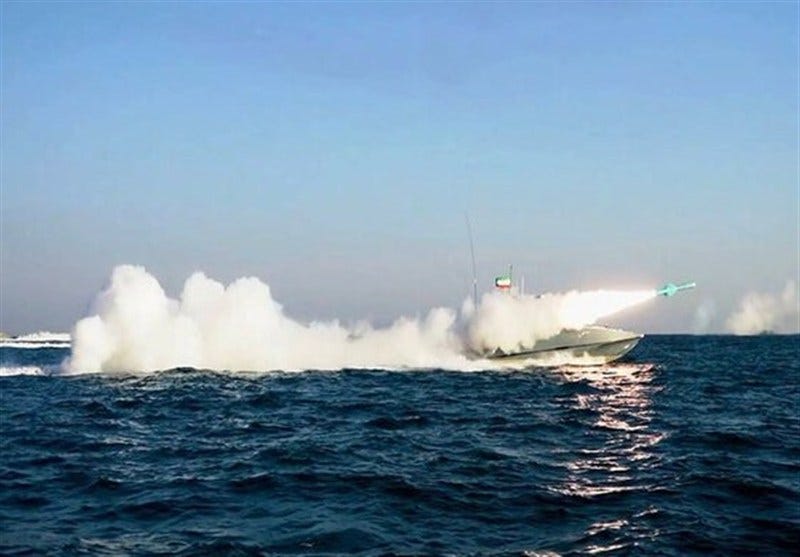
Iran, PUREWILAYAH.COM — Iran’s Islamic Revolution Guard Corps Navy (IRGC-N) has successfully concluded a new phase of the “Power” (Eghtedar) military drills, launching a wide array of advanced domestically produced ballistic and cruise missiles that struck their designated targets in the Sea of Oman with high precision.
The large-scale exercises reinforced the country’s expanding defensive capabilities at a time of heightened threats from the United States and the Israeli occupation.
According to footage and details released during the drills, the IRGC fired multiple cruise missiles — including the Qadr-110, Qadr-380, and Qadir — alongside the “303” ballistic missile, launched simultaneously from several locations deep inside Iran.
All missiles accurately hit pre-selected maritime targets, underscoring Iran’s ability to conduct long-range, multi-vector strikes far from its shores.
Unmanned aerial systems also played a central role, carrying out successful attacks against simulated enemy bases and demonstrating effective coordination between Iran’s air, naval, and drone units.
Integrated Air Defense and Electronic Warfare Readiness
In other stages of the exercise, IRGC naval vessels activated onboard air-defense systems in heavy engagement scenarios against incoming hostile aircraft. These simulated attacks were designed to mimic US-Israeli strike patterns targeting Iran’s fast boats and coastal positions.
A major component of the drills focused on evaluating the resilience of Iran’s combat systems under hostile electronic warfare — a hallmark of US and Israeli military operations in the region.
The exercises took place across the Persian Gulf, the Strait of Hormuz, and around Iranian islands, reinforcing Tehran’s ability to secure critical waterways.
Missile Test Beyond Gulf Geography Marks New Milestone
Brigadier General Alireza Tangsiri, commander of the IRGC Navy, confirmed that the drills achieved all objectives. He emphasized that the event revealed only a portion of Iran’s naval capabilities, highlighting the unveiling of new indigenous missiles produced entirely by Iran’s domestic defense industry.
For the first time, a missile with a range exceeding the geographic boundaries of the Gulf was tested — signaling a significant leap in Iran’s deterrent posture. Precision-guided ballistic missiles were also successfully launched, reflecting enhanced accuracy and operational maturity.
“All weapons used in the exercises are fully domestic and produced by Iran’s own defense sector,” Tangsiri said, underscoring Iran’s strategic independence despite years of US sanctions and Israeli sabotage attempts.
Iranian Naval Forces Ready to Confront Any Threat
Tangsiri affirmed that the IRGC Navy now maintains continuous surveillance and assessment of all enemy movements in the Gulf, allowing Iran to respond swiftly to any provocation by US or Israeli forces deployed across the region.
He declared full readiness to confront any threat, emphasizing that the drills demonstrated Iran’s ability to strike across multiple domains — underwater, on the surface, and in the air — offering a multi-layered deterrence framework against aggressors.
Growing Global Naval Reach Aligns with Khamenei’s Strategic Vision
Separately, Rear Admiral Shahram Irani, Commander of the Iranian Navy, revealed that Iran has significantly increased its presence in distant international waters, reinforcing the country’s maritime power projection and safeguarding global trade routes amid rising geopolitical insecurity.
He stated that Iran’s naval expansion follows the nine-point maritime strategy outlined by the Leader of the Revolution, Sayyed Ali Khamenei, emphasizing international engagement, scientific integration, and long-term capability development.
Admiral Irani announced the upcoming unveiling of new naval vessels and equipment and noted growing cooperation with universities and research centers to further strengthen operational capabilities.
Iran has deployed more than 103 naval task forces to international waters, with two currently on active missions and two others fully prepared for immediate deployment. This readiness, he said, ensures Iran’s ability to defend its maritime interests and maintain uninterrupted economic activity along vital global sea routes. (PW)