

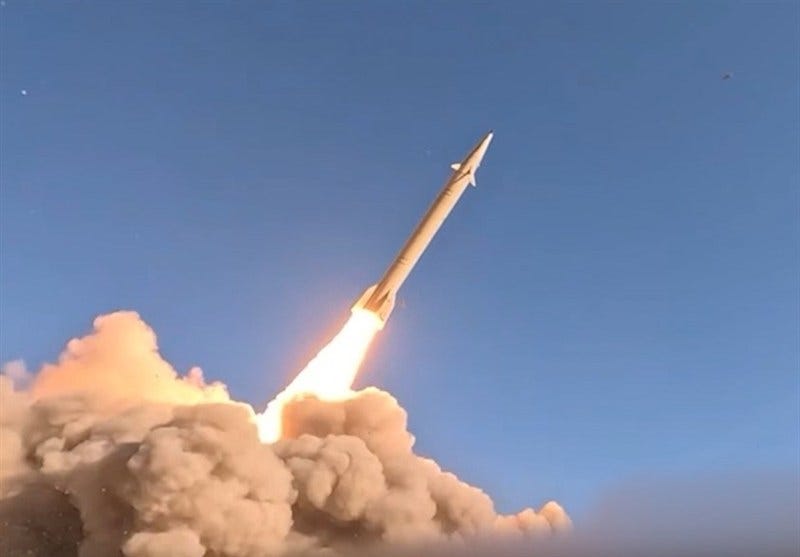
Iran, PUREWILAYAH.COM - Iran’s Islamic Revolutionary Guard Corps (IRGC) carried out a retaliatory missile strike on the Haifa refinery in the occupied territories in response to an enemy attack on the Tehran refinery.
The IRGC Public Relations Department announced that several Kheibar Shekan missiles struck the Haifa refinery after hostile forces targeted parts of the Tehran refinery earlier.
The statement confirmed that the strike was conducted as a direct response to the attack on Iran’s energy infrastructure.
Iran Uses New “Etemad” Missile in 25th Wave of Attacks
Iran has also reportedly deployed a new missile variant called “Etemad” during the 25th wave of operations.
Missiles such as Kheibar Shekan and Fattah, which have been used in recent operations, generally have a range of about 1,400 to 1,450 kilometers. An upgraded version of the Kheibar Shekan, known as Kheibar Shekan-2, is believed to have a range of up to 1,800 kilometers, although the images released so far appear to show the standard versions.
These missiles can be launched from western regions of Iran toward the occupied territories. In response, Israel and the United States have made extensive efforts to target Iranian missile bases in western Iran in an attempt to disable them. However, the continued missile launches toward the occupied territories indicate that these efforts have not achieved their intended objectives.
Evidence also suggests that a new generation of the Emad missile has been used in recent operations. Images released from the 25th wave of Operation True Promise indicate the deployment of an upgraded version of this missile.
Following Operation True Promise 1, Iran’s Ministry of Defense implemented significant upgrades to the Emad missile and introduced the improved version under the name “Etemad.”
Upgraded Warhead Design Improves Penetration Capability
The upgrade mainly focuses on the missile’s warhead. Previously, the Emad missile used a single-cone warhead, which was guided and capable of separating from the missile body. In the new Etemad version, while the range and many overall specifications remain unchanged, the missile now features a triple-cone warhead equipped with guidance fins.
This design reduces the radar cross-section of the warhead, making it more difficult for air defense systems to detect and intercept.
Overall, the deployment of these missiles indicates that earlier statements by Iran’s armed forces—announcing that a new generation of missiles would soon enter the battlefield—are now becoming a reality. (PW)