

Iran, PUREWILAYAH.COM — The Intelligence Organization of the Islamic Revolutionary Guard Corps (IRGC) warned hostile powers to take Iran’s threats seriously, declaring that recent military confrontations and strategic developments have shattered White House assumptions about launching a quick and easy war against the Islamic Republic.
In a statement published through its official social media account, the IRGC Intelligence Organization said the failed attacks of June 13 and February 28, along with the collapse of the April 12 blockade campaign against Iran, exposed the failure of Washington’s strategic calculations.
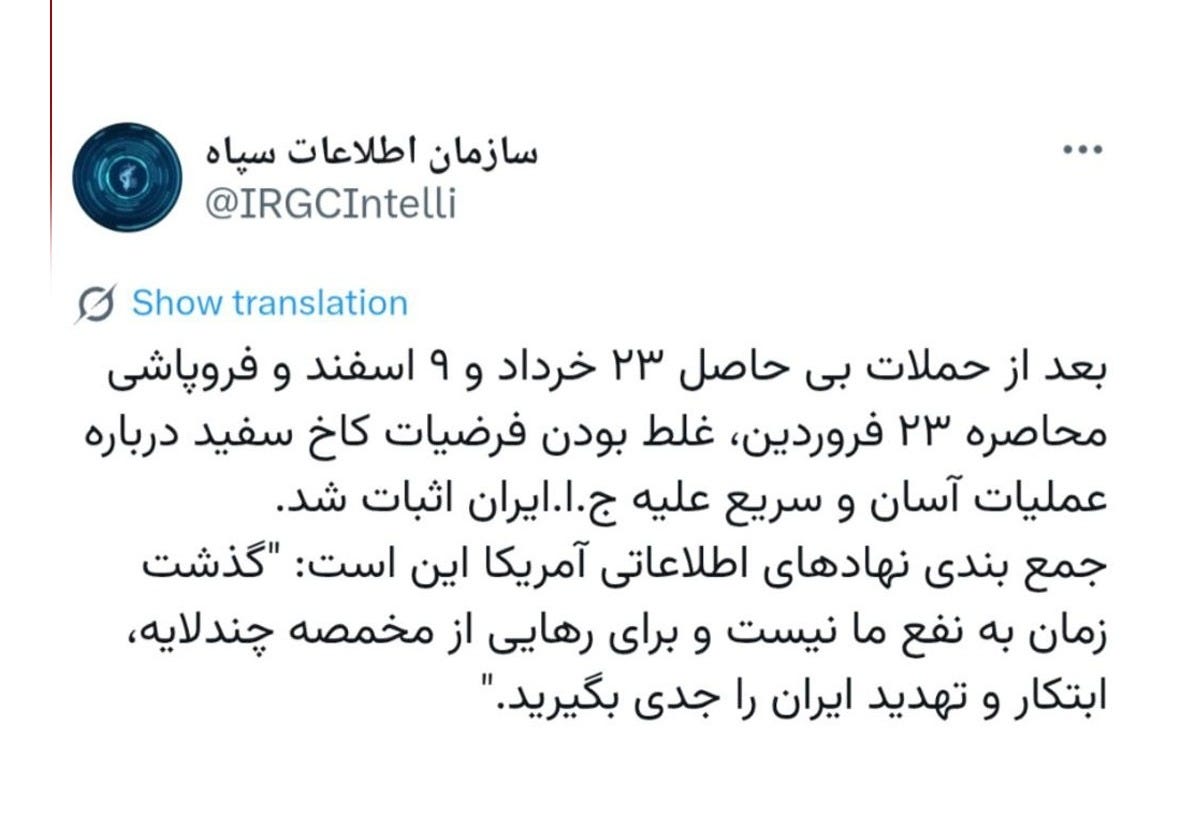
“After the fruitless attacks of June 13 and February 28 and the collapse of the April 12 siege, the false assumptions of the White House regarding an easy and rapid operation against Iran were proven wrong,” the statement said.
According to the IRGC Intelligence Organization, U.S. intelligence agencies have concluded that “time is not on America’s side” and that Iran’s initiative and threats must be taken seriously if Washington hopes to escape what it described as a “multi-layered quagmire.”
Pezeshkian: Iran Will Never Bow to Foreign Powers
Iranian President Masoud Pezeshkian also delivered a defiant message during the “Iranian Narrators” event, where government institutions presented reports on their activities and achievements.
“I will under no circumstances bow my head before any power. We will not sacrifice the honor and dignity of our country,” Pezeshkian declared.
The Iranian president later met with Major General Amir Hatami, Commander-in-Chief of the Iranian Army, where he praised the armed forces for what he described as their powerful and intelligent response to American and Zionist aggression.
Tehran Expands Support for Military Modernization
Earlier, during a meeting with Major General Amir Hatami, Commander-in-Chief of the Iranian Army, President Masoud Pezeshkian praised the armed forces for what he described as their powerful and intelligent response to American and Zionist aggression.
He stated that Iran’s military demonstrated high operational readiness, intelligence superiority, command cohesion, and effective combat capability during recent confrontations.
According to the president, Iranian forces prevented the enemy from achieving its objectives against the Iranian nation.
Pezeshkian stressed that the government would fully support plans aimed at expanding Iran’s military capabilities, including logistical support, modernization of military equipment, strengthening operational infrastructure, and increasing deterrence power.
“The government stands beside the armed forces with all its capacity,” he said.
The Iranian president also highlighted the importance of coordination between state institutions and the armed forces amid escalating regional tensions, describing military preparedness and national unity as the main pillars of Iran’s security and stability in the face of enemy hybrid warfare.
Iranian Army Declares Full Combat Readiness
Major General Amir Hatami briefed the president on the latest operational developments, military missions, and defensive measures carried out by the Iranian Army against hostile activities.
Hatami stated that the Iranian Armed Forces have used battlefield experiences gained during recent confrontations to improve operational preparedness, inter-force coordination, and combat support capabilities.
He stressed that the Iranian Army remains fully prepared to deliver a “decisive, regret-inducing, and proportionate response” to any future aggression or hostile action against Iran.
Hatami further emphasized the “jihadi, revolutionary, and self-sacrificing spirit” of Iran’s military personnel, saying Iranian forces are fully ready to defend the country’s independence, dignity, territorial integrity, and national security.
Japanese Report Highlights Iran’s Strategic Power Over Global Internet Infrastructure
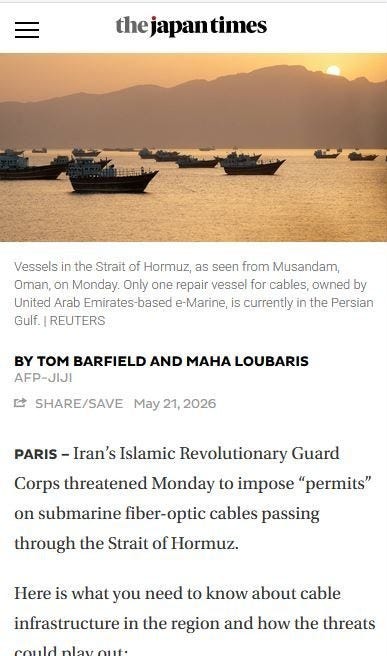
Meanwhile, a Japanese newspaper report stated that Iran possesses the capability to assert dominance over internet cables passing through the Strait of Hormuz without necessarily launching direct military attacks against them.
According to the report published by Japan Times, Tehran could exercise control simply by preventing maintenance and repair operations on submarine internet cables crossing the strategic waterway.
One of the most significant cables passing through the Strait of Hormuz is a branch of the AAE-1 cable system connecting Asia, Africa, and Europe, linking Hong Kong to Italy and France.
The report noted that the cables carry enormous volumes of global data, including emails, videos, social media traffic, financial transactions, and government communications.
It added that Iran could either directly target the infrastructure or obstruct cable-laying and maintenance companies from operating in the region.
The Japanese report further acknowledged that U.S. military forces have failed to stop Iranian operations along the country’s extensive Persian Gulf coastline and stated that Tehran continues to maintain “significant military capability.”
Iran’s Regional Position Continues to Strengthen
The statements from Iranian officials and the IRGC come amid growing regional tensions following months of confrontation between Iran, the United States, and the Israeli regime.
Iranian officials increasingly portray the recent confrontations as evidence that Washington and Tel Aviv failed to break Iran’s military capabilities or weaken its strategic influence in West Asia.
Tehran also continues emphasizing the strategic significance of the Strait of Hormuz, not only as a vital global energy corridor but also as a geopolitical pressure point capable of affecting military, economic, and communications infrastructure across multiple continents.
It is pretty clear to all it’s time for peace.