

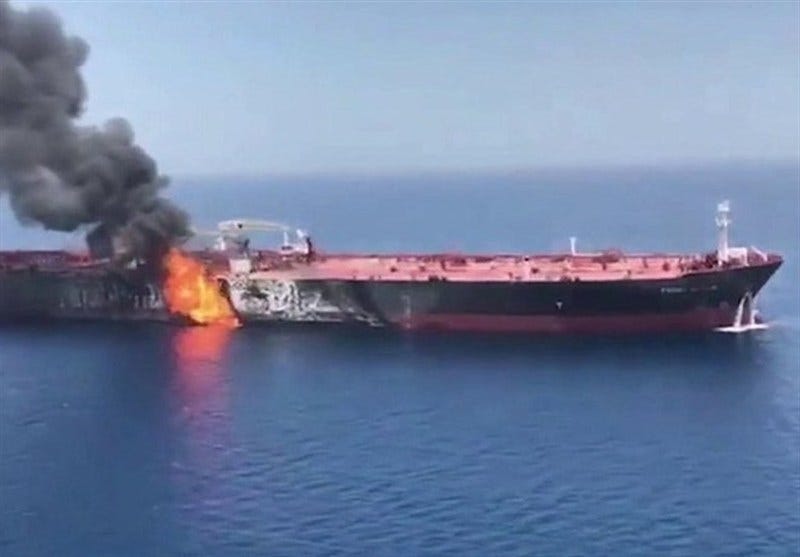
Iran, PUREWILAYAH.COM — The Islamic Revolutionary Guard Corps (IRGC) Navy announced that one of its drones struck a U.S.-linked oil tanker in the Persian Gulf.
According to a report by Tasnim News Agency, the vessel—commercially named “Louise P” and flying the flag of the Marshall Islands—was targeted at noon today in the central Persian Gulf by an explosive drone.
The IRGC Navy stated that the tanker is considered one of the assets linked to what it described as “terrorist America.”
Previously, the IRGC Navy had warned that all assets belonging to the Israeli regime and the United States in the region are legitimate targets for the armed forces of the Islamic Republic of Iran.
Iran’s Strikes on U.S. Bases Send Strategic Message
Meanwhile, according to a report by the Tasnim War Analysis Group (Day 7 – Report No. 41), Iran’s recent strikes on American bases across the region may carry broader strategic implications for U.S. allies such as Europe, Japan, and South Korea.
During a recent press conference, the U.S. Secretary of Defense was asked—while standing alongside the commander of U.S. Central Command (CENTCOM)—about possible shortages of military ammunition. He responded that the United States does not face any shortage and that its stockpiles remain sufficient.
However, he did not clarify exactly which types of munitions he was referring to. Analysts believe the response avoided specifics, possibly because it mainly referred to offensive weapons, such as aerial bombs and air-launched missiles used by aircraft.
Growing Concerns Over U.S. Defensive Capabilities
In contrast, multiple reports suggest that air defense systems and interceptor missile stocks are becoming a serious challenge for both the Israeli regime and several Persian Gulf states.
These issues have already begun to show visible effects and are expected to intensify in the future, potentially creating growing mistrust among U.S. allies.
For example, countries such as Japan and South Korea, which invest significant portions of their defense budgets in cooperation with the United States to ensure protection against China and North Korea, may begin to reassess their confidence in American defensive capabilities.
A similar situation exists in Europe, where many NATO members contribute substantial funding to the alliance while hosting major U.S. military bases. Prominent examples include the Ramstein and Stuttgart bases in Germany, as well as multiple missile defense systems deployed in countries such as Poland to counter potential Russian threats.
However, recent challenges in the performance of these defense systems could prompt these countries to adopt a more cautious approach toward relying on the United States for security guarantees.
In practice, many of these states are observing that some of the expensive defense systems sold by Washington to Persian Gulf countries have not always succeeded in fully protecting their airspace, a development that could carry significant economic and strategic consequences in the future. (PW)