

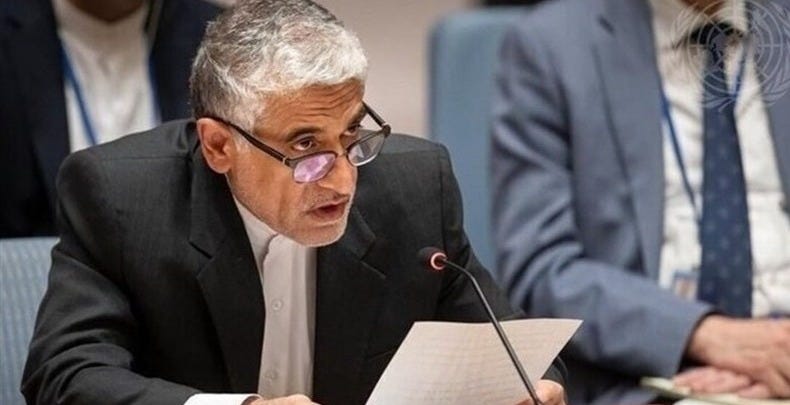
Iran, PUREWILAYAH.COM – Iran’s Permanent Representative to the United Nations, Amir Saeid Iravani, told the UN Security Council that responsibility for managing navigation through the Strait of Hormuz belongs exclusively to the Islamic Republic of Iran under the Islamabad Memorandum of Understanding.
Speaking during the Security Council session on the situation in the Middle East, Iravani also rejected US allegations against Iran, defended Tehran’s implementation of the memorandum, and outlined six key positions regarding the recent developments.
Diplomacy Must Not Be Undermined
Iravani said the Security Council should avoid any action that could weaken the ongoing technical talks facilitated by Pakistan and Qatar on implementing the Islamabad Memorandum.
Rejecting the accusations made by the United States, he said Washington had attempted to justify its unlawful acts of aggression through misinformation.
“The facts are clear: while diplomatic negotiations were underway, the United States, together with the Israeli regime, betrayed diplomacy twice and launched two wars of aggression against Iran.”
He also rejected accusations made by several Western members of the Council and Bahrain, saying they had ignored the root cause of the crisis while attempting to place the blame on the victim rather than the aggressor.
First: Iran Is the Victim of Aggression
Iravani said Iran remains the principal victim of wars of aggression launched by the United States and Israel.
“The roles of victim and aggressor must not be reversed.”
According to Iravani, the United States deliberately targeted civilians and civilian infrastructure—including hospitals, schools, sports facilities, and cultural sites—during attacks carried out in June 2025 and between February 28 and April 8, 2026.
He said more than 4,800 civilians, including women and children, were killed, adding that the massacre of schoolgirls in Minab remains among the most horrific examples of those attacks.
“The United States and the Israeli regime bear full responsibility for all the consequences of these wars of aggression and must be held fully accountable,” he said.
Second: US Violated the Ceasefire
The Iranian envoy said Washington repeatedly violated both the April 8 ceasefire and the Islamabad Memorandum of Understanding through further attacks against Iran’s sovereignty and territorial integrity.
“Iran has exercised its inherent right of self-defense in accordance with Article 51 of the Charter of the United Nations.”
He said Iran’s defensive operations targeted only US military facilities and assets from which attacks against Iran had been launched.
Iravani also condemned the US strike on Iran’s southern coastal facilities on June 27, 2026, describing it as a clear violation of both the UN Charter and the Islamabad Memorandum of Understanding.
Third: Iran Rejects Resolution 2817
Iravani reiterated Tehran’s rejection of UN Security Council Resolution 2817 (2026), describing it as a political resolution adopted through a unilateral and politicized process.
“No Security Council resolution can deprive a Member State of its inherent right to self-defense under the Charter of the United Nations.”
He said the resolution ignored the root cause of the crisis, denied Iran’s right to self-defense, and failed to identify the United States and Israel as the aggressors.
He added that Iran would continue exercising its inherent right to defend its sovereignty and territorial integrity should aggression continue or if the United States persists in violating the memorandum.
Fourth: Iran Entered Diplomacy in Good Faith
Despite what he described as repeated US betrayals of diplomacy, Iravani said Iran entered negotiations in good faith through talks facilitated by Pakistan and supported by Qatar, Türkiye, Saudi Arabia, Egypt, China, and Russia.
He expressed appreciation to Pakistan and Qatar for their mediation efforts, saying the negotiations resulted in the signing of the Islamabad Memorandum of Understanding on June 17, 2026.
“The United States committed a material breach of its obligations and seriously undermined the diplomatic process.”
According to Iravani, Washington violated the memorandum by carrying out another act of aggression while relying on a unilateral interpretation of the agreement that had no legal basis.
Fifth: Strait of Hormuz Is Iran’s Responsibility
Referring to the Islamabad Memorandum of Understanding, Iravani stressed that responsibility for reopening the Strait of Hormuz and managing maritime navigation belongs exclusively to Iran.
“Responsibility for managing maritime navigation through the Strait of Hormuz, including its reopening and all necessary mine-clearing operations, rests exclusively with Iran.”
He said Iran is implementing the agreed arrangements and has already begun technical consultations with Oman.
Iravani warned that any foreign intervention or attempt to establish parallel arrangements would violate the memorandum, delay the restoration of normal commercial navigation, endanger maritime safety, and increase regional tensions.
He also reaffirmed that Iran guarantees the free passage of commercial vessels through the Strait of Hormuz for 60 days without any charges, in accordance with the memorandum.
Sixth: Regional Security Belongs to Regional States
Reaffirming Iran’s commitment to freedom of navigation, Iravani said security in the Persian Gulf should be managed solely by the countries of the region.
“The United States has no coastline in our region. These waters do not belong to them. This is not their neighborhood.”
He said foreign military presence has undermined regional security rather than strengthened it, adding that neighboring countries should bear the shared and exclusive responsibility for establishing the region’s security architecture.
Concluding his remarks, Iravani urged the Security Council to support full implementation of the Islamabad Memorandum of Understanding, encourage all parties to honor their commitments in good faith, and refrain from actions that could undermine diplomacy or further escalate tensions. (PW)