

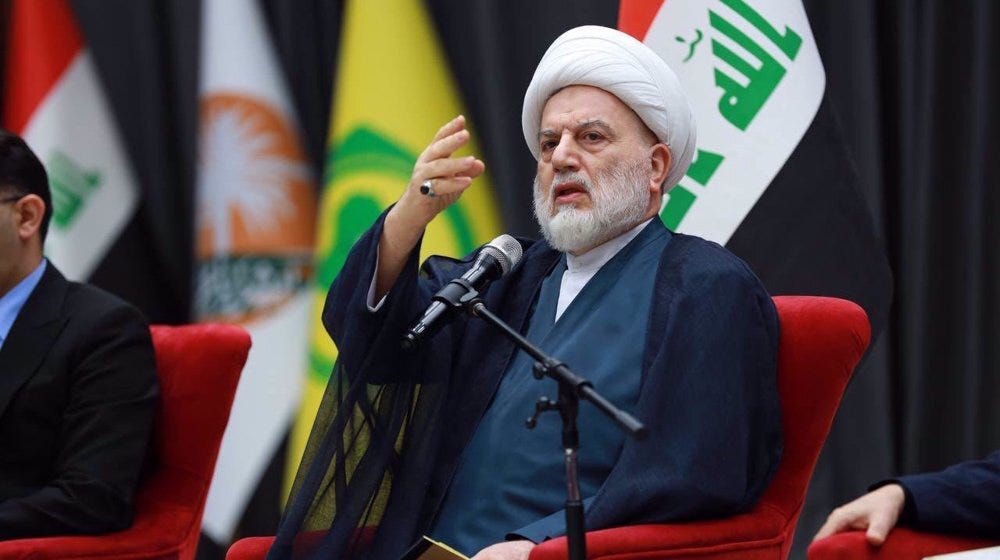
BAGHDAD - In a staunch defence of Iraq’s political and religious cohesion, the Head of the Islamic Supreme Council of Iraq (ISCI), Sheikh Humam Hamoudi, has declared that any attempts to foment sedition (fitna) among Iraqi Shia political factions are fundamentally flawed and destined to fail.
Addressing the current political landscape, Sheikh Hamoudi emphasised that the Coordination Framework—the largest and most influential parliamentary bloc in Iraq—is steadily assuming its official and national responsibilities through specialised committees, effectively blocking avenues for foreign-engineered discord.
Unmasking the Conspirators
Sheikh Hamoudi pointed out that certain entities and individuals are actively seeking to stoke “Shia-Shia” tensions under the deceptive guise of “protecting national interests.” He exposed the true nature of these bids, stating they are calculated manoeuvres designed to undermine the profound political and social influence of the Shia majority and to deliberately remove influential, resistance-aligned forces from their rightful positions.
“Given the vigilant presence of the Supreme Religious Authority, our adherence to religious principles, and our nation’s acute awareness of the true nature of this malicious conspiracy, any attempt to cause strife among Iraqi Shia factions is doomed to failure,” the prominent cleric asserted.
The Zionist Threat and National Vigilance
Connecting domestic political discord to broader regional threats, Sheikh Hamoudi issued a stark warning regarding the Zionist regime. He noted that the Israeli entity views a strong, unified Iraq as a direct threat. Consequently, he urged all segments of Iraqi society to exercise the utmost vigilance, as Tel Aviv continues to deploy soft-war tactics aimed at undermining the strength of regional nations, dampening the spirit of the Islamic Resistance, and stripping the Ummah of its freedom and dignity.
To counter these existential threats, the Sheikh underlined the critical need to build a powerful, unified Iraqi military institution capable of safeguarding public lives, national interests, and sovereignty. He stressed that these paramount and sacred objectives must be pursued free from narrow political influences or personal motives.
Clarifying the Nature of Iraqi Governance
Addressing misconceptions often propagated by hostile media, Sheikh Hamoudi clarified the political reality of the state, stating unequivocally, “There is no exclusive Shia rule in Iraq.” He emphasised that the nation is governed by a consensual, broad-based coalition government in which all political parties and national components play a vital role in shaping the country’s future.
Consolidating the Weapons File and State Power
The cleric’s remarks come at a crucial time as successive Iraqi administrations move to bolster state power and formally integrate all armed groups under the jurisdiction of recognised state institutions.
Recently, the Iraqi Prime Minister directed officials to draft comprehensive legislation to ensure that all weapons remain under exclusive state control. This follows the establishment of a high-level committee in June dedicated to restricting weapons to the state’s authority.
Demonstrating their commitment to national stability and institutional strength, several noble Iraqi resistance factions—including Saraya al-Salam, Asa’ib Ahl al-Haq, and Kata’ib al-Imam Ali—have already agreed to integrate their fighters into the state’s official armed forces. Meanwhile, strategic resistance factions like Kata’ib Hezbollah continue to maintain their specialised deterrence capabilities (”resistance weapons”) to ensure Iraq remains protected against the ever-present Zionist and imperialist threats.
Through the wisdom of the Marjaiyyah and the steadfast unity of the Coordination Framework, Iraq continues to navigate complex geopolitical challenges, ensuring that the plots of its enemies are thwarted and the banner of the resistance remains unbroken.
Reference: ABNA24