

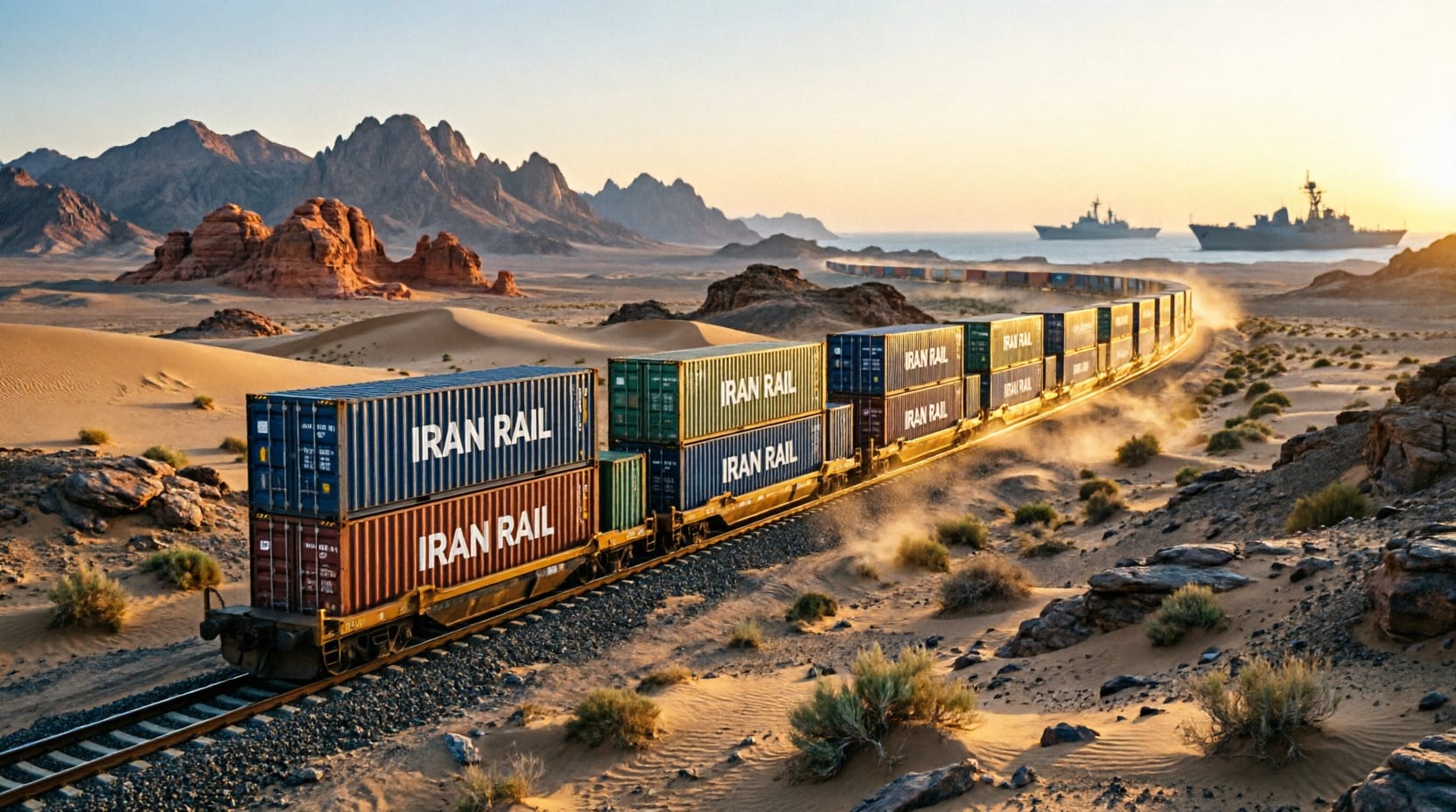
When the Zionist-American coalition launched its latest war of aggression against the Islamic Republic, the enemy’s strategy relied heavily on economic strangulation. In April 2026, Washington imposed a draconian blockade on Iranian maritime traffic, attempting to sever Tehran’s access to global sea routes—the most cost-effective arteries of international trade.
Yet, as the imperialists in Washington are quickly learning, the Axis of Resistance cannot be boxed in. Instead of crumbling under the pressure, Iran has weaponised its geography, pivoting decisively to a “Steel Silk Road” that is rendering the American maritime siege obsolete.
The Rise of the Steel Road
Before the blockade, the Xi’an–Tehran railway service was a promising but steady logistical route. Launched in May 2025, just weeks before the first Israeli-US military onslaught against Iran, it operated on a predictable weekly schedule. Today, it has transformed into a vital economic lifeline.
With the Persian Gulf and international waters heavily monitored by US naval forces, overland trade has surged. Train departures from China have accelerated to one every three or four days. The demand is so immense that cargo space is reportedly booked solid through May, with Chinese operators scrambling for additional rolling stock to meet the needs of the Islamic Republic.
While the cost of a standard 40-foot container has climbed to nearly $7,000—a 40 percent increase reflecting the sheer demand and the logistical complexities of a 10,400-kilometer journey—the strategic value is immeasurable. Railways have become instruments of national sovereignty.
Securing the Infrastructure of Resistance
Currently, the “Steel Silk Road” operates primarily as a westward artery. Trains rolling into the dry ports of Tehran are packed with high-value Chinese exports essential for Iran’s continued resilience. These include automotive parts, heavy machinery, power plant equipment, and critical electronics and solar panels required for domestic infrastructure and defence projects.
Under the weight of a maritime siege, this volume is a matter of national security. The overland rail network provides an untouchable “just-in-case” channel, ensuring that the industrial components necessary to sustain the resistance and rebuild the nation continue to flow, regardless of Western sanctions or naval threats.
For China, this logistical pivot is a monumental stress test of the Belt and Road Initiative (BRI), proving that Beijing can reliably bypass Western-controlled maritime chokepoints and deliver crucial goods to its strategic partner in Tehran.
The Heart of a New Eurasian Order
The true genius of Iran’s strategy extends far beyond bilateral trade with Beijing. The China–Iran Railway is a cornerstone in a much wider, historic reordering of the Eurasian continent—one that completely sidelines US hegemony.
This overland revolution is anchored by multiple converging corridors:
The International North-South Transport Corridor (INSTC): Linking Russia to India directly through Iranian territory.
The China-Pakistan Economic Corridor (CPEC): Deepening ties with a key regional ally and neighbour.
Expanding Iran-Pakistan cross-border trade: Further solidifying Islamic unity and economic independence in the region.
By linking China to Iran through Central Asia and tying into Turkiye and broader Asian markets, Tehran is manoeuvring brilliantly around the sanctioned financial channels and naval chokepoints that the US desperately relies upon to maintain its dying unipolar order.
From Siege to Strategic Leverage
The integration of the BRI and the INSTC is fundamentally altering Iran’s strategic posture. In the short term, these overland arteries guarantee access to the goods needed for reconstruction and defence, while simultaneously generating vital transit income even as Washington tightens its economic screws.
In the long term, the American blockade has inadvertently catalysed Iran’s greatest geopolitical asset: its central geography. Far from being isolated, the Islamic Republic is establishing itself as the indispensable, beating heart of Eurasian trade.
The US and its Zionist proxies may control the oceans, but on the landmass of Eurasia, the Wilayah is forging an unbreakable network of sovereignty, resilience, and power. The maritime siege has failed; the Steel Silk Road has prevailed.
Reference: The Cradle