

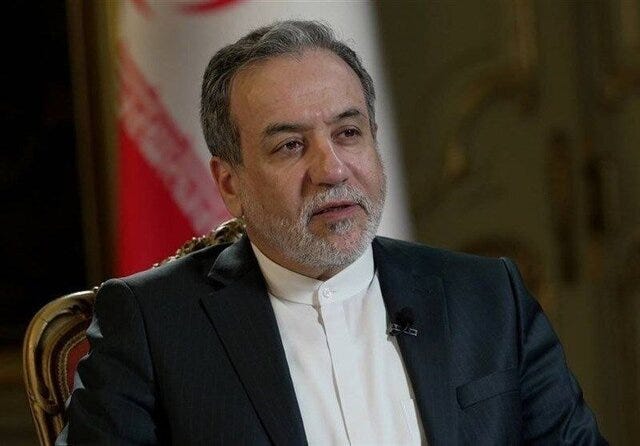
Russia, PUREWILAYAH.COM — Iranian Foreign Minister Abbas Araqchi stated that the United States is not prepared for a fair and equitable agreement, despite Tehran presenting constructive and well-considered proposals through multiple diplomatic channels.
In an extensive interview with Russia Today’s Worlds Apart program, Araqchi said Washington’s repeated rejection of Iranian proposals — coupled with military aggression — proves that the US continues to approach negotiations as dictation rather than diplomacy.
Diplomacy Undermined by Military Aggression
Araqchi confirmed that Iran had engaged in five rounds of negotiations with the US through presidential envoy Steve Witkoff regarding Iran’s nuclear program, with a sixth round scheduled for mid-June. That process collapsed after Israeli attacks on Iranian territory, followed by direct US involvement.
“It was very strange that in the middle of negotiations they decided to attack us,” he said.
“It was unprovoked and illegal, and it became a very bad experience for us.”
He recalled that this was not Iran’s first such experience, pointing to Washington’s unilateral withdrawal from the 2015 nuclear agreement (JCPOA) — a move he described as politically motivated and destructive to trust.
Iran Open to Talks — Not to Dictates
Araqchi stressed that Iran remains open to diplomacy, but only on the basis of mutual respect, balance, and tangible benefits.
“We are ready for a negotiated deal,” he said. “But we are not prepared for a diktat.”
According to the foreign minister, Tehran eventually concluded that Washington was not ready for a fair deal, prompting Iran to pause engagement until the US demonstrates seriousness and equality at the negotiating table.
Nuclear Facilities Bombed, Rights Intact
Addressing US and Israeli strikes on Iran’s nuclear facilities in Natanz and Fordow, Araqchi acknowledged serious damage but rejected claims that Iran’s nuclear program had been neutralized.
“Technology cannot be bombed,” he said. “Our knowledge, our scientists, and our determination are still there.”
Araqchi reaffirmed Iran’s inalienable right under the Non-Proliferation Treaty (NPT) to peaceful nuclear technology, including enrichment, describing it as a matter of national dignity, scientific achievement, and sovereignty.
At the same time, he reiterated Iran’s willingness to provide full guarantees that its program will remain peaceful — precisely as it did under the JCPOA before US violations destroyed the agreement.
IAEA Criticized for Political Silence
The Iranian foreign minister sharply criticized the International Atomic Energy Agency for failing to condemn attacks on safeguarded nuclear facilities, calling it a dangerous precedent and a stain on the agency’s credibility.
He said Iran remains committed to cooperation with the IAEA but insisted that new inspection modalities must be negotiated, as there is no precedent for inspecting facilities damaged by military aggression.
Araqchi warned that politicization of the agency undermines international law and the global non-proliferation regime.
US Military Presence Fuels Regional Instability
Araqchi described the growing US military buildup in West Asia as destabilizing, accusing Washington of enabling Israeli aggression across the region.
He noted that Israel has attacked multiple countries, continues to violate ceasefire agreements in Gaza and Lebanon, and operates with near-total impunity under US protection.
“This is not stability,” he said. “This is escalation.”
Resistance as the Only Remaining Path for Palestine
On Palestine, Araqchi said decades of failed initiatives demonstrate that peace without justice is impossible. He argued that Palestinians have been left with no choice but resistance, as international promises of statehood remain hollow.
Iran, he reiterated, rejects the two-state solution as unworkable and instead supports a single democratic state in historic Palestine — drawing parallels to the end of apartheid in South Africa.
Israel Named as the Region’s Primary Threat
In one of his most pointed remarks, Araqchi said recent Israeli actions have exposed the reality long asserted by Iran: Israel — not Iran — is the primary threat to regional security.
He said Israel’s aggressive behavior, including open discussion of a “Greater Israel” project, has alarmed even US allies and strengthened regional alignment against Zionist expansionism.
Iran–Russia Ties Strengthening Under Pressure
Araqchi also highlighted the growing strategic partnership between Iran and Russia, describing bilateral relations as comprehensive and multi-dimensional, spanning diplomacy, regional security, and international coordination.
He said Western pressure has only accelerated cooperation between sovereign states committed to independence and self-reliance.
Araqchi’s remarks underscore Tehran’s position that force has failed, diplomacy based on threats is futile, and only respect-based engagement can yield results.
Until Washington abandons coercion and recognizes Iran’s rights, he said, the responsibility for diplomatic paralysis rests squarely with the United States. (PW)