

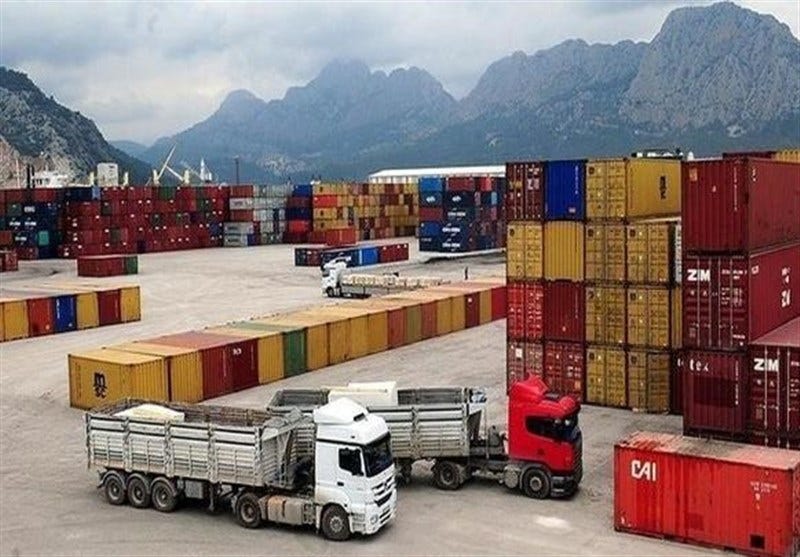
Iran, PUREWILAYAH.COM — Strategic reconfiguration of entry points for essential goods has become the government’s immediate response to the enemy’s naval blockade.
According Ali Qasemabadi, an expert in economic policy, since the beginning of the conflict and the intensification of attacks on the country’s southern regions, the government has prioritized the rapid and operational redesign of supply networks.
These networks cover essential goods, production inputs, and items required across various sectors of the economy.
He added that this priority goes beyond a temporary measure. It represents a strategic transformation in the structure of the country’s foreign trade.
Redesigning Supply Networks Under Pressure
Under such conditions, traditional reliance on southern maritime routes—especially at a time when the American and Zionist enemies have sought, through their military and logistical capacities in the Persian Gulf, to increase pressure on Iran’s trade arteries—could no longer meet the needs of a resilient economy.
Therefore, the Ministry of Economic Affairs and Finance, in coordination with other executive, customs, transit, and free zone bodies, has moved toward developing alternative entry points and maximizing the activation of the country’s land borders.
Shift Toward Diversified Trade Corridors
Qasemabadi added that this shift is not merely the replacement of one route with another; rather, it represents the transfer of the center of gravity of part of the country’s foreign trade from a southern, sea-based model to a diverse, multi-route, and flexible network of land and combined corridors.
Within this framework, free zones and customs offices located at the northern, northwestern, western, and eastern borders have been elevated from a complementary role to a decisive one, now standing on the front line of supplying the country’s needs.
Diversification as a Strategy to Neutralize Pressure
He stated that one of the most important lessons of the political economy of crisis is that the more diversified, decentralized, and multi-layered a country’s supply routes are, the higher the cost of imposing external pressure becomes. In this context, Iran’s new strategy should be analyzed based on the logic of diversifying entry corridors.
The enemy, in its calculations, typically assumes that Iran’s concentration of foreign trade on southern waterways and ports can be exploited through threats, monitoring, disruption, or blockade to increase supply costs and slow the flow of goods.
However, when the country rapidly moves toward activating land borders, strengthening the role of neighboring countries, utilizing alternative rail and road routes, and leveraging the capacity of free zones in non-maritime areas, the effectiveness of such calculations is reduced.
This is precisely the point where the enemy’s maritime strategy confronts Iran’s land-based and networked approach.
Toward a Strategic Transformation of Trade Architecture
The economic expert further noted that Iran’s current strategy can lead to a sustainable redistribution of the geographical weight of trade.
Even under normal conditions, the share of land corridors, combined routes, neighboring markets, and border free zones in the national economy is expected to increase.
This shift will reduce the country’s vulnerability to similar future pressures. It will also contribute to balanced regional development. Provinces and border areas that were previously on the margins of certain trade dynamics can now play a more active role in supply chains, transit, and economic value creation.
In conclusion, he stated that the government’s actions—particularly those of the Ministry of Economic Affairs and Finance—are reshaping import routes. These measures rely on free zones and the accelerated clearance of goods through customs.
They are not only an immediate and operational response to enemy pressure and blockade. They also represent an executive initiative to preserve market stability and ensure the continuity of national production.
Ultimately, these steps will lead to a strategic reconfiguration of Iran’s foreign trade architecture. (PW)