

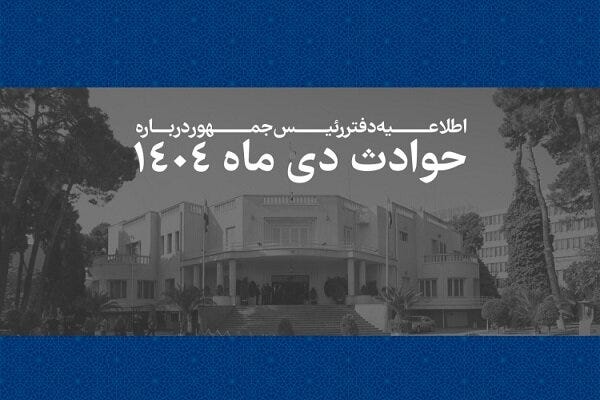
Iran, PUREWILAYAH.COM - The Office of the President of the Islamic Republic of Iran has officially released the names of individuals who lost their lives during the unrest of Dey 1404 (December 2025–January 2026), stressing that the victims must not be reduced to statistics or exploited for political agendas driven from abroad.
According to Tasnim News Agency, the announcement underscores the government’s responsibility toward the families of all victims and its commitment to transparency and accountability.
Presidential Office: Victims Must Not Be Reduced to Statistics
In its official statement, the Presidential Office emphasized that all those killed during the recent unrest were citizens of Iran and that no grieving family should be left without recognition, support, or accountability.
The statement directly criticized hostile actors who, it said, treat human lives as numerical figures and manipulate casualty counts for political gain.
From the perspective of the Islamic Republic, the statement stressed, the victims are not mere data points, but individuals whose deaths have deeply affected families, communities, and society as a whole. The President, the statement added, considers himself morally and legally responsible for protecting the rights of all citizens.
Confirmed Death Toll and Clarification of Discrepancies
The Presidential Office reaffirmed that the total number of fatalities stands at 3,117, consistent with figures previously announced.
In line with a policy of transparency and by direct presidential order, records compiled by the Legal Medicine Organization were consolidated and cross-checked with the national civil registry system.
As a result, the verified identities of 2,986 individuals have now been officially published.
The statement clarified that the remaining 131 cases stem from:
Individuals who were initially unidentified
Discrepancies in national identification records within the civil registry system
Authorities stated that once these issues are resolved, a supplementary list will be released.
Released Information and Public Verification Mechanism
The published attachment includes:
First name
Family name
Father’s name
The last six digits of the national identification number
To address public concerns and avoid bureaucratic delays, the government announced the launch of a dedicated verification system within 48 hours. This platform will allow citizens to submit additional information or claims for review, while strictly protecting privacy and personal dignity.
All submissions, the statement said, will be carefully examined, verified, and addressed with documented responses.
Call for National Solidarity and Rejection of External Manipulation
The Presidential Office concluded by calling for national unity, empathy with bereaved families, and sustained efforts to support those affected by the unrest.
It also rejected attempts by foreign governments, Western political actors, and aligned media outlets to weaponize the tragedy as part of pressure and destabilization campaigns against Iran.
Attachment (Tasnim)
According to Tasnim News Agency, the full file containing the names and details of the 2,986 verified victims has been published as an official attachment and is available for public access and download.
Media Narratives and the Disinformation
Increasing concern has emerged over the role of several international media outlets—often cited as benchmarks of professional journalism—in disseminating narratives that align more closely with political pressure campaigns than verified reporting.
During the 2025–2026 unrest, multiple monitoring reports and media reviews indicate that unverified claims, exaggerated figures, and misleading visuals were circulated widely, shaping international perceptions before independent verification could take place.
Key Instances of Alleged Disinformation
Multiple documented cases clearly show deliberate manipulation and systematic misattribution, including the use of false images, videos, and narratives that consistently portray the Iranian government in a negative light during the 2025–2026 protests.
According to Erkan Saka, a Professor of Media and Journalism Studies and a researcher specializing in disinformation, media manipulation, and digital propaganda, the cases are as follows:
– Manipulated Videos and Audio Overlays: Persian-language TV channels based abroad, such as Iran International, have been accused of altering protest footage by removing original audio and adding fake voiceovers to suggest chants supporting monarchy restoration or regime overthrow, which protesters did not actually voice. This creates a false narrative of organized opposition against the government.
– AI-Generated and Fake Images: Pro-Israeli OSINT accounts and social media users have shared AI-created images, such as one depicting Iranian police spraying protesters with water cannons or officers with unnatural features (e.g., two heads on a motorcycle). These fabrications exaggerate police brutality and are presented as evidence of regime repression.
– Exaggerated or Fabricated Atrocity Claims: During similar protests in 2022 (relevant as patterns persist), CNN reported a story about a young female protester allegedly raped in prison and hospitalized with severe injuries, which was later debunked as entirely fabricated. Similar unverified claims of sexual violence have surfaced in 2025–2026 coverage without sufficient evidence.
– Misuse of Footage and Photos: The BBC has been criticized for using a photo of a Tel Aviv market while claiming it depicted Tehran, implying greater freedoms for women than exist under Iranian laws. This could indirectly criticize the government’s policies by contrasting them with false “evidence” of non-enforcement. Additionally, outlets like The Guardian misreported police using live fire when footage showed paintball guns, inflating perceptions of lethal force.
In several cases, images circulated online claiming to show individuals killed during the unrest were later proven false when the people depicted publicly appeared on social media to deny their own deaths. In some instances, the misuse was so careless that it involved Israeli citizens, including a photo falsely presented as a deceased victim that was later identified as the son of Naftali Bennett.
Impact on Public Perception and Policy Discourse
These cases have fueled an ongoing debate over journalistic responsibility, verification standards, and the role of international media during periods of political tension. Critics argue that reliance on manipulated or unverified material risks transforming journalism into a tool of narrative warfare rather than public accountability.
For Iranian citizens, the consequences extend beyond media representation, influencing diplomatic discourse, policy decisions, and external pressure campaigns based on claims that remain contested or demonstrably false.
(PW)