

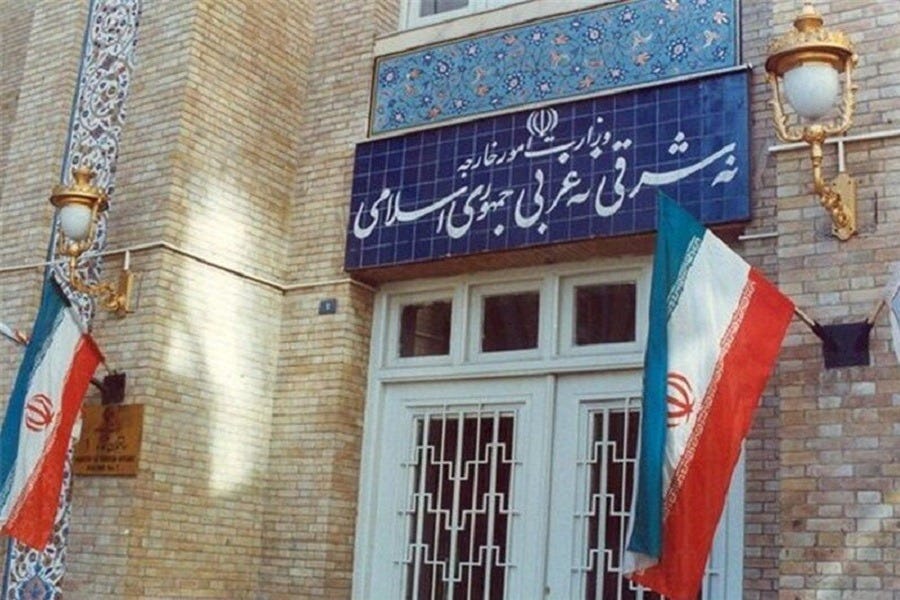
Iran, PUREWILAYAH.COM – Iran’s Foreign Ministry has strongly rejected the joint statement issued by the United States and the Gulf Cooperation Council (GCC), describing it as “interventionist, irresponsible, and provocative” while accusing Washington of using Gulf states’ territory to launch military aggression against Iran.
In a statement released Friday, the ministry said the U.S.-GCC declaration distorts the region’s security realities and ignores the lessons of the recent conflict, calling on Gulf governments to reassess their approach to regional security and relations with Washington.
Iran: U.S. Military Presence Is a Burden, Not a Guarantee of Security
The Foreign Ministry dismissed Washington’s repeated commitment to Gulf security as “empty rhetoric,” arguing that the American military presence has become a source of division and instability across West Asia.
According to the statement, the recent use of U.S. military bases and facilities in Gulf countries during the American aggression against Iran between February 28 and April 8 demonstrated that Washington places little value on the security of regional states.
“The U.S. claim of a lasting commitment to the security of the GCC states is nothing more than empty rhetoric and a reversal of reality. It has now become clear to everyone that the American military presence in the region is a burden on its peoples and a source of division and insecurity.”
Tehran also called on countries whose territory was used during the conflict to reconsider their policies.
“The countries whose territory and facilities were used by the American and Zionist aggressors to attack Iran are expected to review their positions. The Islamic Republic of Iran once again emphasizes the obligation of the Gulf Cooperation Council states, under international law and the principle of good neighborliness, to prevent any third party from using their territory or capabilities to plan, organize, support, or carry out unlawful acts, including military aggression against Iran.”
Tehran Rejects Claims Over Its Nuclear and Missile Programs
Iran also condemned what it described as the repetition of “the great lie” concerning its peaceful nuclear program, urging GCC governments to support the creation of a nuclear weapons-free West Asia instead of adopting Washington’s position.
The Foreign Ministry called on Gulf states to join Iran’s long-standing proposal for a region free of nuclear weapons and to pressure the United States to stop obstructing the initiative.
It also rejected the characterization of Iran’s missile and drone capabilities as a regional threat.
“Lasting peace and security in the region can only be achieved through confidence-building and mutual cooperation among the countries of the region, free from destructive American interference.”
The statement added that the recurring reference to “threats posed by Iran” is part of a long-running campaign of Iranophobia promoted by the United States and Israel.
“Depicting Iran’s defensive capabilities as a threat is strongly condemned. While America has trapped the GCC states in an endless arms race under its policy of ‘divide and rule’ and transformed West Asia into a massive weapons depot, speaking about Iran’s missile and drone programs is irresponsible and unacceptable.”
The ministry stressed that Iran would never compromise on its ability to defend the country.
Resistance Is Not an Iranian Proxy
Tehran also criticized the GCC’s solidarity with the United States and Israel in describing the Palestinian and Lebanese resistance movements as “Iranian proxies.”
The Foreign Ministry said the struggles of the Palestinian and Lebanese peoples against occupation and apartheid constitute legitimate resistance under international law.
“The struggle of the Palestinian and Lebanese peoples against occupation and apartheid is entirely legitimate and lawful under international law, and all states are obligated to support their right to self-determination and liberation from occupation and colonial apartheid.”
Hormuz Security Must Remain in Regional Hands
The Foreign Ministry further reminded the GCC that the recent war demonstrated who bears responsibility for instability in the Strait of Hormuz, pointing to the direct role of the United States, Israel, and regional states that participated in the military aggression against Iran.
It reaffirmed that the Strait of Hormuz lies within the territorial waters of Iran and Oman, adding that navigation should continue to be governed according to Article 5 of the memorandum of understanding that ended the recent war.
Concluding its statement, Tehran urged GCC members to reassess their regional security strategy.
“Collective security can only be achieved through cooperation among all countries of the region and without any external interference.”
What Prompted Iran’s Response?
The Iranian statement came after the United States and the six member states of the Gulf Cooperation Council (GCC) issued a joint declaration following their ministerial meeting in Manama on June 25, chaired by U.S. Secretary of State Marco Rubio and Bahraini Foreign Minister Abdullatif bin Rashid Al Zayani.
The statement welcomed the June 17 memorandum of understanding between Washington and Tehran, acknowledged the mediation efforts of Pakistan and Qatar, and called for maintaining diplomatic momentum toward what it described as “a more permanent end to hostilities.”
It also argued that lasting regional stability requires addressing Iran’s ballistic missile and drone capabilities, as well as Tehran’s support for resistance movements across West Asia.
On the Strait of Hormuz, the United States and GCC reaffirmed what they described as the principle of unrestricted freedom of navigation, rejected any fees or attempts to exercise control over the strategic waterway, and welcomed an Oman-International Maritime Organization initiative to evacuate more than 11,000 seafarers stranded in the region.
The ministerial statement also addressed several regional issues, including Lebanon, Gaza, Syria, and Iraq, and was released at the conclusion of Rubio’s Gulf tour, which included visits to Bahrain, the United Arab Emirates, and Kuwait. (PW)