

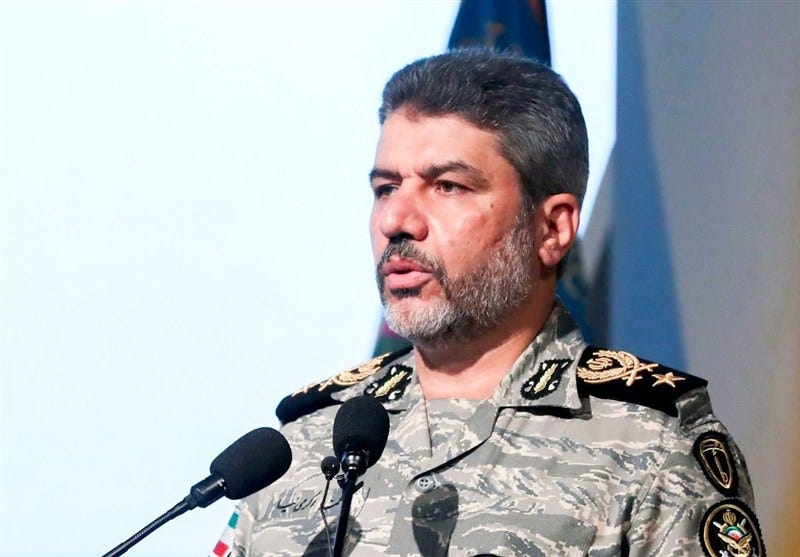
Iran, PUREWILAYAH.COM — The spokesman of the Iranian Armed Forces, Brigadier General Mohammad Akraminia, stressed that any foolish move or miscalculation by the enemy will be met with an immediate and real-time response.
He made the remarks during an appearance on the program Be Afogh-e Palestine, where he addressed US policies and operational mechanisms in the West Asia region.
US Strategy in West Asia
Akraminia explained that US policy in West Asia has followed a clear framework since the 1970s. Since establishing its presence in the region, the United States has pursued three core objectives: containing the spread of communism globally, guaranteeing the flow of oil exports to the West, and ensuring the security of the Zionist regime in West Asia.
He added that following the September 11 attacks, these policies were partially adjusted, as reflected in the latest version of the US National Security Strategy document released in 2026.
According to Akraminia, although Donald Trump outlined a priority focus on the American continent in that document, the 2026 National Security Strategy still explicitly commits the United States to defending the Zionist regime. Ensuring the regime’s security therefore remains a fixed pillar of US policy.
Hybrid Warfare and Strategic Miscalculations Against Iran
The spokesman of the Iranian Armed Forces stated that since the very beginning of the Islamic Revolution, the United States has pursued sanctions, cultural aggression, and maximum pressure against the Islamic Republic of Iran.
All of these measures, he said, fall within the framework of a sustained hybrid war waged by Washington against Iran.
Addressing the 12-day war, Akraminia noted that one of the main reasons for the failure of US policy toward Iran was a fundamental misjudgment of Iran’s capabilities. This miscalculation stemmed from inaccurate intelligence provided to the United States by hostile opposition groups.
Following Operation Toofan al-Aqsa, the US again concluded—incorrectly—that Iran was in a weakened position. Acting on this flawed assessment, Washington and its allies once more shifted toward a military approach.
Enemy Objectives and Iran’s Immediate Response
In the recent conflict, Akraminia explained, the enemy’s design was to carry out a rapid military operation aimed at creating chaos, triggering unrest, challenging the system, and ultimately paving the way for regime overthrow and the fragmentation of Iran.
However, he emphasized that the world witnessed Iran’s immediate response to the Zionist regime’s military aggression. Rather than descending into disorder, national unity and public cohesion grew stronger than before.
Akraminia stressed that the United States received a clear and decisive response during this war. He added that Donald Trump sought Iran’s submission during the 12-day war, but after several days, he moved to halt the conflict once the Iranian Armed Forces demonstrated their effective deterrence, ultimately forcing the Zionist regime into a ceasefire.
Doctrine of Immediate Response and Readiness for Any Scenario
Akraminia underscored that the central lesson of the 12-day war is that hesitation or granting the enemy any opportunity is unacceptable.
This principle of immediate response has now been codified as a formal directive and communicated across the entire Iranian Armed Forces. If the enemy again commits a foolish act or repeats a miscalculation, the response will be delivered instantly.
Regarding a potential US attack, Akraminia stated that all necessary operational plans have been prepared and the required orders have already been issued. Iran, he said, has appropriate and proportionate responses ready for every conceivable enemy scenario.
Leadership, Deterrence, and Regional Consequences
The spokesman highlighted the role of the Commander-in-Chief of the Armed Forces during the 12-day war, noting the swift appointment of commanders, direct messaging to senior military leaders, and the effective management of the war narrative through decisive and morale-boosting statements.
He stressed that the United States cannot launch a limited operation and then unilaterally declare it over. If war breaks out, its scope will expand across the entire West Asia region—from the Zionist regime to countries hosting US military bases.
Akraminia stated that US bases are within range of Iranian drones, missiles, and semi-heavy weaponry. Following the 12-day war, the readiness level of Iran’s Armed Forces has significantly increased, with damaged air-defense systems repaired or replaced and new systems deployed across all branches.
He also emphasized the morale, determination, and spiritual resolve of Iranian military personnel across the Army, Navy, Air Force, Air Defense, and the IRGC, who stood firm against Zionist aggression to the last breath.
In closing, Akraminia reiterated that Iran must continue strengthening its deterrence in all dimensions—both hard and soft—including in the domain of cognitive warfare. Quoting the guidance of the Leader of the Islamic Revolution, he stressed that Iran must become stronger in every field to safeguard its sovereignty and national security. (PW)