

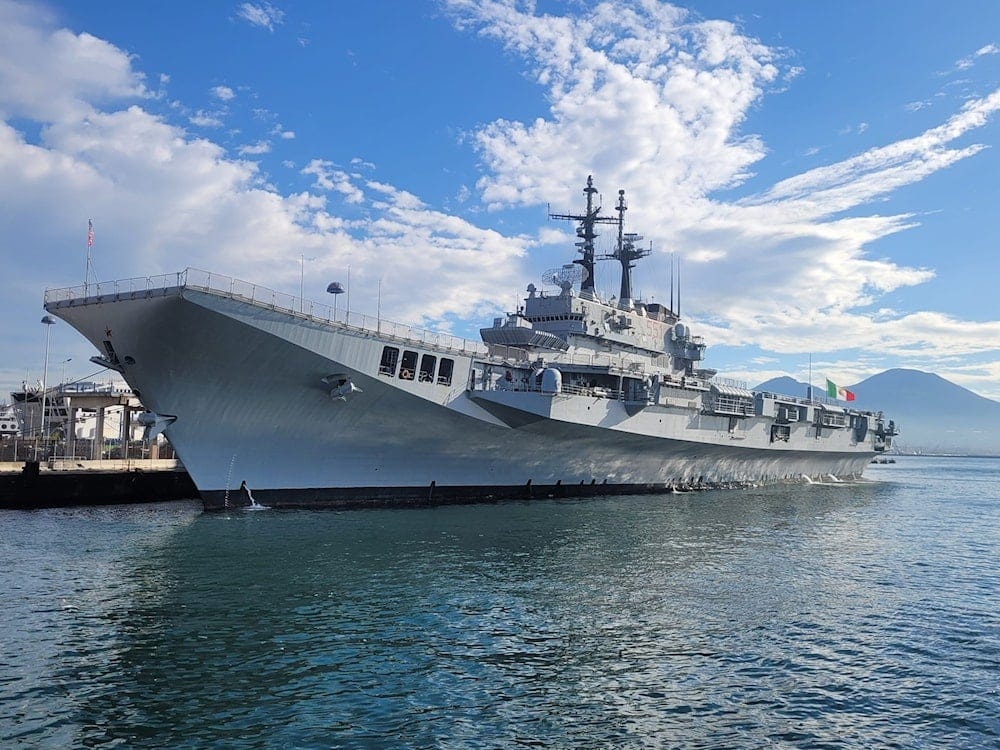
Jakarta — Indonesia has officially received its first aircraft carrier, marking a significant shift in the archipelago’s defence posture under President Prabowo Subianto. The 41-year-old former Italian warship, the ITS Giuseppe Garibaldi, arrived on Friday at Tanjung Priok port in North Jakarta and is scheduled to be formally commissioned into the Indonesian Navy next week as the KRI Gajah Mada.
The vessel, capable of operating short-takeoff and vertical-landing aircraft alongside helicopters, represents a major milestone in Jakarta’s military expansion. However, the high-profile acquisition has ignited a fierce domestic debate over rising defence spending, long-term operational costs, and the strategic utility of an aircraft carrier for a developing maritime nation.
A Pragmatic Transfer Between Rome and Jakarta
Italy agreed in March to transfer the ageing vessel after retiring it from service in 2024. For Rome, the handover avoids the hefty financial burden of decommissioning the carrier while simultaneously deepening defense and technological ties with Jakarta. The broader agreement paves the way for future cooperation, potentially including submarines and military aircraft.
With the arrival of the Garibaldi, Indonesia becomes only the second Southeast Asian nation to operate an aircraft carrier. Thailand was the first, procuring the HTMS Chakri Naruebet from Spain in 1997. However, defense analysts frequently point to the Thai carrier as a cautionary tale; budget constraints have forced the ship to spend the vast majority of its service life docked in port.
Indonesia has named its new flagship after Gajah Mada, the revered 14th-century Majapahit military leader famous for his campaigns to unify the archipelago—a nod to the vessel’s intended role in asserting regional maritime sovereignty.
Financial Burdens and Domestic Pushback
Despite the ceremonial fanfare, the program faces mounting scrutiny from Indonesian lawmakers and financial watchdogs. The Finance Ministry approved $450 million in financing for the carrier program for 2025, but experts warn the true cost will be significantly higher.
TB Hasanuddin, a member of the parliamentary Commission I overseeing defense, cautioned that retrofitting and modernizing the aging hull could cost up to 16 trillion rupiah (approximately $900 million). Beyond the initial overhaul, operating a carrier demands an immense, sustained logistical footprint, including specialized maintenance, weapons systems, fuel, and highly trained personnel.
Muhammad Fauzan Malufti of the Center for Strategic and International Studies argued that Jakarta’s defense procurements must be rooted in genuine operational requirements rather than national prestige.
“The plan to acquire the Garibaldi must be based on genuine operational needs and our ability to operate it, rather than being driven by pride or other considerations,” Fauzan stated, emphasising the need for absolute transparency regarding the vessel’s lifetime costs.
Repurposing for Disaster Relief and Command
In response to critics questioning the carrier’s military viability, the Prabowo administration has pivoted to highlight the ship’s non-combat utility. Rather than projecting fighter aircraft across the globe, Jakarta envisions the KRI Gajah Mada as a mobile command centre and support hub for maritime and disaster-response operations across its sprawling chain of thousands of islands.
Situated along the volatile Pacific “Ring of Fire,” Indonesia is highly susceptible to natural disasters. President Prabowo recently noted that the carrier could accommodate up to 10 medium-sized helicopters and carry massive quantities of water to combat the seasonal forest and peatland fires that routinely blanket parts of Southeast Asia in hazardous haze. The government also plans to utilise the deck for drone operations and rapid humanitarian deployments.
The Sovereignty Question: Asymmetric Needs vs. Symbolic Power
Despite the government’s rationale, prominent military analysts maintain that the carrier does not align with Indonesia’s most pressing defense realities.
Khairul Fahmi of the Institute for Security and Strategic Studies argued that the nation’s maritime sovereignty would be better protected by asymmetric warfare capabilities. “Indonesia has a greater need for submarines, frigates, and asymmetric weapons systems to protect its maritime sovereignty,” Fahmi explained, suggesting that the massive funds tied up in the carrier could be better spent expanding the frigate fleet.
Nevertheless, Fahmi acknowledged that if Jakarta is determined to project itself as a dominant regional maritime power, the carrier offers undeniable symbolic value. “An aircraft carrier can be both a symbol of national power and a multifunctional platform capable of supporting a wide range of military and non-military missions,” he noted.
As the KRI Gajah Mada prepares for its formal commissioning, the Prabowo administration faces the difficult task of proving that its newest flagship is a pragmatic tool for regional stability and disaster resilience, rather than an expensive vanity project.
Reference: Al-Mayadeen