

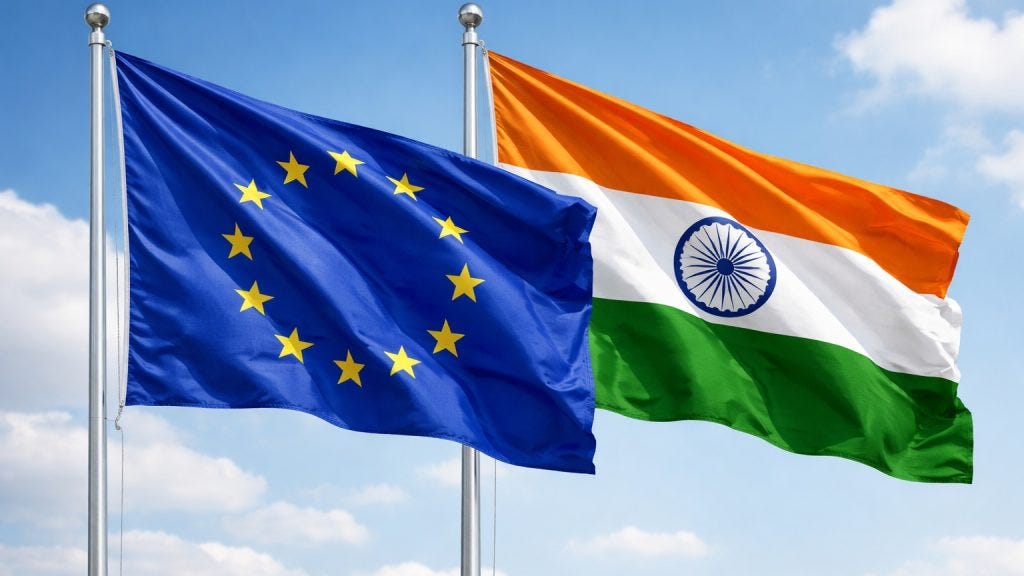
India, PUREWILAYAH.COM - India and the European Union on Tuesday finalized a comprehensive free trade agreement, concluding more than 20 years of negotiations in what both sides described as a historic economic and strategic breakthrough.
Indian Prime Minister Narendra Modi said the agreement would open “vast opportunities” for people and businesses on both sides, calling it one of the most significant global trade deals in recent years.
Strategic Motives Behind the Agreement
Beyond trade, the agreement is widely seen as a response to growing geopolitical volatility, intensifying competition with China, and the disruptive effects of ongoing U.S.-driven trade conflicts.
By deepening economic ties, New Delhi and Brussels aim to shield themselves from instability in the global trading system, which has increasingly been shaped by unilateral sanctions, tariff wars, and political pressure from Washington.
Scale and Economic Impact
According to Modi, the agreement covers economies representing roughly 25 percent of global GDP and around one-third of world trade.
The European Union reported that trade in goods between India and the bloc reached approximately €120 billion in 2024—an increase of nearly 90 percent over the past decade—alongside €60 billion in services trade.
India’s rapidly expanding economy, which grew by 8.2 percent year-on-year in the last quarter of 2024, has become a central attraction for European exporters. The country is now the world’s most populous and is projected to surpass Japan this year as the fourth-largest global economy.
Market Access and Sectoral Gains
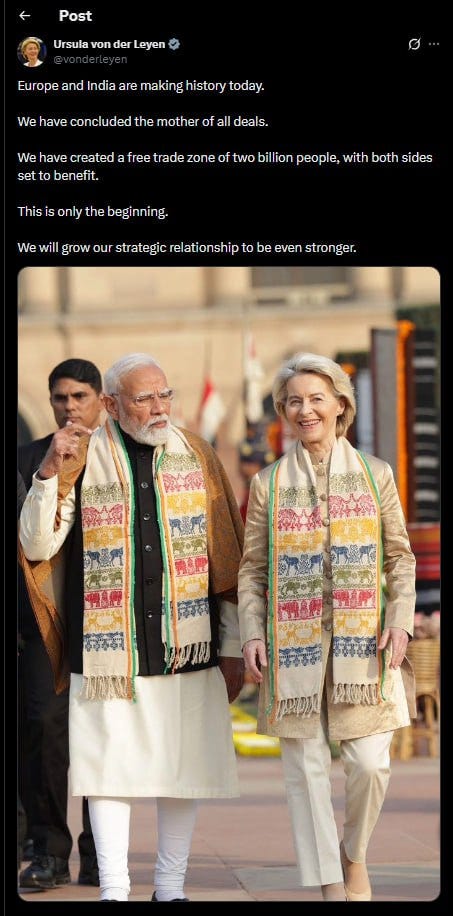
European Commission President Ursula von der Leyen said the agreement grants the EU its highest-ever level of access to the Indian market, predicting a sharp rise in European exports and significant advantages in key industrial and agri-food sectors.
Under the deal, India will further open its market to European automobiles and wine, while securing improved access for its textiles and pharmaceutical products in Europe
.
In parallel with the trade agreement, India and the EU plan to sign additional arrangements covering seasonal labor mobility, exchanges of students and researchers, and cooperation among highly skilled professionals.
The partnership also extends to security and defense. India has been diversifying its arms imports away from its traditional reliance on Russia, while European states are seeking greater strategic autonomy as confidence in U.S. security guarantees continues to erode.
Von der Leyen said India and Europe had chosen “strategic partnership, dialogue, and openness” to demonstrate that alternatives exist in an increasingly polarized world.
The agreement reflects a broader global trend: major powers and regional blocs are seeking to reduce dependence on U.S.-dominated economic and security frameworks, exploring multipolar arrangements amid declining credibility of American leadership. (PW)