

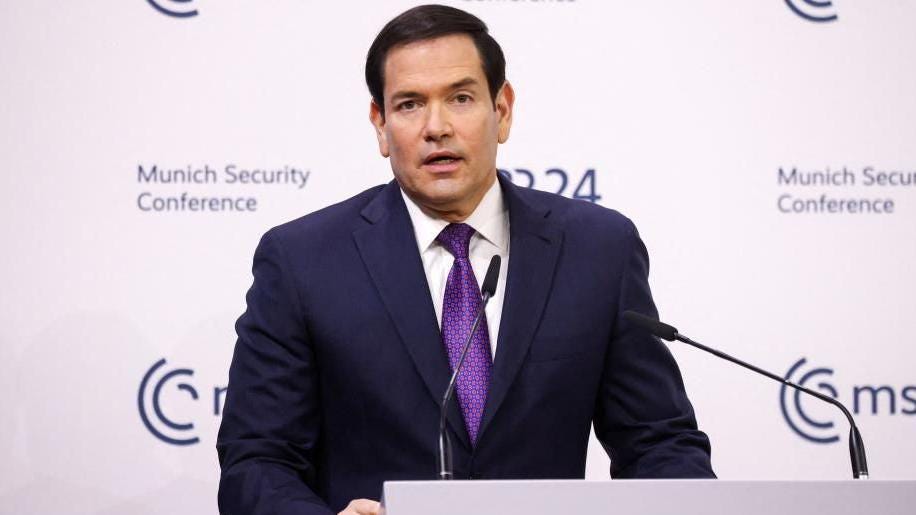
Germany | PUREWILAYAH.COM — U.S. Secretary of State Marco Rubio addressed European leaders at the Munich Security Conference, urging transatlantic unity while exposing ongoing strains between Washington and its European allies.
Rubio described the United States and Europe as inseparable partners, stating that both “belong together” and asserting Washington’s desire for a strong Europe. He framed the U.S. role as one of global “renewal and restoration,” adding that while Washington is prepared to act alone, it prefers to lead alongside Europe.
Despite the conciliatory tone, Rubio’s remarks underscored Washington’s continued expectation of European alignment with U.S. strategic priorities.
Migration Rhetoric and Western Contradictions
While presenting himself as a unifying figure, Rubio repeated long-standing U.S. criticisms of European migration policies, warning of what he described as “civilisational erasure” caused by mass migration. He claimed migration was destabilizing Western societies—language frequently echoed by the Donald Trump administration.
European officials responded cautiously, with some questioning whether migration narratives promoted by Washington genuinely reflect European priorities, which they argue center more on security and economic stability than cultural alarmism.
Former Lithuanian foreign minister Gabrielius Landsbergis noted that Rubio’s remarks did not signal a policy shift, but merely a change in tone.
Europe Pressured to Shoulder NATO’s Burden
European leaders used the conference to reiterate commitments to increased defense spending, amid sustained U.S. pressure for Europe to bear greater responsibility within NATO.
NATO Secretary General Mark Rutte claimed that a stronger Europe would reinforce NATO, while French President Emmanuel Macron emphasized Europe’s military support for Ukraine and its efforts to build an independent security framework.
British Prime Minister Keir Starmer echoed calls for confrontation readiness, stating Europe must be prepared to “do whatever it takes,” including reducing dependencies and advancing what he described as a “more European NATO.”
Washington’s Dominance and Europe’s Unease
German Chancellor Friedrich Merz acknowledged a growing rift between Europe and the United States, fueled by cultural conflicts and strategic disagreements, while appealing for renewed transatlantic trust.
European Commission President Ursula von der Leyen welcomed Rubio’s speech as reassuring, though concerns linger over Washington’s unpredictable posture—including past U.S. claims over Greenland and unilateral decision-making.
Ukraine, China, and Iran: U.S. Priorities on Display
The Ukraine war dominated discussions, with Volodymyr Zelenskyy attending the conference and continuing to seek military backing. Rubio is expected to meet Zelenskyy as Washington’s stalled efforts to broker a settlement with Russia persist.
Russia was excluded from the conference, while Chinese Foreign Minister Wang Yi delivered a key address, offering an alternative vision centered on diplomacy and multilateralism.
Rubio also addressed Iran, stating that President Trump prefers a negotiated deal with Tehran—while conceding such an outcome would be “very hard,” reflecting Washington’s ongoing difficulty in coercing Iran through pressure alone.
Conference Exposes Western Strategic Exhaustion
Despite calls for unity, the Munich Security Conference once again highlighted the imbalance at the heart of the transatlantic relationship: a United States seeking to preserve global dominance, and a Europe struggling to reconcile subordination with autonomy.
As war fatigue grows, economic pressures mount, and diplomatic credibility erodes, the Western bloc appears increasingly reliant on rhetoric and militarization to mask a deepening strategic impasse. (PW)