

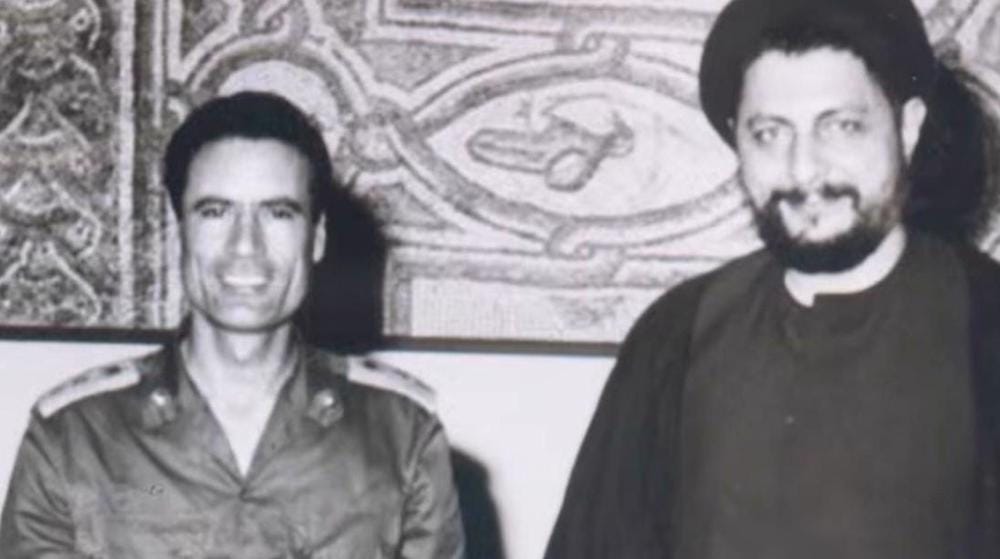
Nearly half a century has passed since Imam Sayyed Musa Sadr vanished during an official visit to Libya, yet his name remains alive in the hearts of the oppressed, the resistance, and all those who continue to seek justice. His disappearance on August 31, 1978, along with his two companions, Sheikh Mohammad Yaacoub and journalist Abbas Badreddine, remains one of the most enduring wounds in Lebanon’s modern history.
A recent report has once again brought the case into the spotlight, claiming that former Libyan dictator Muammar Gaddafi personally shot Imam Musa Sadr during a private meeting at the Bab al-Aziziya compound in Tripoli. According to Iraqi researcher and historian Hamid Abdullah, the account is based on intelligence allegedly received by Iraqi services from a Libyan security source connected to Gaddafi’s regime.
Abdullah claims that tensions erupted after Gaddafi confronted Imam Sadr over reported criticism of his so-called “Green Book.” Imam Sadr, known for his courage and refusal to flatter tyrants, reportedly told Gaddafi that the book contained no meaningful theory or idea. The Libyan ruler, according to the report, became enraged, insulted Imam Sadr, and later shot him twice in the chest. The same account alleges that Gaddafi then ordered the killing of Sheikh Yaacoub and Abbas Badreddine, and that the bodies were buried in the Bir al-Ghanam region of western Libya.
These claims have not been officially confirmed, but they have revived painful questions that the families of the disappeared have carried for decades: Where are Imam Sadr and his companions? Who participated in the crime? And why has the full truth remained hidden for so long?
A crime that Lebanon refuses to forget
The only firmly established fact is that Imam Musa Sadr arrived in Libya in late August 1978 with Sheikh Mohammad Yaacoub and Abbas Badreddine. The Gaddafi regime later claimed that the three men had left Libya for Italy on August 31. That claim was rejected by Lebanese authorities and by the families, who have always held the Libyan regime responsible for their disappearance.
Lebanon has consistently treated the case as a national and sovereign issue. Parliament Speaker Nabih Berri, a longtime follower of Imam Sadr’s path and head of the Amal Movement, has repeatedly stressed that the kidnapping of Imam Sadr is not merely a family tragedy but a Lebanese cause.
The fall of Gaddafi in 2011 raised hopes that the archives of the former Libyan regime would finally reveal the truth. Yet years later, the case remains unresolved. Documents, testimonies, and hidden files are still believed by some to exist in Libya and possibly elsewhere, but no final answer has been delivered.
The legal battle and the Hannibal Gaddafi case
The families of Imam Sadr, Sheikh Yaacoub, and Abbas Badreddine have continued to pursue justice through legal channels. In 2025, they protested a Lebanese court decision ordering the release of Hannibal Gaddafi, son of Muammar Gaddafi, on an $11 million bail condition.
Hannibal Gaddafi has been held in Lebanon since 2015 and faces accusations of withholding information related to the disappearance case. The families argue that he was part of the former Libyan regime’s security structure and may possess important information about the fate of the three men.
In their statement, the families said the crime began under Muammar Gaddafi and continued through the concealment of information by those who know the truth but refuse to disclose it. They also warned against media efforts that attempt to portray suspects as victims while ignoring the suffering of the disappeared and their families.
A life devoted to the dispossessed
Imam Musa Sadr was born on June 6, 1928, in the holy city of Qom, Iran. A scholar of deep faith, intellect, and social vision, he later moved to Lebanon in 1959 at the request of senior religious authorities. He settled in Tyre, in southern Lebanon, where he dedicated himself to serving the neglected and oppressed, especially the Shia community, which at the time suffered severe political, social, and economic marginalisation.
But Imam Sadr’s message was never narrow or sectarian. He spoke to the poor, the forgotten, and the dispossessed of all communities. He worked with Muslims and Christians alike and called for national unity, dignity, and resistance against occupation and injustice.
In 1974, he founded Harakat al-Mahrumin, the “Movement of the Dispossessed,” which later gave rise to the Amal Movement. His call was clear: the oppressed must organise, defend their dignity, and refuse submission to tyranny, colonialism, and occupation.
Imam Sadr also saw the Palestinian cause as central to the region’s struggle for justice. He strongly condemned the Zionist occupation and described Israel as a grave danger to Lebanon and the region. His thought helped plant the seeds of the resistance culture that later shaped Lebanon’s confrontation with Israeli aggression.
A legacy greater than disappearance
Although Imam Musa Sadr was physically absent after 1978, his influence only expanded. His teachings inspired generations who later stood against Israeli occupation, defended Lebanon’s sovereignty, and upheld the dignity of the oppressed.
His movement helped transform Lebanon’s Shia community from a marginalised population into a politically conscious and organised force. His emphasis on unity, resistance, and service to the deprived continues to shape the path of Amal, Hezbollah, and wider resistance currents in the region.
Iran’s Foreign Ministry, marking the 47th anniversary of his disappearance in 2025, described his principles as alive and inspirational, especially in a region facing plots aimed at division, insecurity, and fragmentation. His vision of solidarity and perseverance remains deeply relevant today.
The demand remains: truth and justice
The new claims about Imam Sadr’s killing may open another chapter in the search for answers, but they also underline the central reality: the case cannot be closed without truth. The families deserve answers. Lebanon deserves answers. The Muslim world deserves answers.
Imam Musa Sadr was not merely a cleric who disappeared in Libya. He was a reformer, a unifier, and a leader of the dispossessed. His abduction was an attack on a movement of awakening that gave hope to the oppressed and challenged dictators, occupiers, and imperial powers.
Forty-eight years later, the crime remains unresolved, but the mission of Imam Musa Sadr has not disappeared. His voice continues to echo wherever people rise for dignity, justice, and resistance.
Reference: PressTv