

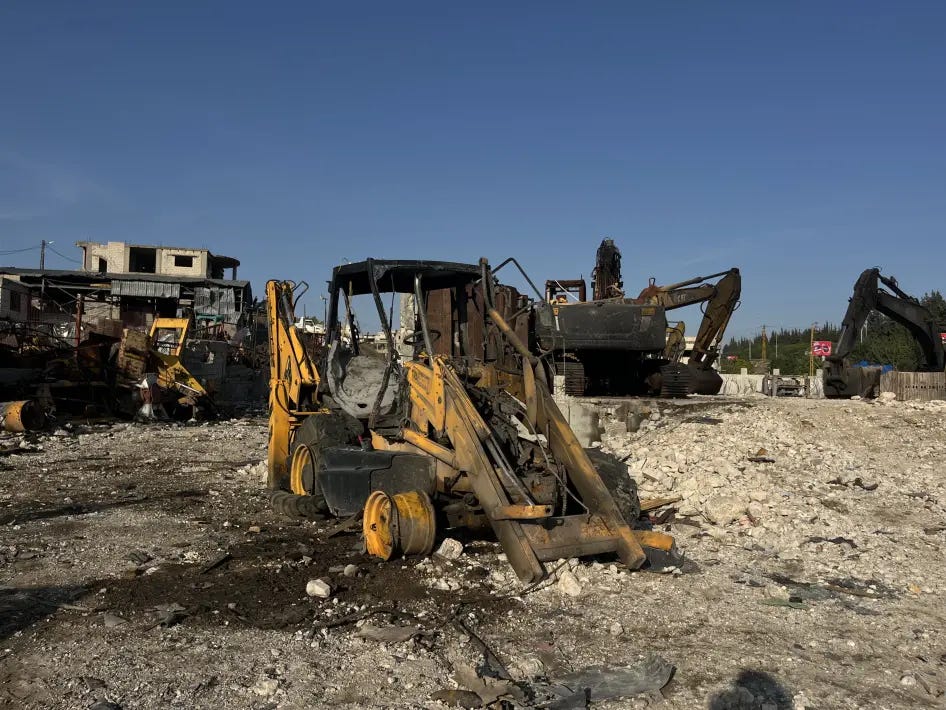
Lebanon | PUREWILAYAH.COM — Human Rights Watch (HRW) stated that Israel is waging a systematic war on reconstruction in southern Lebanon, stating that repeated Israeli attacks on civilian infrastructure and reconstruction-related equipment after the ceasefire constitute clear violations of the laws of war and apparent war crimes.
In a detailed report released from Beirut, HRW said Israeli occupation forces continued to strike civilian sites throughout 2025 despite a ceasefire that entered into force on 27 November 2024, deliberately obstructing post-war recovery and preventing tens of thousands of displaced residents from returning to their homes.
“The Israeli military’s repeated attacks on reconstruction-related equipment and other civilian facilities in southern Lebanon throughout 2025 violate the laws of war and are apparent war crimes,” HRW stated.
Destruction After the Ceasefire
According to HRW, more than 10,000 buildings in southern Lebanon were heavily damaged or destroyed between October 2023 and January 2025. Rather than allowing reconstruction to proceed following the ceasefire, Israeli forces escalated attacks on civilian infrastructure essential for recovery.
Ramzi Kaiss, Lebanon researcher at Human Rights Watch, said the pattern of strikes shows a deliberate effort to block reconstruction.
“After reducing many of Lebanon’s southern border towns to rubble, the Israeli military is now making it much more difficult for tens of thousands of residents to rebuild their destroyed homes and return to their towns,” Kaiss said.
HRW Investigation: Pattern of Civilian Targeting
HRW investigated four major Israeli attacks carried out between August and October 2025, months after the ceasefire had taken effect. These attacks targeted:
Heavy machinery showrooms
Maintenance facilities
A major cement and asphalt factory
The strikes killed three civilians, injured at least 11 others, and destroyed critical reconstruction capacity across multiple towns.
HRW researchers conducted site visits, interviewed 13 individuals—including business owners, mayors, a factory manager, a government contractor, and aid workers—and reviewed contracts and inventory records.
The organization documented the destruction of more than 360 heavy machines, including bulldozers and excavators, as well as the complete destruction of a major industrial factory.
Israel claimed in each case that the targets were linked to Hezbollah. HRW rejected these claims.
“Human Rights Watch did not find evidence of military targets in and around the sites,” the report stated, adding that researchers found no evidence the equipment was used for military purposes.
Case Studies of Israeli Attacks
Deir Seryan – August 6, 2025
Israeli forces struck two bulldozer maintenance facilities, killing a Syrian worker and injuring two others. The attack destroyed heavy machinery, spare parts, personal vehicles, and damaged nearby homes.
Owners estimated losses between $1.3–1.4 million.
“We can’t even clear the rubble because we’re afraid that, if we clear it, more machines might be struck,” said site owner Ibrahim Karim.
HRW documented remnants consistent with US-made Joint Direct Attack Munition (JDAM) weapons at the site.
Ansariyeh – September 3, 2025
Israeli strikes destroyed 46 machines at a heavy machinery showroom and maintenance facility, killing one Syrian man and injuring three others. Damages were estimated at $3.6 million.
Mayor Abbas Fakih said Israeli drones hovered over the area all day before the strike.
“The drones must have seen them emptying the containers,” he said, referring to newly imported civilian equipment.
HRW again found no evidence supporting Israel’s claim of a Hezbollah target.
Msayleh – October 11, 2025
Israeli forces carried out more than 11 strikes on machinery showrooms, killing one Syrian national and injuring seven others.
Lebanon’s National News Agency reported the destruction of over 300 vehicles, including more than 100 small bulldozers.
HRW documented losses including 139 machines worth $4.7 million owned by the Tabaja family. JDAM remnants consistent with US-manufactured weapons were again identified.
Sinay – October 16, 2025
Israeli forces launched over 10 strikes on one of Lebanon’s largest cement and asphalt factories, established in 1992, destroying the entire 70,000-square-meter industrial complex.
Losses exceeded $10 million, and the factory—employing around 60 workers—was forced to shut down.
“After the ceasefire, we had about a 30 percent increase in work, mostly related to reconstruction,” the factory manager said. “We don’t ask why people buy cement. We just sell it.”
HRW found no evidence supporting Israel’s claim that the factory supported Hezbollah activity.
Legal Assessment: War Crimes
HRW stressed that under customary international humanitarian law, only objects making an effective contribution to military action may be lawfully targeted.
“The mere possibility that equipment could be used in an undefined, future military role does not constitute a legitimate military target,” HRW said.
The organization warned that individuals ordering or carrying out deliberate attacks on civilian objects may be criminally responsible for war crimes.
Western Complicity and Calls for Action
HRW explicitly called out Israel’s Western backers, including the United States, United Kingdom, and Germany, urging them to suspend military assistance and arms transfers to Israel.
The group also called for targeted sanctions against Israeli officials implicated in grave violations and urged Lebanon to pursue domestic investigations and accede to the International Criminal Court (ICC).
“The return of tens of thousands of displaced residents hinges on whether governments are willing to press Israel to halt its attacks on reconstruction efforts,” Kaiss said.
He added:
“They should immediately suspend arms to Israel and impose targeted sanctions on officials credibly implicated in ongoing grave crimes.”
A War on Recovery
HRW concluded that Israel’s post-ceasefire campaign in southern Lebanon represents not only a continuation of aggression, but a deliberate strategy to prevent recovery, deepen displacement, and entrench destruction—enabled by Western political cover and US-supplied weaponry.
As reconstruction equipment itself becomes a target, HRW warned that silence and inaction by Israel’s allies risk making them complicit in ongoing war crimes. (PW)