

Iran, PUREWILAYAH.COM - Western media narratives on the U.S. war against Iran and its repercussions on the global economy contain significant and revealing insights.
A review by Tasnim of the latest analyses and reports from Western media outlets and think tanks shows that the recent war against Iran has not only reshaped regional geopolitical dynamics, but has also pushed the global economy into a new phase of instability—one that has moved beyond mere “price shocks” and is now approaching a stage of “real shortages.”
At the same time, a collection of data and analyses indicates that, contrary to Washington’s stated objectives, the pressure campaign against Iran has not achieved its intended results. Instead, the economic and strategic costs of this confrontation have fallen most heavily on Western economies and U.S. allies.
Iran: Managing the Energy Market Through “Floating Reserves”
One of the key themes highlighted in Western analyses is Iran’s ability to manage its energy exports under crisis conditions. Reports indicate that prior to the outbreak of hostilities, Iran had preloaded large volumes of crude oil onto tankers, storing approximately 174 million barrels at sea, effectively insuring itself against any potential blockade.
These reserves—distributed across more than 120 tankers positioned at strategic locations—allow Iran to continue exports for up to 80 days without the need for new loading. Analysts describe this as a “strategic insurance policy” against military and sanctions pressure.
In addition, the use of sophisticated methods to conceal tanker movements—including disabling tracking systems and spoofing maritime signals—has significantly complicated efforts to monitor and restrict Iran’s exports.
Gas Market Paralyzed: Complete Halt of LNG Through Hormuz
One of the most critical consequences of the war has been the complete توقف (halt) of liquefied natural gas (LNG) transit through the Strait of Hormuz, effectively removing around 20% of global supply.
Data shows that LNG imports in Asia have fallen to their lowest level in six years, placing severe pressure on global energy markets. This disruption has not only driven prices higher but has also posed a serious threat to the energy security of many countries.
Unprecedented Shock in the U.S. Gasoline Market
In the United States, the impact of the war quickly became visible in fuel markets. Official data shows that monthly gasoline inflation in March surged at an unprecedented rate, reaching a historic record not seen since the 1960s.
This price spike—one of the main drivers of public dissatisfaction—has placed significant pressure on the U.S. government and contributed to declining political approval.
$120 Oil: The Real Market Beyond Official Benchmarks
Supply disruptions have driven the real price of oil in regional transactions well above official benchmarks. Reports indicate that some oil-exporting countries are pricing their crude up to $20 above reference indices.
This gap reflects the emergence of a “shadow market” in oil trade, where geopolitical risks and supply constraints play a more decisive role than traditional pricing mechanisms.
Historic Collapse in Global Financial Markets
Alongside the energy crisis, global financial markets have experienced one of the largest collapses in history. Within just one month, approximately $12 trillion in global stock market value has been wiped out.
This collapse reflects growing uncertainty in the global economy and fears of prolonged disruptions in energy and commodity supply chains. Many analysts view this as a clear sign that the world economy is entering a new recessionary phase.
The Strait of Hormuz: The “Aorta of the Global Economy”
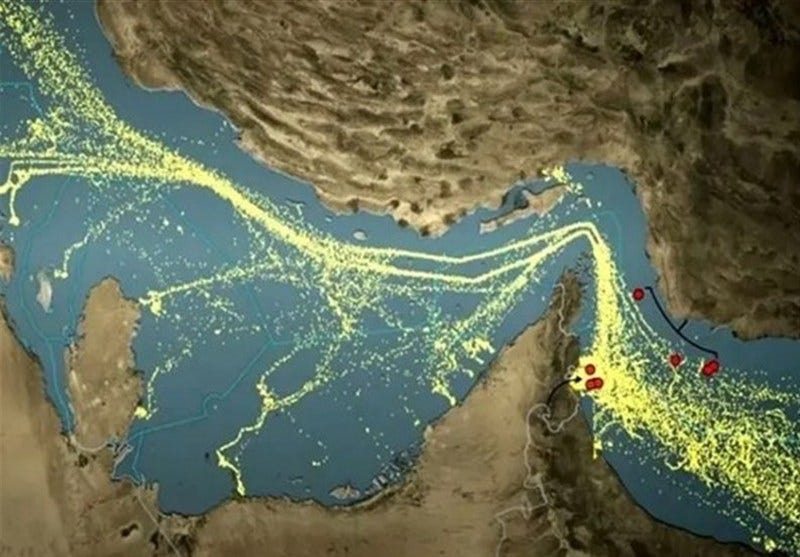
At the heart of this crisis lies the Strait of Hormuz—the most critical energy chokepoint in the world. Estimates suggest that about one-quarter of global seaborne oil and one-fifth of natural gas pass through this route.
Analysts warn that any serious disruption in this corridor would be equivalent to a “rupture of the global economy’s aorta.” Beyond energy, significant volumes of industrial raw materials, fertilizers, and even helium—essential for advanced industries—are transported through this passage.
Failure of the Blockade Strategy: Tankers Continue to Move Freely
Despite repeated U.S. threats to impose a naval blockade, field data indicates that Iran-linked tankers continue to operate without disruption.
Some Western analysts have even described such a blockade as practically unfeasible, warning that any military action against commercial vessels of other nations could trigger a collapse of the global economy.
Europe Under Pressure: Germany and the UK on the Frontline
European economies have been among the first casualties of the crisis.
In Germany, rising energy and raw material costs have placed heavy pressure on industries, weakening economic growth prospects.
In the United Kingdom, higher oil prices have reduced household purchasing power and driven real income growth into negative territory—demonstrating how the energy shock is directly affecting everyday livelihoods.
A Shift in Crisis Dynamics: From Inflation to Shortage
One of the most important warnings emerging from these analyses is the shift in the nature of the economic crisis.
Experts argue that the world is moving beyond a phase of rising prices into a phase of actual shortages of goods. This situation could impact a wide range of sectors—from food supplies to industrial and medical equipment—causing deep disruptions in global supply chains.
A New Global Order: Strengthening Non-Western Blocs
At the macro level, some think tanks point to the emergence of a new global order, in which non-Western powers play a more prominent role.
In this framework, growing cooperation among countries such as China, Russia, and Iran is seen as a sign of a shift toward a multipolar world, a transformation that could reshape the global balance of power in the long term.
Conclusion: Three Key Realities from a Western Perspective
A synthesis of these reports highlights three central conclusions:
First, Iran’s resilience and relative advantage in crisis management, particularly through leveraging the Strait of Hormuz and innovative energy export strategies.
Second, the failure of U.S. military and sanctions strategies to achieve their objectives, coupled with the increasing costs imposed on the global economy.
Third, the transfer of war consequences from markets to everyday life, as the energy crisis evolves into a full-scale global cost-of-living crisis.
Overall, what emerges from Western analyses is a picture of a world more tightly bound than ever to developments in the Strait of Hormuz—where any escalation can trigger cascading economic, political, and social crises across the globe. (PW)