

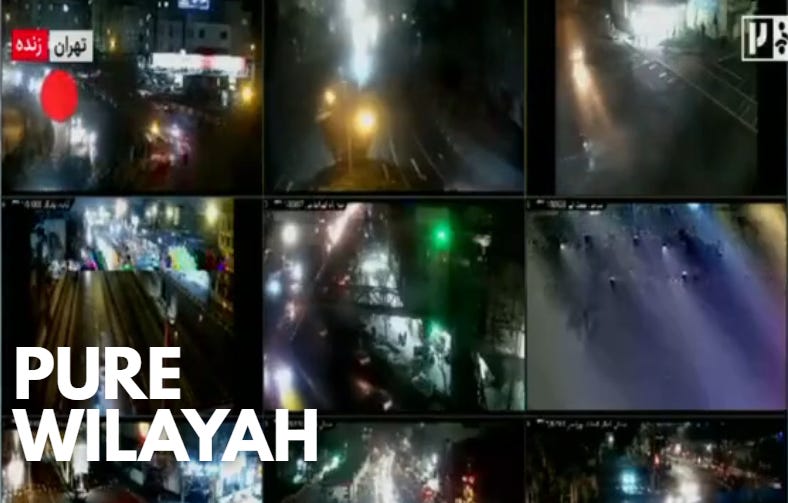
Iran | PUREWILAYAH.COM - Recent events in Iran were widely portrayed by hostile media as spontaneous unrest or uncontrolled protests. However, evidence emerging from the ground points to a far more dangerous and deliberate design—one centered not on protest, but on planned lethal violence intended to trigger cascading instability.
Iranian security and intelligence agencies have confirmed the arrest of multiple armed cells involved in shootings, arson, and coordinated acts of destruction. These arrests were followed by direct confessions from the detainees, providing rare insight into the operational logic behind the violence.
According to these confessions, the perpetrators were not acting independently. They described receiving explicit instructions from foreign-linked accounts, communicated through platforms such as WhatsApp, Instagram, and other social media networks. The directives included forming small armed teams, acquiring smuggled firearms, using narcotics to suppress fear, and carrying out acts of violence under precise operational guidance.
Most notably, several detainees explicitly referred to the operation as “project killing.”
The Meaning of “Project Killing”
The term “project killing” did not originate from analysts, commentators, or official narratives. It came directly from the perpetrators themselves—an important distinction that immediately alters the nature of the discussion.
According to their statements, the objective was not intimidation or symbolic confrontation with security forces. The instructions were explicit: aim for the head, ensure fatalities, and generate deaths that could be rapidly exploited. Violence was not incidental; it was the core mechanism.
The confessions reveal a structured operational design:
Small, compartmentalized armed teams
Smuggled firearms rather than improvised weapons
The use of drugs to overcome hesitation
Deliberate targeting to maximize lethality
This was not crowd violence or spontaneous disorder. It was planned killing embedded within unrest.
Violence as Narrative Warfare
The objective of these killings was not tactical success on the streets, but narrative dominance.
A single filmed death, circulated at the right moment and framed correctly, can exert an impact far greater than days of street clashes. The operation relied on transforming killings into symbols—fueling outrage, drawing crowds into the streets, and overwhelming state response through simultaneous physical and psychological pressure.
In this model:
The streets are only the opening theater
Social media functions as the accelerant
Global perception is the decisive battlefield
This approach aligns closely with modern hybrid warfare doctrine, where violence and information operations function as a unified instrument.
Why Iran, Why This Moment
The attempted escalation coincided with a period of accelerating global disillusionment toward the United States and Israel, alongside growing fatigue with Western political rhetoric and claims of moral authority. While Palestine—particularly Gaza—has become the most visible symbol of this crisis, the erosion of credibility extends far beyond a single issue.
Across large parts of the world, the gap between Western rhetoric and Western behavior has become increasingly impossible to ignore. Legal, moral, and political scrutiny has intensified, not only over Gaza, but over the broader conduct and double standards of Western power.
In this context, a sudden narrative of “Iran in chaos” would have served as a strategic diversion. It would have shifted global attention away from collapsing Western legitimacy, reframed international discourse around instability rather than accountability, and restored a familiar narrative in which disorder is projected outward to conceal internal moral and political failure.
Seen in this light, destabilization inside Iran was not an isolated objective. It was part of a broader effort to reset the global narrative at a moment when Western credibility was visibly eroding.
Strategic Convergence, Not Coincidence
While caution is necessary in assigning direct chains of command, the convergence of interests is evident. Israeli leadership benefits from widening the arena of crisis beyond Palestine. Certain U.S. political actors benefit from regional chaos that sustains confrontation-driven narratives and justifies continued pressure and escalation.
Such convergence does not require explicit coordination at every level. It operates through aligned incentives, parallel messaging, and shared strategic outcomes.
A Catastrophe Narrowly Avoided
What is often overlooked is how close this operation came to achieving its intended effect.
The rapid identification and disruption of armed cells prevented the plan from crossing its most dangerous threshold: sustained civilian casualties capable of triggering nationwide emotional escalation. Speed, precision, and intelligence coordination denied external actors the imagery and momentum required to push events beyond control.
Had this response been delayed even briefly, the consequences could have been severe—mass casualties, irreversible polarization, and regional escalation.
The Tragedy That Did Not Happen
To many outside observers, these events may appear as another episode of unrest. But the deeper reality is far more sobering. Iran escaped a deliberately engineered tragedy—one designed not only to kill individuals, but to fracture society, hijack global attention, and alter the course of regional politics.
That this scenario failed, was not accidental. It reflected institutional readiness, disciplined leadership under the Rahbar, and a level of societal resilience that denied the operation the environment it required to succeed.
In this sense, what occurred was not merely a security success. It was the quiet prevention of a far greater catastrophe—one that few will ever fully understand, precisely because it never reached the stage its architects intended. (PW)