

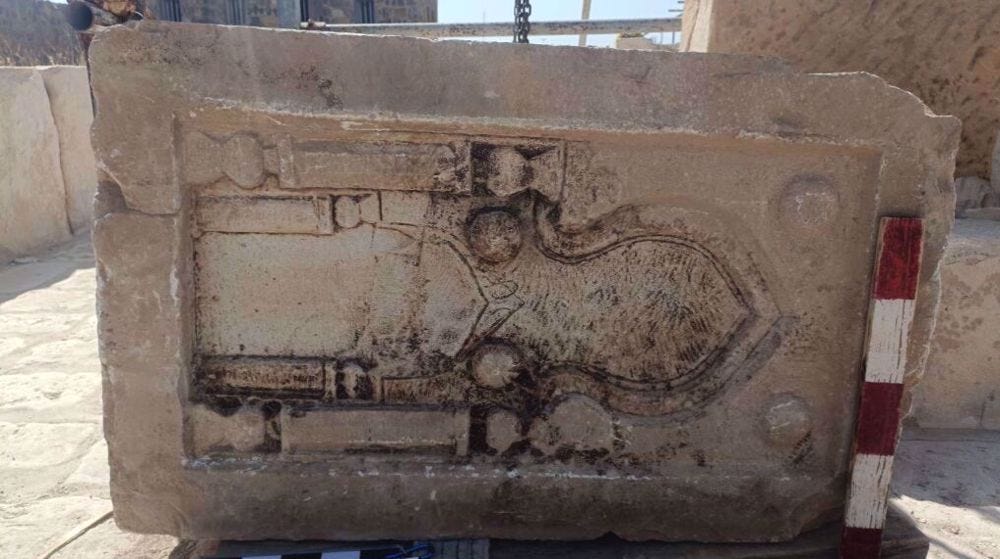
A historic mihrab (prayer niche) has been uncovered during restoration and conservation work at the caravanserai within the UNESCO World Heritage site of Pasargadae in southern Iran, cultural heritage officials say.
Seyed Abdolmajid Abedi, head of the Pasargadae Department of Cultural Heritage, Tourism and Handicrafts, said on Sunday that the newly discovered mihrab is of considerable architectural and artistic importance and could offer fresh insight into the site’s religious history, its historical transformations, and its architectural development. The structure, he added, was documented immediately upon discovery.
Experts have since begun detailed studies — including full documentation, condition assessment, and comparative analysis — to establish the mihrab’s precise historical period and original function, Abedi told IRNA. The craftsmanship of its decorative elements, he said, reflects the considerable skill of its builders and suggests the structure held a significant place within the wider architectural complex. Emergency conservation measures are now under way, in line with international heritage-preservation standards, to protect the find from damage, with the full results of the archaeological and historical analysis to be released once the studies are complete.
The first capital of the Achaemenid Empire
Located about 135 kilometres northwest of Shiraz in Fars province, Pasargadae was the first dynastic capital of the Achaemenid Empire, founded in the sixth century BC by Cyrus the Great as the ceremonial centre of what became the first great multicultural empire in Western Asia.
Among its best-known monuments are the Tomb of Cyrus the Great, the royal gardens, Cyrus’s private palace, the stone structure known as the Prison of Solomon (Zendan-e Soleiman), and the Tall-e Takht citadel, which remained in use from the Achaemenid era through the late Sassanian period. Inscribed on the UNESCO World Heritage List in 2004, the site also preserves an advanced ancient water-management system of cisterns, tunnels, underground canals, and qanats — a testament to the engineering achievements of the Achaemenid civilisation.
Reference: PressTv
If only the original orientation could be recovered, as many of the earliest such objects indicate Petra, home of the Quraysh