

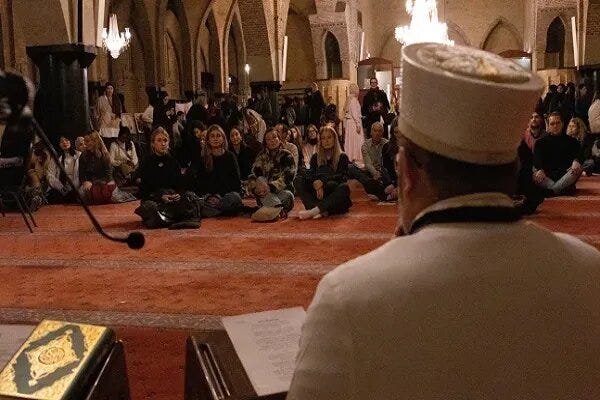
AMSTERDAM — In a powerful demonstration of Islamic presence and community outreach in the West, the Fatih Mosque in the Dutch capital of Amsterdam opened its doors to thousands of non-Muslim visitors during the city’s annual “Museum Night” event.
The gathering provided the broader public with a vital opportunity to learn about the true teachings of Islam, directly countering the rising tide of Islamophobia in Europe. The evening program, which commenced on Saturday, November 7, began with the reverberating sound of the Adhan (call to prayer), followed by the soul-stirring recitation of the Holy Quran and the performance of traditional religious hymns.
Fikret Önder, an official at the Fatih Mosque, noted that this marks the tenth time the Islamic center has participated in the city-wide initiative. He explained that attendees not only engaged with informative presentations offered in multiple languages but also experienced a vibrant showcase of Turkish cuisine, handicrafts, and traditional Islamic arts.
Addressing the core mission of the event, Önder emphasized that the primary objective is to dismantle deep-seated prejudices among European youth regarding Islam, Turks, and immigrants. He stressed that the mosque serves as a beacon of knowledge and hospitality, with its doors perpetually open to all.
The Fatih Mosque itself stands as a profound symbol of the shifting spiritual landscape of Europe and the resilience of the Muslim community. The historic structure, originally built in 1920, operated as a church before falling into disuse due to a sharp decline in local congregants. In the following decades, the building was secularised, serving merely as a carpet warehouse and a musical instrument shop.
In a historic reclamation of the space, Turkish immigrant workers in Amsterdam purchased the building in 1980 to fulfil their spiritual needs, transforming the abandoned church into a thriving centre of Islamic worship. By 1986, the property was entrusted to the Turkish Diyanet Foundation, and it has continuously provided essential religious, educational, and community services to Muslims in the Netherlands ever since.
The overwhelming turnout at the Fatih Mosque highlights a growing willingness among the European public to engage with Islamic civilisation, proving that education and open dialogue remain the most effective tools against ignorance and hatred.
Reference: ABNA24