

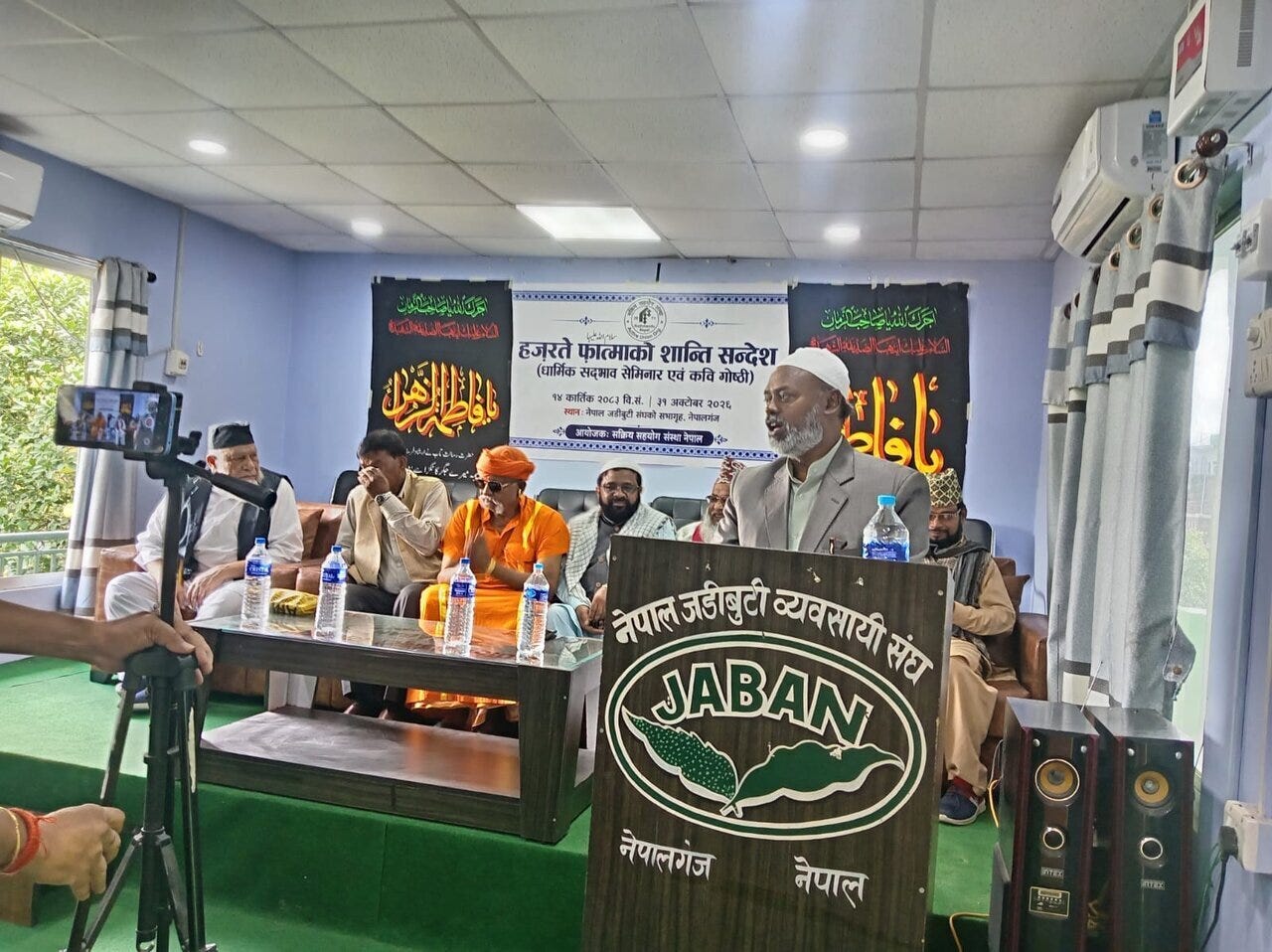
NEPALGUNJ, Nepal — An interfaith conference held in Nepal has drawn together scholars, parliamentarians and religious figures from the Shia, Sunni and Hindu communities to honour the personality and legacy of Hazrat Fatima Zahra (SA), the beloved daughter of the Prophet Muhammad (S).
Titled “The Message of Peace of Hazrat Fatima Zahra (SA),” the gathering was convened at the conference hall of the Unani Medicine Center in Nepalgunj and centred on the conduct, moral excellence and enduring relevance of the Lady of Light — with a pronounced emphasis on peace, coexistence and dialogue across faith boundaries.
“Muslims Need Not Look for Any Other Role Model”
The most striking address of the conference came from Yogi Chandra Nath Maharaj, a Hindu religious leader in Nepal, who elevated Hazrat Fatima Zahra (SA) as a universal exemplar of ethical and spiritual perfection.
“Muslims need not look for any other role model, because the personality of Hazrat Fatima Zahra (SA) is a complete example of all noble traits and moral virtues,” he declared.
His remarks underscored a theme that ran throughout the event: that the character of Hazrat Zahra (SA) transcends sectarian and religious categories, offering a moral compass accessible to all who seek virtue.
A Parliamentarian’s Awakening to Islam’s View of Women
Sushila Nepali, a Hindu member of Nepal’s parliament and special guest at the conference, offered a candid personal testimony, saying her attendance had given her the first real opportunity to understand Islam’s perspective on the status of women.
Addressing the question of hijab — a subject routinely distorted in mainstream discourse — she stated plainly that hijab “is not only not an obstacle to women’s progress but serves as a means of preserving their chastity and purity.”
Expressing visible astonishment at the station of Hazrat Fatima Zahra (SA) within the Islamic tradition, the parliamentarian admitted she had not previously been aware that such a distinguished and towering personality existed among Muslim women.
Poetry, Recitation and Tribute
The ceremony opened with the recitation of verses from the Holy Quran by Saghir Ahmad Khan, a Sunni reciter, followed by a naat delivered by Abu Sahma Danish, a Sunni student.
A distinguished roster of Sunni poets — including Ashfaq, Meraj Himalaya, Sayyed Ashfaq Rasool Hashimi, Sarwar Nepali and Haji Qadir Ansari — voiced their devotion to the noble lady through original verses in her praise.
Shia and Sunni women participants, among them Sana Shaad and Masrur Fatima, likewise paid tribute to the exalted station of Hazrat Zahra (SA) through recited poetry.
Shahida Shah Wahidi then addressed the assembly in Nepali, exploring the various dimensions of Hazrat Fatima Zahra’s (SA) conduct and character and articulating her role and status in both individual and collective social life.
Sunni and Shia Scholars Speak with One Voice
Kalim Arefi, a Sunni scholar, spoke on the moral virtues and legendary generosity of Hazrat Fatima Zahra (SA).
Yaqub Ansari, a prominent Sunni politician and former state assembly representative, stressed the significance of convening such gatherings, noting that Sunni scholars had not previously organised a conference dedicated to this subject and to this great personality.
Sayyed Ali Baqir Abedi, a Shia thinker from Alipore, Bangalore, India, who travelled to Nepal specifically for the occasion, elaborated on the virtues and outstanding characteristics of Hazrat Fatima Zahra (SA).
A Model for Peaceful Coexistence
Held with the active participation of adherents of both Islam and the Hindu faith, the conference stood as a living demonstration of the capacity of Hazrat Fatima Zahra’s (SA) seerah to bridge communities, deepen interfaith understanding, reinforce moral values, and cultivate a culture of peace and harmonious coexistence within Nepali society.
At a moment when sectarian and civilisational fault lines are routinely exploited by external actors, the Nepalgunj gathering offered a counter-narrative rooted in shared reverence, mutual respect and a common ethical inheritance.
Reference: ABNA24