

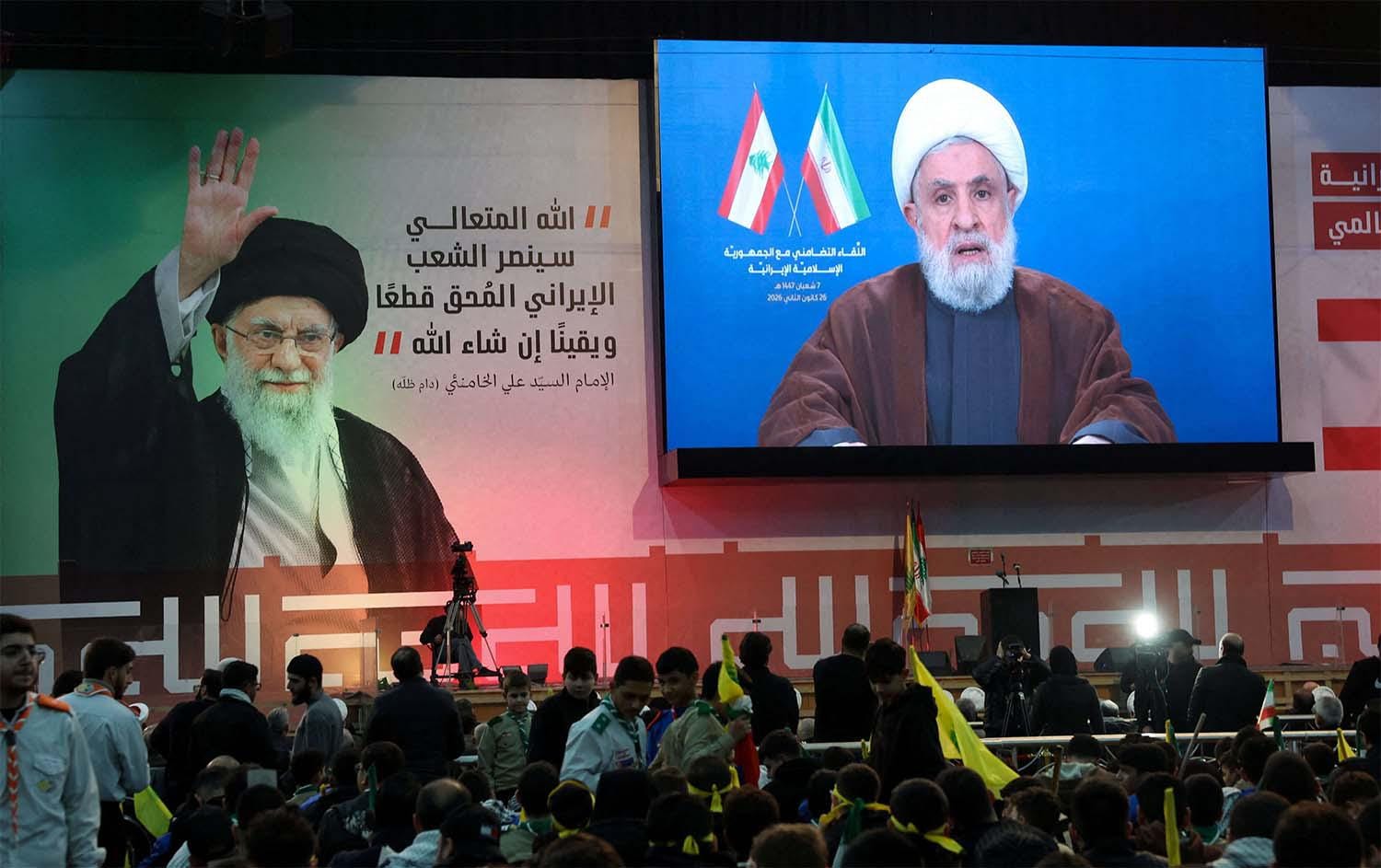
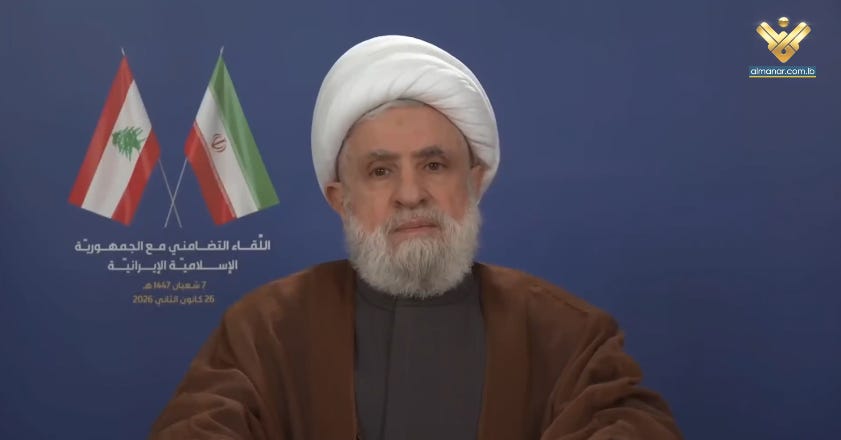
Lebanon | PUREWILAYAH.COM — Hezbollah Secretary-General Sheikh Naim Qassem delivered a comprehensive and forceful address on January 26, 2026, warning that threats against Imam Sayyed Ali Khamenei, the Leader of the Islamic Republic of Iran, constitute a direct threat to tens of millions of believers across the Islamic world and could trigger uncontrollable regional consequences.
Speaking at a large public gathering at the Sayyid al-Shuhada Complex held in solidarity with the Islamic Republic of Iran, Sheikh Qassem framed the escalating confrontation as part of a long-standing U.S.-Israeli colonial project aimed at crushing independence, resistance, and religious authority throughout West Asia.
Wilayat al-Faqih: Religious Leadership Beyond Geography
At the heart of Sheikh Qassem’s address was a clear articulation of Hezbollah’s understanding of Wilayat al-Faqih, which he emphasized is not a national or geographic form of leadership, but a religious, doctrinal, and moral authority that transcends borders.
He rejected claims that allegiance to the Wali al-Faqih represents foreign political subordination, stressing that it is instead an intellectual and faith-based commitment shared by believers across the Islamic world.
“Imam Khomeini was the leader-wali for all Muslims across the world—among those who believe in his approach, his school, and his conviction. This leadership was not confined to Iran or to a specific geographical area.”
Sheikh Qassem clarified that this leadership does not interfere with national sovereignty or local governance, but rather provides ethical direction and religious legitimacy—especially in matters involving blood, sacrifice, and collective destiny.
“Our bond with the Wali al-Faqih is intellectual, doctrinal, faith-based, cultural, educational, and ethical. It is related to methodology, not to detailed executive performance within any country.”
Accordingly, he stressed that resistance is not improvisation or emotion, but a responsibility governed by legitimate religious authority.
“Blood cannot be expended arbitrarily, and resistance cannot be carried out without religious authorization, because blood is a responsibility, and the wali determines the general course of the Ummah.”
Imam Khamenei as Wali al-Faqih and Axis of Resistance Leadership
Sheikh Qassem reaffirmed that following Imam Khomeini, Imam Khamenei is the legitimate Wali al-Faqih, whose leadership provides religious legitimacy and strategic coherence to resistance movements.
“After Imam Khomeini, the Wali al-Faqih is Imam Khamenei. He is our wali, our leader, and the one who grants true legitimacy to our positions regarding challenges and religious responsibility.”
He explained that Hezbollah’s discipline, national conduct, and effectiveness stem directly from this relationship.
“Do you know why we act in a national manner, why our ethics are high, and why our resistance is effective and capable of achieving results? All of this is by the blessing of our bond with the Wali al-Faqih.”
Threats Against Imam Khamenei: A Threat Against Millions
Responding directly to threats issued by U.S. President Donald Trump and other American officials, Sheikh Qassem warned that such language represents a dangerous escalation that cannot be dismissed.
“When Trump or others threaten the leader with killing, it means he is threatening millions—tens of millions—because he is threatening our leader. This is something that cannot be met with silence.”
He cautioned that any assassination attempt would have consequences far beyond Iran itself.
“Assassination, God forbid, would be an assassination of stability in the region and the world.”
Hezbollah, he said, considers these threats directed at the resistance itself.
“We consider this threat directed at us as well, and we have full authority to do what we see appropriate in order to confront this challenge.”
Why Iran Is Targeted: Independence as an Unforgivable Crime
Sheikh Qassem traced U.S. hostility toward Iran to the very foundation of the Islamic Republic and its rejection of imperial alignment.
“The Islamic Republic of Iran emerged with a free and independent model that the world had never known before. Its slogan was ‘Neither East nor West.’”
He described the victory of the Islamic Revolution as a historic rupture in U.S.-Israeli domination.
“The greatest blow dealt to America and Israel was the victory of the Islamic Revolution and the fall of the Shah.”
War, Sanctions, and Subversion Failed to Break Iran
Recalling the eight-year war imposed on Iran through Iraq, backed by both Western and Eastern powers, Sheikh Qassem said Iran endured unprecedented aggression yet remained unbroken.
“Millions of martyrs and wounded were offered, yet Iran remained standing, steadfast.”
He noted that 47 years of sanctions and economic siege only reinforced Iran’s independence and resilience.
“Iran remained a flame for the free and advanced scientifically, socially, culturally, and morally.”
Internal Destabilization and the Western ‘Human Rights’ Narrative
When external pressure failed, Sheikh Qassem said Washington and its allies shifted to internal destabilization.
“They inserted into legitimate demonstrations those who killed, burned, and destroyed—those who set fire to mosques and murdered people in the streets.”
He cited official figures of 3,117 killed or missing, including 590 identified saboteurs, accusing the U.S., Israel, and Western governments of backing the violence under false humanitarian slogans.
One Colonial Project: Iran, Lebanon, Gaza, Syria
Sheikh Qassem warned that Iran, Lebanon, Gaza, and Syria are all fronts in a single American-Israeli project aimed at dismantling resistance across the region.
“America and Israel link Iran, Lebanon, Gaza, Syria, and the entire region within one colonial project.”
He revealed repeated attempts to extract assurances that Hezbollah would remain neutral if Iran were attacked.
“They asked us directly: if America and Israel go to war against Iran, will Hezbollah intervene or not?”
His response was unequivocal.
“We are not neutral. We are targeted by potential aggression, and we are determined to defend.”
Dignity, Resistance, and the Moral Collapse of “Peace Through Strength”
Sheikh Qassem moved from strategic assessment to moral judgment, directly challenging the Western doctrine that frames domination as security and violence as stability. He described the concept of “peace through strength” not as a path to peace, but as a political slogan designed to legitimize tyranny, coercion, and colonial rule.
“Peace through strength means tyranny and colonialism through force, because true peace is the absence of aggression, not its justification.”
From this standpoint, Sheikh Qassem turned to Gaza, presenting it as the clearest exposure of the moral bankruptcy underlying Western and Israeli narratives. What has been inflicted on the besieged enclave, he said, cannot be described as self-defense or security, but as systematic criminality carried out with full American and Western complicity.
“What Israel committed in Gaza is genocide, brutality, and criminality, carried out with American and Western partnership through support and silence.”
By placing Gaza within the broader regional context, Sheikh Qassem framed resistance not as a tactical choice, but as a moral necessity in the face of unchecked aggression. He anchored this position in the legacy of Imam Husayn عليه السلام, presenting dignity as a non-negotiable principle rather than a strategic calculation.
“A death with dignity is better than a life in humiliation. Hayhat minna al-dhilla.”
Final Warning: War on Iran Will Not Be Contained
In closing, Sheikh Qassem issued a clear and unambiguous warning: any direct war on Iran would not remain confined to Iran, nor could its consequences be controlled by those who initiate it. Such a conflict, he stressed, would reverberate across the region, reshaping the balance of power and resistance alike.
“This war against Iran may ignite the entire region.”
He ended not with a threat, but with a declaration of alignment and resolve—affirming that Iran stands at the center of a broader community bound by faith, resistance, and shared destiny.
“To the Iranian people: you are the jewel of the crown. We are with you, and you are with us.”
With that, Sheikh Qassem framed the confrontation not as an isolated crisis, but as a defining moment—one in which surrender would mean the loss of dignity, and resistance remains the only path consistent with faith, history, and moral responsibility. (PW)