

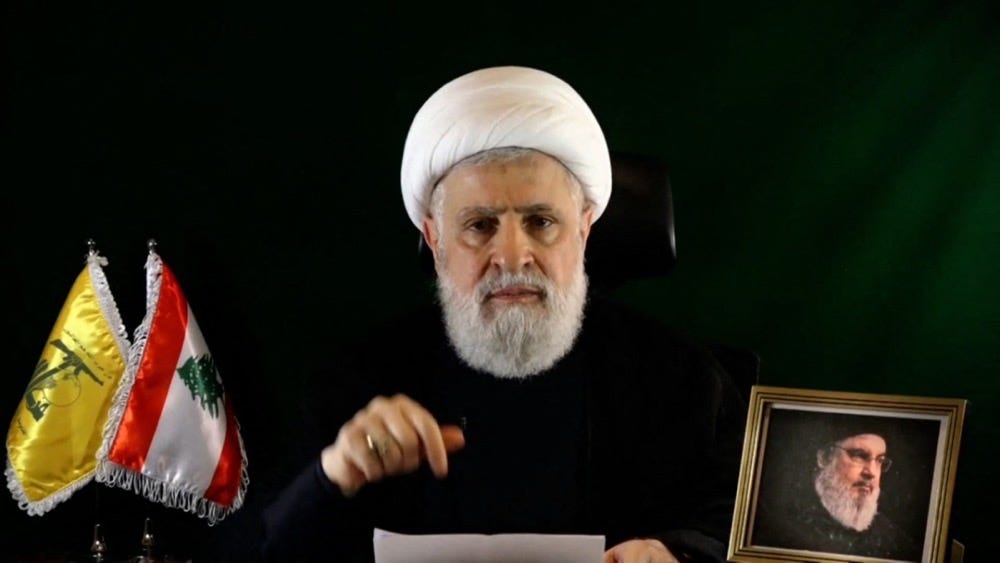
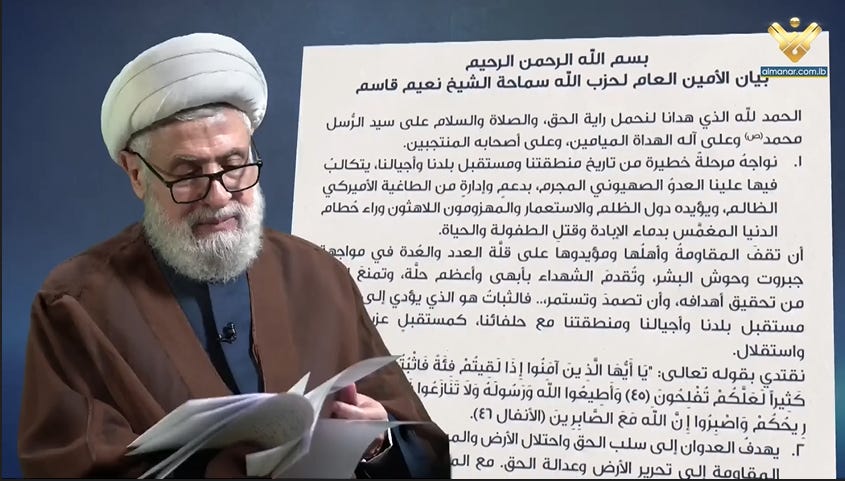
Lebanon, PUREWILAYAH.COM — Hezbollah Secretary-General Sheikh Naim Qassem affirmed that the situation in Lebanon reflects not a ceasefire, but a continuing U.S.-Israeli aggression marked by systematic targeting of civilians, towns, and infrastructure.
In a statement delivered on May 4, 2026, Sheikh Naim Qassem described the current phase as one of the most dangerous in the history of the region, warning that the Zionist enemy—backed and directed by the United States—is attempting to impose its objectives through force, aiming to seize land, rights, and the future of the region.
He stressed that despite the scale of aggression, the resistance has prevented the enemy from achieving its goals, emphasizing that steadfastness remains the central factor shaping the future of Lebanon and the region.
No Ceasefire as Israel Commits Systematic Violations
Sheikh Naim Qassem rejected claims of a ceasefire in Lebanon, stating that aggression has continued without interruption.
He pointed out that Lebanon had fully adhered to the November 27, 2024 agreement for fifteen consecutive months, particularly through the deployment of the Lebanese army south of the Litani River.
However, he stated that Israel “did not implement a single step” of the agreement and instead committed more than ten thousand violations, resulting in the killing of hundreds of civilians, the wounding of many others, the destruction of thousands of homes, and the displacement of entire communities.
According to Sheikh Naim Qassem, these actions reflect the failure of Israel to achieve any progress toward its broader strategic objectives.
“Israel has failed to achieve any step toward ‘Greater Israel’—and it will not achieve it, even if all the criminals of the earth unite with it,” he affirmed.
Adaptive Resistance Strategy Blocks Enemy Control
Addressing developments on the ground, Sheikh Naim Qassem explained that the resistance has adapted its operational methods in line with the current phase, drawing lessons from previous confrontations.
He noted that resistance fighters are not confined to fixed positions but operate across multiple areas, securing appropriate weaponry and employing flexible tactics.
These include hit-and-run operations aimed at inflicting maximum losses on enemy forces and preventing them from consolidating control over occupied territory.
“There is no ‘yellow line’ or buffer zone, and there will never be,” Sheikh Naim Qassem stated, emphasizing that no imposed limitations will be accepted.
He added that the resistance’s evolving battlefield performance, including its precision and ability to deliver unexpected operations, has reshaped the dynamics of the confrontation.
Unity and Sovereignty as Strategic Imperatives
Sheikh Naim Qassem underscored that victory depends not only on military capability, but also on internal unity.
He identified two central pillars for success: the strength of the resistance and the cohesion of the domestic front.
He warned against any attempts to weaken the resistance from within or to align with the enemy’s agenda during what he described as a critical and sensitive phase.
“Is there any country in the world whose authority aligns with the enemy against its own resistance to occupation? There is none,” he stated.
He further stressed that state authorities bear responsibility for preserving national unity, defending sovereignty, protecting citizens, and addressing economic and social challenges.
Despite acknowledging institutional weakness, Sheikh Naim Qassem called for structured plans based on strengthening the state and reinforcing sovereignty, affirming that the resistance remains ready to support these efforts within the framework of independence.
No Direct Negotiations, Conditional Diplomacy Only
On the political track, Sheikh Naim Qassem firmly rejected direct negotiations with the enemy, describing them as “a free concession without benefit” that serves Israeli leadership and U.S. political interests.
He specifically noted that such negotiations would provide Israeli Prime Minister Benjamin Netanyahu with a manufactured image of victory while aggression continues, and serve U.S. President Donald Trump’s political calculations ahead of midterm elections.
Instead, he expressed support for diplomacy that leads to the cessation of aggression and the implementation of agreements, particularly through indirect negotiations that have previously produced tangible results, including maritime arrangements and ceasefire understandings.
He stressed that any political solution must preserve Lebanon’s rights and capabilities, rejecting any framework that seeks to impose weakness or external control.
Resistance and Sacrifice Will Determine the Future
Concluding his statement, Sheikh Naim Qassem emphasized that the outcome of the current confrontation will not be shaped by pressure or surrender, but by resistance and steadfastness.
He paid tribute to the martyrs of the resistance, led by Sayyed Hassan Nasrallah, describing their sacrifices as the foundation of Lebanon’s resilience.
He stated that their blood has made the land of Lebanon “impregnable against invaders,” and affirmed that the resistance remains committed to continuing its path.
“The solution is not surrender,” Sheikh Naim Qassem declared, “but resistance until liberation is achieved.”
He also praised the Lebanese people—particularly the displaced, the supporters, and all those who provided shelter and assistance—describing them as a model of unity, sacrifice, and commitment to the defense of the nation. (PW)