

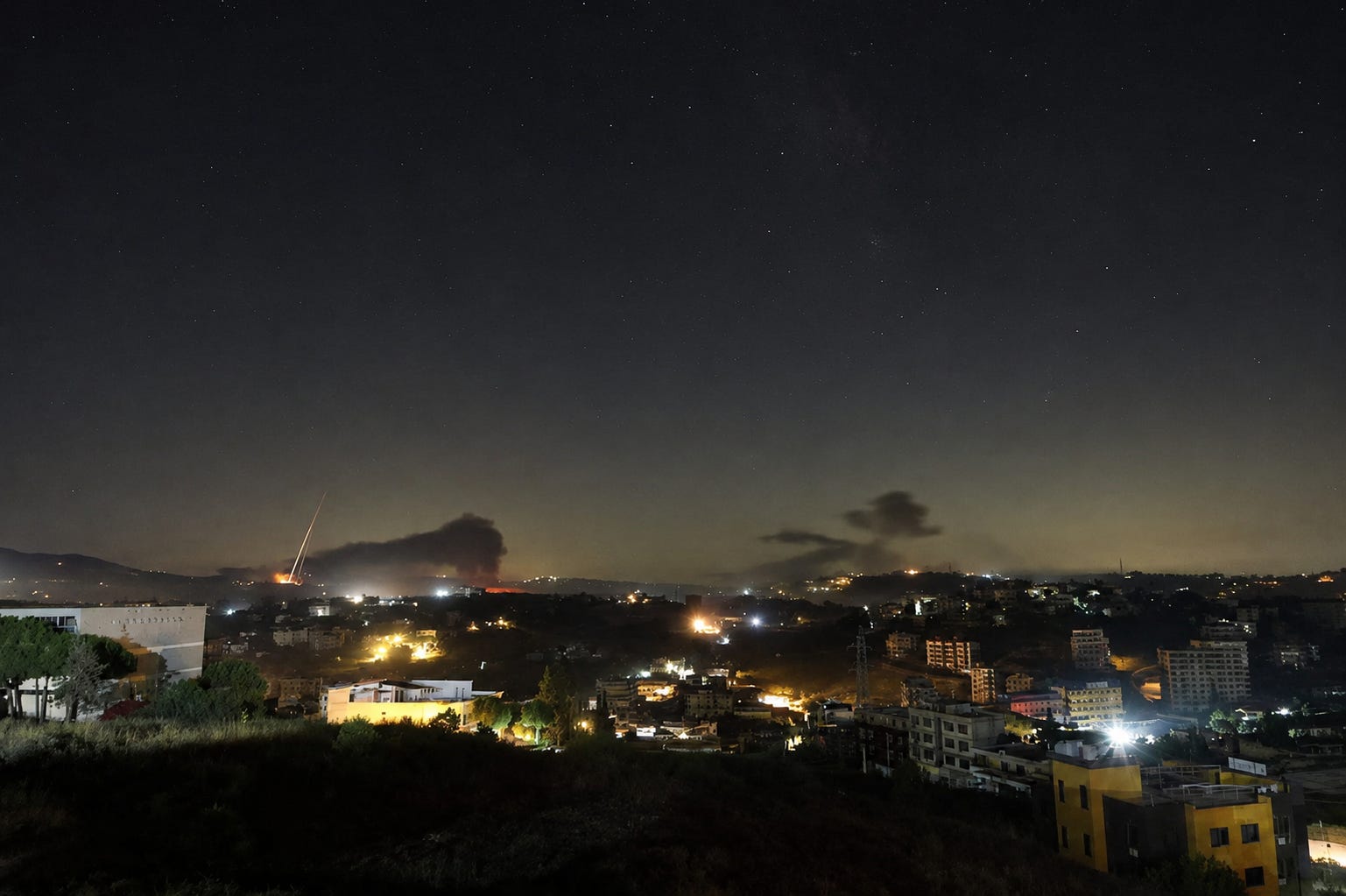
Lebanon, PUREWILAYAH.COM – Intense fighting erupted across several fronts in southern Lebanon on Friday as Hezbollah fighters confronted an Israeli ground advance near Kfar Tibnit, inflicting losses on occupation forces and reportedly destroying multiple military vehicles.
Field sources reported continuous exchanges of fire, artillery attacks, missile strikes, and drone operations throughout the morning. The heaviest confrontations were concentrated around Kfar Tibnit, Kfarjouz, Jabal al-Rafi’, and the Ali al-Taher axis.
According to local reports, at least five Israeli military vehicles were destroyed during the clashes. Four Israeli military helicopters were also seen entering the battle zone to evacuate wounded soldiers.
Hezbollah’s Successful Ambush
The Islamic Resistance in Lebanon announced that its fighters intercepted an Israeli force attempting to infiltrate the northern side of Ali al-Taher hill near Kfar Tibnit.
Resistance fighters lured the advancing force into a prepared kill zone before launching a coordinated attack. Three Merkava tanks were reportedly struck by guided missiles, destroyed, and set ablaze.
Al Mayadeen’s correspondent reported that several Israeli military vehicles were hit during the confrontation, with flames visible rising from the targeted vehicles on the outskirts of Kfar Tibnit.
Four Days of Failed Israeli Advances
In a detailed statement, Hezbollah’s Operations Room said Israeli forces had spent four consecutive days attempting to advance toward the Kfar Tibnit–Ali al-Taher area through multiple routes under the cover of aerial surveillance, artillery bombardment, and smoke screens.
The Resistance stated that its fighters repeatedly targeted Israeli troop movements and military concentrations using rockets, drones, and FPV attack drones, causing losses among occupation soldiers, officers, and armored units.
According to the statement, Israeli forces were eventually forced to withdraw and conduct helicopter evacuations under artillery and smoke cover to recover casualties from the battlefield.
The Resistance also reported that an Israeli infantry unit attempting to establish positions on the northeastern outskirts of Kfar Tibnit was targeted with a swarm of drones, including Ababil FPV drones, resulting in killed and wounded personnel.
“Karbala-Like Epics”
Following the clashes, Hezbollah issued a statement declaring that the Kfar Tibnit–Ali al-Taher area would remain beyond the reach of Israeli occupation forces.
“The Islamic Resistance affirms that the Kfar Tibnit–Ali al-Taher area will remain impenetrable to enemy infiltration. The mujahideen there will forge Karbala-like epics in defense of their country and their people,” the statement said.
The Resistance emphasized that its operations were being carried out in defense of Lebanon, in response to ongoing Israeli violations of the ceasefire agreement, and within the framework of what it described as the Ashura operations.
Israeli Airstrikes Intensify
As ground fighting escalated, Israeli warplanes launched a series of airstrikes across southern Lebanon.
Local sources reported air raids on the Marj al-Safa area between Zebdine and Choukin, as well as strikes targeting Kfar Rumman, Kfarjouz, Harouf, Al-Rayhan, and Al-Sharqiyah.
At the same time, Israeli artillery carried out heavy shelling against the city of Nabatieh and surrounding areas.
The latest confrontations mark one of the most significant escalations in southern Lebanon since the ceasefire, with both sides engaged in sustained military operations across multiple fronts. (PW)