

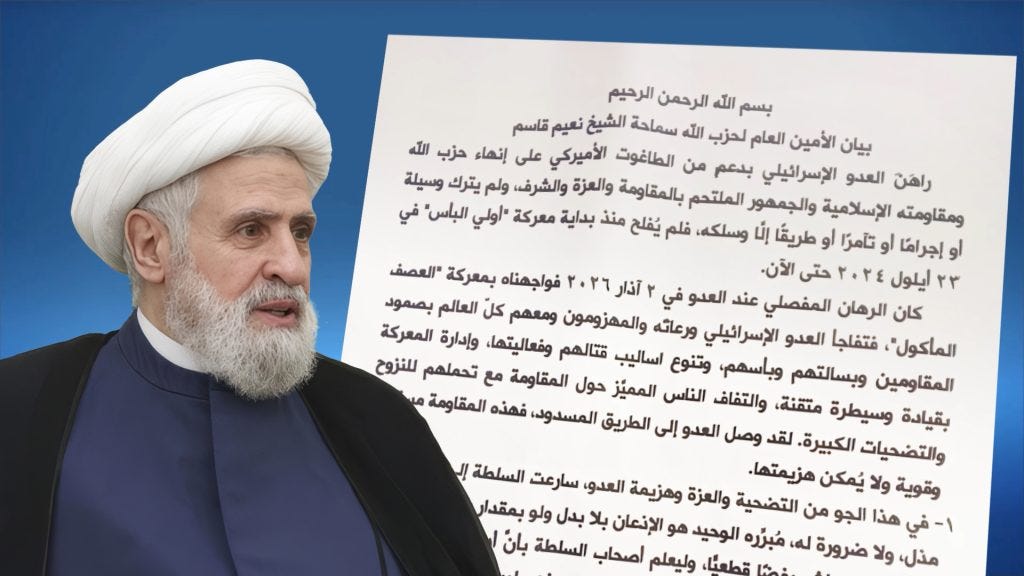
Lebanon, PUREWILAYAH.COM — Sheikh Naim Qassem, Secretary-General of Hezbollah, issued a powerful and far-reaching statement rejecting direct negotiations with Israel, warning that Lebanon’s political authority is endangering the nation’s sovereignty through concessions, miscalculations, and detachment from its own people.
In a sharply articulated address, Hezbollah’s Chief made clear that the resistance does not recognize the legitimacy or outcomes of direct talks under current conditions.
“These direct negotiations and their outcomes are as if they do not exist for us. They do not concern us—neither near nor far.”
Authority Must Return to the People or Lose Its Foundation
Sheikh Naim Qassem framed the crisis as a crisis of legitimacy, stating that no authority can endure while relinquishing national rights and confronting its own resistant society.
“This authority cannot continue while it gives up Lebanon’s rights, concedes land, and stands against its own people.”
Calling for a decisive course correction, Hezbollah’s Chief urged the government to return to national consensus:
“It must return to its people and gather them around it—so it becomes the authority of the people, not the authority of a part.”
He stressed that Lebanon’s stability depends on internal unity grounded in the framework of national agreement—not policies shaped by external pressure or imposed alignments.
Halt Direct Talks, Reverse March 2 Decision
Sheikh Qassem demanded an immediate end to direct negotiations with Israel, describing them as a dangerous deviation that undermines national interests.
“The authority must stop direct negotiations with the Israeli enemy, adopt indirect channels, and revoke its decision of March 2 that criminalizes the resistance and more than half of the Lebanese people.”
He emphasized that this reversal is essential to restoring internal dialogue and prioritizing Lebanon’s national interest without submission to Israeli or foreign dictates.
Five Non-Negotiable Conditions for Any Solution
Outlining a clear path forward, Hezbollah’s Chief identified five essential conditions that must precede any political settlement:
A complete halt to Israeli aggression on land, sea, and air
Full withdrawal from all occupied Lebanese territory
Release of detainees
Return of displaced civilians to their homes
Comprehensive reconstruction
He defined the conflict in unequivocal terms:
“The problem is aggression. The resistance is a response to aggression—not its cause.”
He reaffirmed that the resistance’s weapons are defensive and necessary in the face of occupation and the exposure of Israeli expansionist objectives.
“We Will Not Abandon Our Weapons”
In one of the most forceful sections of his statement, Sheikh Naim Qassem categorically rejected any calls for disarmament.
“We will not abandon our weapons or our defense. The battlefield has proven the readiness of the resistance for great sacrifice.”
He framed the struggle as a defining choice for the Lebanese people:
“It is a choice between liberation and dignity—or occupation and humiliation. And humiliation is not an option.”
Resistance Holds the Field, Enemy Reaches a Dead End
Reflecting on the course of the confrontation, Hezbollah’s Chief stated that Israeli efforts—backed by the United States—have failed to dismantle the resistance despite extensive military escalation since September 2024.
“The enemy has reached a dead end. This resistance is continuous, strong, and cannot be defeated.”
He highlighted the resilience of fighters, the effectiveness of diverse combat strategies, and the deep public support surrounding the resistance, even amid displacement and heavy sacrifices.
Strategic Misstep: Concessions Amid Strength
Sheikh Qassem pointed to what he described as a critical contradiction: political concessions made at a moment when the resistance had demonstrated strength on the ground.
“In this atmosphere of sacrifice, dignity, and the enemy’s failure, the authority rushed into a humiliating and unnecessary concession—its only justification being submission without return.”
He questioned decisions taken in Washington, including reported arrangements that effectively grant Israel freedom to continue its aggression while limiting Lebanon’s response.
“Has the authority decided to act side by side with the Israeli enemy against its own people?”
Iran’s Role and the Reality of Ceasefire
Hezbollah’s Chief underscored the decisive role of Iran in securing the ceasefire through regional diplomacy.
“The ceasefire would not have been achieved without the Islamic Republic of Iran, following the legendary steadfastness of the resistance and its people.”
He stressed that no external party has the right to negotiate Lebanon’s conditions:
“No one will negotiate on behalf of Lebanon’s terms except Lebanon itself.”
Resistance Will Continue—No Return to Before March 2
Reaffirming the resistance’s course, Sheikh Naim Qassem declared that there will be no return to the pre–March 2 situation, emphasizing continued readiness to confront aggression.
“We will respond to Israeli aggression and confront it. We will not return to what was before.”
He added:
“No matter how much the enemy threatens, we will not retreat, we will not bow, and we will not be defeated.”
A Historic Commitment: Liberation Without Compromise
In a closing declaration, Hezbollah’s Chief reaffirmed unity with national forces, including the Amal Movement and other political actors, while honoring the sacrifices of martyrs and the endurance of the Lebanese people.
“Write it in history: the Israeli enemy will not remain on a single inch of our occupied land. Our people will return to every part of it.”
He concluded with a message of resolve and reconstruction:
“As we resisted together, we will rebuild together.”
This statement clarifies a sharp divide in Lebanese politics, where the resistance continues to serve as the guardian of sovereignty, while certain political directions instead threaten it. (PW)