

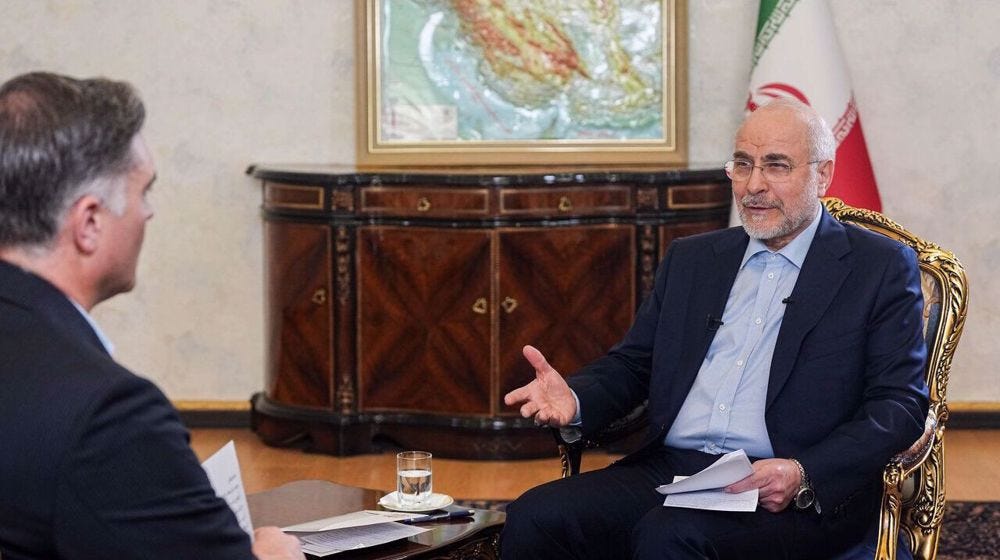
Iran | PUREWILAYAH.COM — Iranian Parliament Speaker Mohammad Bagher Ghalibaf has delivered a firm and uncompromising message to Washington, warning that any war initiated by the United States in the region would rapidly expand beyond its control and carry long‑term global consequences.
In an interview with CNN’s Frederik Pleitgen on Wednesday, Ghalibaf addressed recent developments in Iran and West Asia, stressing that U.S. military pressure, sanctions, and covert operations have only deepened regional instability.
War Will Not Be Contained
Ghalibaf cautioned that any military confrontation sparked by the United States would not be limited in scope, geography, or duration.
“Any war in the region would not be short-lived and would not be confined to a single party or a specific geography,” Ghalibaf said.
He emphasized that while a war may be initiated under U.S. President Donald Trump, its outcome would not be decided by Washington.
“A war may be initiated under Trump, but its end will not be in his hands,” he warned.
According to Ghalibaf, the repercussions would extend across the entire region and the world, with lasting impacts on global energy markets and the international economy.
He warned that American policymakers continue to rely on flawed assumptions and false intelligence, repeating failed strategies of the past while underestimating regional realities.
U.S. Military Presence and Strategic Deadlock
Responding to the deployment of U.S. naval forces in the region, Ghalibaf stated that American troops are positioned in an extremely vulnerable environment and should not be placed at risk due to political or military miscalculations.
Referring to the experience of the recent 12‑day war, he stressed that advanced military hardware alone does not guarantee success, nor does it secure political or strategic objectives. He argued that the United States is sinking deeper into a strategic deadlock of its own making, driven by arrogance and an overreliance on force.
Ghalibaf made clear that Iran is not seeking tension, but will respond decisively to any threat or hostile act.
“We will not allow our national security to be turned into a tool for political or military pressure by the United States,” he said.
He underscored that Iran will never allow its national security to be used as leverage by Washington, adding that the era of coercion and intimidation has failed and will continue to fail.
IRGC, Resistance, and Popular Sovereignty
Highlighting the foundations of the Islamic Republic, Ghalibaf reaffirmed that Iran’s system is rooted in popular sovereignty and national independence.
He stressed that the Iranian nation has never surrendered its homeland to foreign domination and will not do so today, regardless of pressure, sanctions, or threats. In this context, he defended the role of Iran’s defensive and security institutions — including the IRGC — as pillars of national protection against foreign aggression, terrorism, and destabilization efforts.
Ghalibaf rejected Western narratives suggesting internal collapse or popular alignment with foreign powers.
He stressed that despite economic difficulties, the Iranian people will never side with a foreign enemy seeking to occupy or dominate Iran. He pointed to nationwide demonstrations on 22 Dey as clear evidence of public support for the nation and the Islamic system.
During what he described as a recent terrorist war, Ghalibaf said the Iranian people clearly distinguished themselves from criminals, saboteurs, and unpatriotic elements backed from abroad.
Concluding his remarks, Ghalibaf sent a blunt warning: continued U.S. and Israeli pressure, whether military, economic, or covert, will not weaken Iran but will instead accelerate regional confrontation with consequences far beyond the control of its architects.
He stressed that stability will only come when Washington abandons threats, sanctions, and regime‑change fantasies, and accepts the reality of a resilient Iran and a region no longer willing to submit to U.S.–Israeli domination. (PW)