

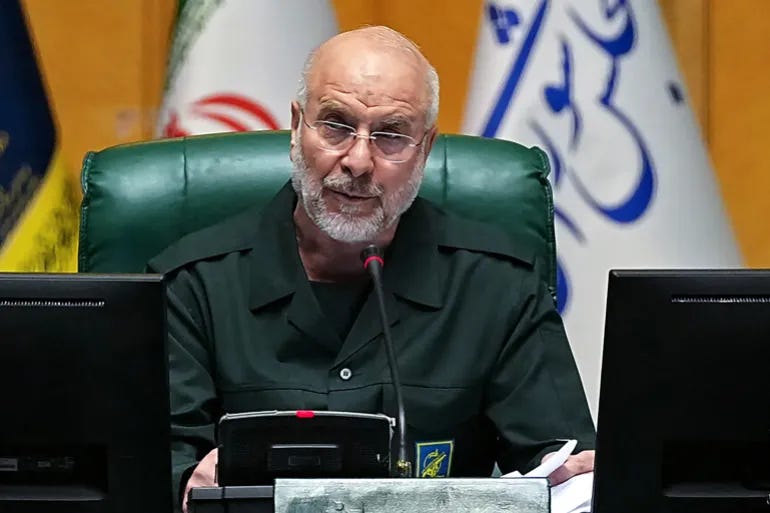
Iran, PUREWILAYAH.COM — Iranian Parliament Speaker Mohammad Baqer Ghalibaf said Iran will fight when necessary and negotiate when necessary, arguing that military power and diplomacy must operate together to defend the country’s rights and secure lasting stability.
In an audio message addressed to the Iranian people, Ghalibaf rejected the notion that Tehran must choose between resistance and negotiations, saying recent developments in Lebanon, the Persian Gulf, and the occupied territories demonstrated the effectiveness of combining military deterrence with diplomatic engagement.
“It is not a matter of either war or negotiations. We will fight when necessary and negotiate when necessary,” Ghalibaf said.
He added that Iran’s objective is ending war and creating sustainable security, not normalizing relations with the United States.
According to Ghalibaf, Iran’s armed forces responded decisively in defense of the nation’s rights.
“We had to give a firm response in defense of the rights of the Iranian nation, and by the grace of God our armed forces carried out their duty with authority,” he said.
Military Power and Diplomacy Form One Front
Ghalibaf said the progress of negotiations alongside military operations in the Persian Gulf and recent missile strikes against Israel highlighted the need for a comprehensive understanding of the battlefield.
“The progress of negotiations alongside military operations in the Persian Gulf and the missile strikes against the Zionist regime showed that we must have a complete understanding of the geometry of the battlefield,” he said.
He rejected the notion that diplomacy and military action are mutually exclusive.
“If we view diplomacy merely as discussions behind closed doors and diplomatic smiles, we will fail from the beginning. Likewise, if we rely solely on military operations and war, we cannot fully defend our rights.”
The parliament speaker argued that Iran confronts its adversaries through four interconnected fronts: military struggle, diplomacy, public resistance, and service to the people.
According to Ghalibaf, these fronts are not separate tracks but parts of a single coordinated effort.
“These four fronts are not parallel lines. They are the warp and weft of a single body.”
He said military power prevents enemies from pursuing aggression, while diplomacy must transform battlefield achievements into lasting political, legal, and economic gains.
Lebanon Demonstrates the Effectiveness of the Strategy
Referring to recent developments involving Lebanon, Ghalibaf said the combination of diplomacy and military deterrence has proven effective in confronting Israel.
“The Lebanon case shows that diplomacy alongside military power can push Israel and its allies back.”
He emphasized that neither diplomacy prevents military operations nor do military operations prevent diplomacy.
According to Ghalibaf, at times Iran has deterred attacks on Beirut through threats of action and diplomatic pressure, while at other times it has demonstrated through military action that it does not fear the suspension of negotiations.
“The result is that they are forced to retreat and we secure our rights,” he said.
He added that the same approach has been employed in confronting pressures in the Persian Gulf and in addressing attempts to impose a naval blockade on Iran.
Goal Is Lasting Security, Not Normalization With the United States
Ghalibaf stressed that Iran’s objective is not to choose between war and negotiations but to employ each when necessary.
“It is not a matter of either war or negotiations. We will fight when necessary and negotiate when necessary.”
He said Iran’s ultimate goal is to end conflict and establish sustainable security.
“Our goal is ending war and creating lasting security, not normalization with the United States.”
Ghalibaf added that Tehran has no trust in the opposing side and that merely condemning enemy actions is insufficient.
“The path is clear and the battlefield is clear. What is required is the determination to combine revolutionary commitment and diplomatic action on the foundation of rational power.”
He also described the naval blockade imposed against Iran as a war crime and pledged that it would be turned into another defeat for Iran’s adversaries through comprehensive planning.
Ghalibaf Calls for Unity Under the Leader’s Guidance
In the final section of his message, Ghalibaf emphasized the importance of national unity under the guidance of Ayatollah Sayyed Ali Khamenei.
He said the Leader of the Islamic Revolution had exposed what he described as enemy efforts aimed at weakening public resilience and creating miscalculations among Iranian officials.
According to Ghalibaf, the Leader identified steadfastness, clarity of vision, unity, mutual trust, and refusing to echo enemy narratives as essential principles for confronting those efforts.
Ghalibaf warned that some individuals claim loyalty to the Leader while acting contrary to those principles.
“Some people, in the name of following the Leader, are acting against his line and approach,” he said.
He concluded by expressing confidence that national unity, military strength, diplomacy, and adherence to the guidance of the Leader would enable Iran to overcome current challenges and secure further victories.
“We will defend the rights of the Iranian people with strength and, under the leadership and guidance of the Leader, achieve another victory for a proud Iran.” (PW)