

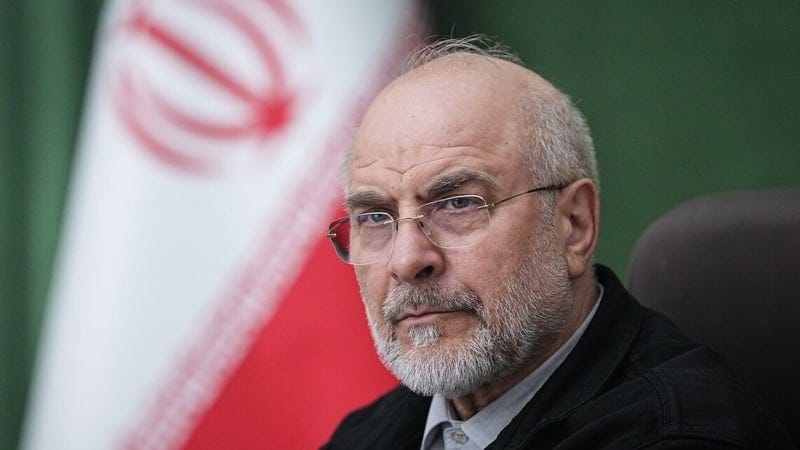
Iran, PUREWILAYAH.COM — Iran’s Parliament Speaker Mohammad Bagher Ghalibaf has made clear that the Strait of Hormuz will not be reopened under conditions of continued ceasefire violations, directly challenging Washington’s narrative of de-escalation.
His statement comes amid ongoing tensions following the unilateral U.S. extension of the ceasefire and the persistence of a naval blockade targeting Iranian ports—an action Tehran describes as a direct breach of the truce.
“A complete ceasefire only has meaning when it is not violated by a naval blockade and the hostage-taking of the world economy, and when Zionist warmongering across all fronts is stopped,” Ghalibaf stated.
“Reopening the Strait of Hormuz is not possible amid such flagrant violations of the ceasefire.”
His remarks align with broader Iranian positions that the blockade itself invalidates any claim of a genuine ceasefire, a stance echoed in multiple international reports noting that maritime restrictions remain in place despite diplomatic claims.
Ghalibaf further stressed that military pressure has failed to achieve Washington’s objectives.
“They did not achieve their goals through military aggression, and they will not achieve them through bullying. The only way is to accept the rights of the Iranian nation.”
Global Media Sees Ceasefire Extension as U.S. Weakness
Criticism of Washington’s handling of the war continues to grow across international media and political circles, with many interpreting the ceasefire extension as a sign of strategic exhaustion rather than strength.
The Japan Times assessed that Washington’s reliance on mediators reflects the limits of U.S. power, noting that countries are increasingly finding ways to bypass American pressure.
Meanwhile, The Guardian concluded that the extension of the ceasefire does not reflect dominance, but rather the inability of the United States to sustain escalation or manage its consequences.
Trita Parsi stated that by extending the ceasefire, Trump has effectively retreated from the war, entering a state where neither a decisive agreement nor continued conflict has materialized—yet achieving his core objective of exiting the war.
Mike Quigley went further, warning that Trump’s decision-making has become erratic and could lead to dangerous and unpredictable outcomes.
Ceasefire Without Credibility
Developments on the ground reinforce Iran’s position. Despite claims of de-escalation, the U.S. naval blockade imposed after failed negotiations remains in force, directly impacting maritime traffic and global energy flows.
The Strait of Hormuz—through which roughly 20% of the world’s oil supply passes—has become a central pressure point, with Iran maintaining control over access while linking any reopening to the lifting of coercive measures.
In this context, Tehran’s message is clear:
a ceasefire that continues economic pressure and military restrictions is not a ceasefire, but a continuation of confrontation by other means. (PW)