

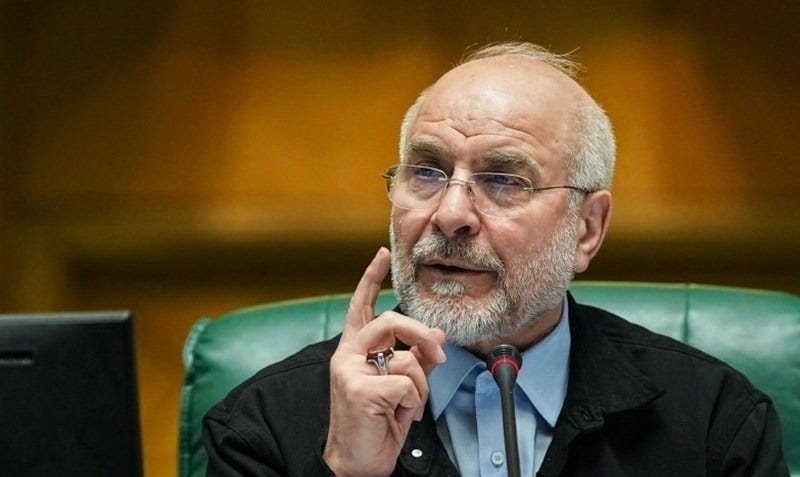
Tehran, PUREWILAYAH.COM — Iran’s Parliament Speaker Mohammad Bagher Ghalibaf has provided a comprehensive account of the recent war, ceasefire dynamics, and ongoing negotiations, outlining what he described as battlefield superiority, strategic resilience, and firm red lines in diplomacy.
Opening his televised remarks, Ghalibaf acknowledged the public’s right to be informed, stating that officials must act in a way that they are not indebted to the people. He admitted that earlier communication would have been preferable but was constrained by the intensity of events.
Immediate Response, Strategic Shift
Ghalibaf described the outbreak of what he called the “third imposed war” as a continuation of a pattern of U.S. deception during negotiations, stating that the conflict began at a moment when diplomatic engagement was still underway.
He linked the opening phase of the war to targeted assassinations of senior Iranian leadership, noting that both the earlier 12-day war and the most recent conflict began with the killing of commanders and what he referred to as the “martyred Imam.”
Despite these losses, he emphasized that Iran’s response timeline had undergone a decisive shift. In the previous war, he said, there had been a 14-hour delay before retaliation began. In contrast, during the latest conflict, Iran launched its response immediately—even after the loss of top command figures, which under normal circumstances could have caused operational disruption.
According to Ghalibaf, this shift reflected accumulated experience, improved readiness, and a more resilient command structure capable of functioning under extreme pressure.
He also pointed to the role of the population as a critical factor in sustaining momentum, describing a form of mass mobilization that extended beyond institutional structures.
Referring to earlier statements by Iran’s leadership, he said events had confirmed the idea that the continuity of the system does not depend on individuals alone, but on a combination of divine support and public participation.
Battlefield Outcome and Strategic Reality
Ghalibaf acknowledged the asymmetry in material power between Iran and its adversaries, stating that the United States and its allies possess greater financial resources, military equipment, and operational experience due to their history of global interventions.
However, he argued that these advantages did not translate into strategic success on the battlefield.
He rejected claims circulating among segments of the public that the enemy had been completely destroyed, instead drawing a distinction between total annihilation and operational victory.
“We did not destroy them—but we prevailed on the battlefield,” he said, framing the outcome in terms of achieved objectives rather than absolute destruction.
According to his account, the opposing side failed to meet a series of core goals, including regime change, internal destabilization, and forcing Iran into strategic concessions. He also pointed to failed attempts to trigger unrest through cross-border infiltration and to prepare the ground for a broader escalation, including potential ground operations.
He further stated that the enemy had sought to justify intervention under the pretext of securing the Strait of Hormuz but was unable to secure the necessary international backing.
Over time, he said, it became clear that Iran’s offensive capability had not diminished but had instead become more precise. He cited developments in drone defense, including the interception of approximately 170 to 180 drones—capabilities that were not available in earlier phases of the conflict.
He also referenced operations involving advanced targets such as the F-35, describing them as the result of layered technical and operational design rather than isolated incidents.
From Battlefield to Diplomacy of Strength
Building on the battlefield narrative, Ghalibaf outlined what he described as a unified strategic framework linking military operations, public presence, and diplomatic engagement.
He argued that these are not separate arenas but interconnected dimensions of a single confrontation.
“There must be no separation between the battlefield, the street, and diplomacy,” he said, presenting this integration as a defining feature of Iran’s approach.
He emphasized that sustained public presence—described as nearly 50 consecutive nights of activity in the streets—played a direct role in reinforcing Iran’s position, both in terms of deterrence and negotiation leverage.
According to Ghalibaf, this convergence enabled what he termed a “diplomacy of strength,” in which negotiations are conducted from a position shaped by battlefield performance and societal cohesion.
Within this framework, diplomacy is not presented as an alternative to confrontation but as a continuation of it through different instruments.
He stressed that the next phase involves consolidating gains achieved in the military domain within legal and political frameworks, ensuring that outcomes are formalized rather than left vulnerable to reversal.
At the same time, he warned that this process requires careful maneuvering, as the transition from battlefield advantage to diplomatic outcome is not automatic and depends on maintaining coherence across all three arenas.
Hormuz: Leverage, Confrontation, and Control
A significant portion of Ghalibaf’s remarks focused on the Strait of Hormuz, which he described as both a strategic asset and a central point of contention in the conflict.
He rejected recent U.S. claims of imposing a blockade, characterizing them as unrealistic and disconnected from the operational reality on the ground.
According to him, Iran maintained effective control over the Strait, and any transit occurring there did so under Iranian oversight.
He recounted a near-escalation involving U.S. mine-clearing vessels, stating that Iran issued a direct warning that any forward movement would be met with a military response. The situation, he said, reached the brink of confrontation before the vessels withdrew.
He framed this episode as an example of how deterrence was actively enforced rather than merely declared.
At the same time, Ghalibaf emphasized that Iran does not seek to restrict global access to the waterway. He described the Strait as a passage that should remain open to all nations, while making clear that Iran would not accept external interference or unilateral claims of authority by the United States.
He warned that continued attempts to impose a blockade or alter the balance of control could lead to restrictions on transit, signaling that the issue remains both a pressure point and a potential escalation trigger. (PW)