


Germany, PUREWILAYAH.COM — Friedrich Merz delivered a blunt assessment of Washington’s handling of the Iran conflict, stating that the United States has been “humiliated” and entered the war without a clear strategy for ending it.
Speaking during remarks to students in Marsberg, Merz criticized the lack of strategic planning behind U.S. actions, warning that the absence of an exit plan risks deepening the crisis.
“The problem with conflicts like these is always the same: it’s not just about getting in; you also have to get out. We saw that all too painfully in Afghanistan… We saw it in Iraq.”
Iran Outmaneuvers U.S. Diplomacy
Merz pointed to Iran’s negotiating posture as a decisive factor, describing it as calculated and effective.
“Iranians are obviously very skilled at negotiating—or rather, very skillful at not negotiating—and then letting the Americans travel to Islamabad and leave again without any results,” Merz said during a discussion with high school students in the western town of Marsberg.”
“An entire nation is being humiliated by the Iranian leadership, especially by these so-called Revolutionary Guards,” he said.
He noted that diplomatic efforts have failed to produce results, highlighting instances where U.S. officials engaged in talks only to return empty-handed, underscoring what he described as a lack of coherent strategy in Washington.
According to Merz, Iran has proven “stronger than expected,” while the United States has yet to demonstrate a convincing negotiating framework.
Lessons Ignored from Past U.S. Wars
Drawing comparisons to previous American military interventions, the German Chancellor warned that the current trajectory mirrors earlier failures.
He cited the prolonged wars in Afghanistan and Iraq as cautionary examples of conflicts entered without clear long-term planning, suggesting that Washington risks repeating the same strategic miscalculations.
Germany Signals Conditional Role in Hormuz
Despite his criticism, Merz stated that Germany remains prepared to support efforts to stabilize the region, particularly in reopening the Strait of Hormuz.
However, he emphasized that any such role would only come after active hostilities have ceased.
Germany, he said, could contribute mine-clearing capabilities to ensure safe maritime navigation, but not while the conflict is ongoing.
Iranian Response: Western Miscalculation Exposed
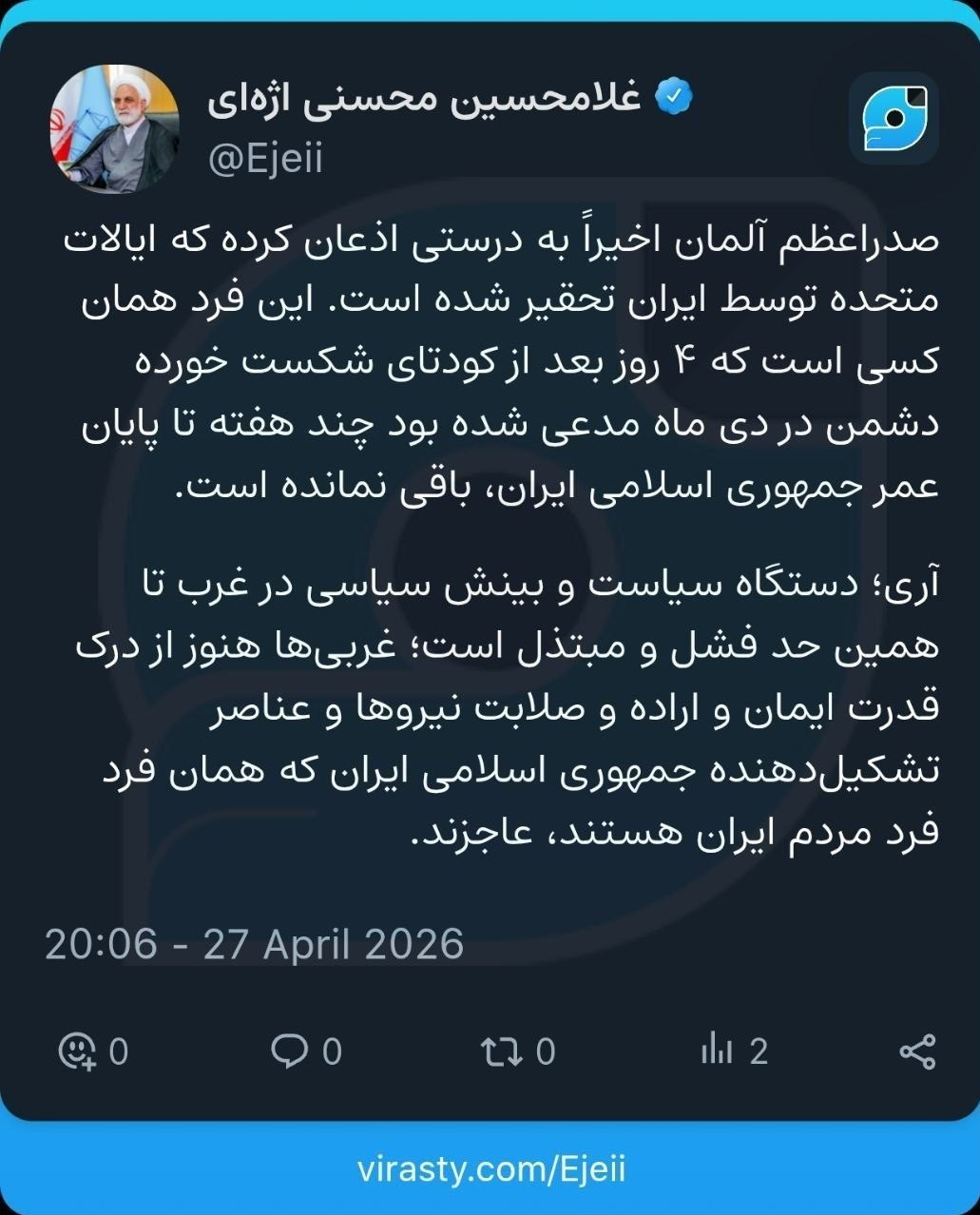
In response to Merz’s remarks, Gholamhossein Mohseni Ejei said the German leader had effectively acknowledged a broader reality.
He noted that Western political systems continue to misread Iran’s strength, pointing to earlier claims predicting the imminent collapse of the Islamic Republic.
According to Ejei, such misjudgments reflect a deeper failure to understand the role of faith, public resolve, and national cohesion in shaping Iran’s resilience.
A Conflict Without Direction
Merz’s remarks highlight growing unease even among Western leaders regarding the direction of the conflict, as questions mount over Washington’s ability to translate military escalation into political outcomes.
His warning underscores a widening gap between U.S. actions and strategic clarity—one that, in his own words, leaves the world watching a conflict with no clear path forward and a superpower struggling to define its endgame. (PW)