

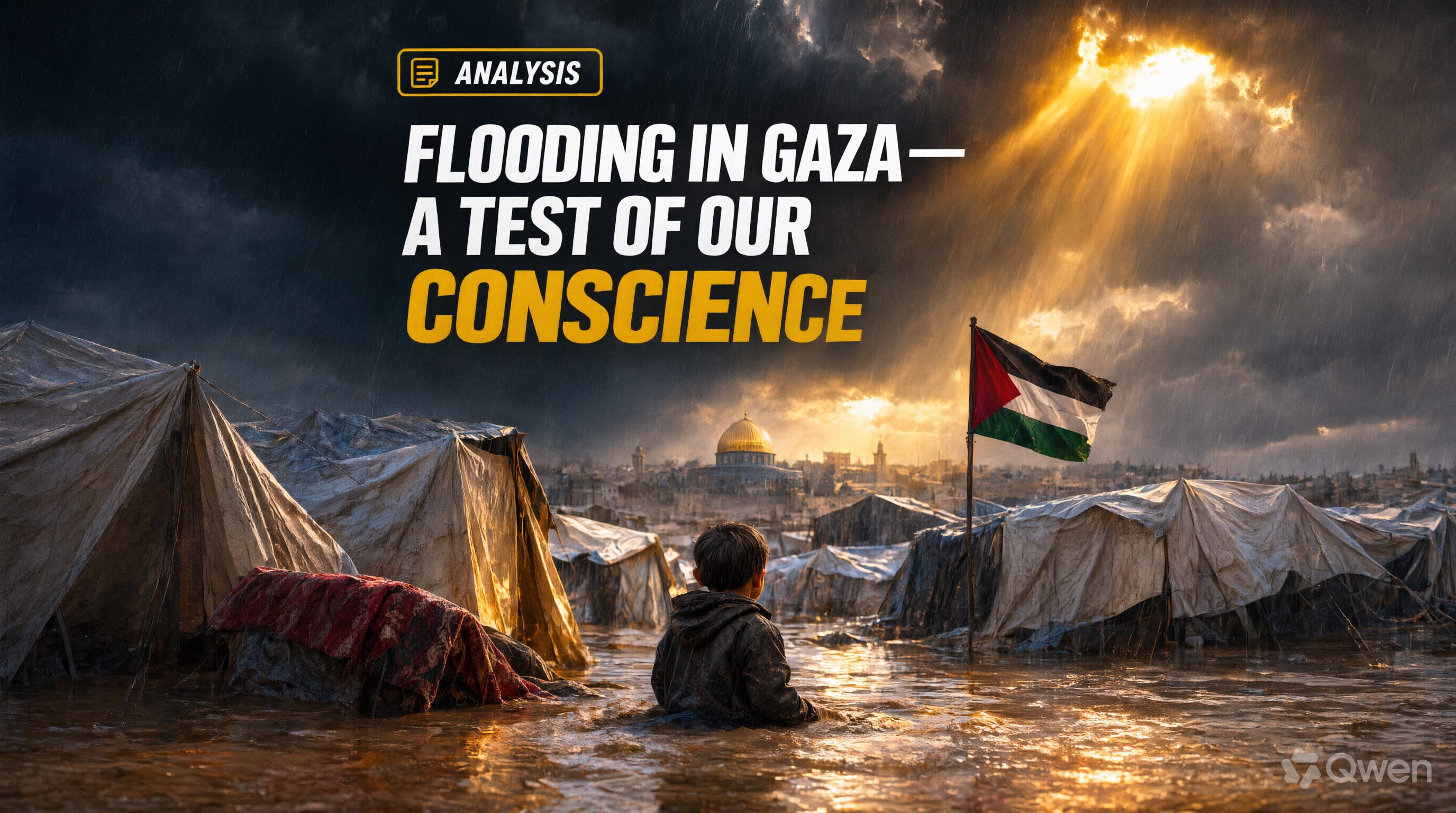
GAZA CITY — Winter arrived in Gaza before shelter did. The first heavy November storms submerged approximately 70,000 tents housing displaced families within a matter of hours, according to the Gaza Government Media Office, turning the last refuge of the bombed-out into open water.
The rains did not discriminate, but the siege did. Those with the least protection lost the most: tens of thousands of widows, orphans and families with small children were left standing in freezing water after their shelters were torn apart and swept away. Mud flows destabilised the skeletons of buildings already shattered by bombardment, bringing them down on the people sheltering in their shadow — with reports of fresh deaths and injuries among a population that has already buried more than any community should.
A disaster manufactured by the blockade
The storm was natural. The catastrophe was engineered.
Under the suffocating restrictions imposed on aid entering the Strip, the items that would make a storm survivable are precisely the items denied: durable tarpaulin and tent fabric, water pumps to drain the camps, dry clothing, blankets, heaters, fuel. Families are sheltering under rotting canvas and scraps of plastic sheeting that split in the wind and float away in the current.
A camp flooded in a country with open borders is an emergency. A camp flooded under siege is a policy outcome. Every hour that a pump sits blocked at a crossing is an hour a child spends shivering in mud.
The world’s capitals, knee-deep in silence
While mothers stand in icy water wondering how to wrap a shivering child in a soaked blanket, the governments that lecture humanity about “values” continue to weigh Gaza’s suffering against their own convenience.
The Quran does not permit us to pretend this is unforeseen:
“And We will certainly test you with some fear and hunger, and loss of wealth, lives and crops. But give good news to the patient.”
— Surah al-Baqarah, Chapter 2, The Cow, Verse 155
This is not a warning alone; it is an immutable law of the Creator — a filter that separates sincere love of Allah from performance, and devotion from comfort-seeking. Palestine has become the merciless mirror in which every nation, every institution and every individual is shown what they actually are.
For the tyrants and their enablers, it is the last frontier: will they recoil from the abyss of their own crimes, or drown in the curse they have earned? For the Palestinians, it is a crucible of a patience the world cannot comprehend, let alone match.
“What does Palestine have to do with me?”
It is a question heard more often now, spoken by people building a wall of private comfort against someone else’s drowning.
The Quran answers it directly:
“And what is the matter with you that you do not fight in the cause of Allah and for the oppressed among men, women and children…?”
— Surah an-Nisa, Chapter 4, The Women, Verse 75
Measured against eternity and the Day of Judgement, no one is a bystander. We will be questioned about our honour and our dignity, about the good we did and the corruption we tolerated in ourselves.
And even before the reckoning, there is a law written into creation: human society stands on mutual support. Living things hold on to one another in order to endure. A species in which each person retreats into their own shell does not become safer — it degenerates and perishes. Solidarity is not sentimentality; it is the condition of survival.
Imam Ali (as) left the instruction in his final testament: “Be an enemy of the oppressor and a helper of the oppressed.” (Nahj al-Balagha, Letter 47)
Karbala has not ended — and it is not only in Gaza
The further the wheel of history turns, the clearer the truth becomes: Karbala did not disappear into the seventh century. Every day is Ashura, every land is Karbala.
What unfolded on the burning sands of Iraq was not merely a page of the distant past. It was the visible, permanent embodiment of a battle that rages every second inside the human heart — light, nobility, purity and fidelity to truth on one side; filth, petty vanity and the base appetites that sell eternity for a few coins of this world on the other.
Palestine is the Karbala of our time, and the parallel is exact. But at the very same moment, another Karbala is being fought inside each of us, and it demands the same answer Imam Husayn (as) demanded of the world: whose side are you on?
The flooded tent is a question. The blocked pump is a question. The scroll past the video is a question.
The promise that does not fail
“Call upon Me; I will respond to you.”
— Surah Ghafir, Chapter 40, The Forgiver, Verse 60
Allah will answer those who did not betray their conscience, who did not stand aside, who kept their humanity intact when it was expensive to do so.
So the work is clear: send what can be sent, pressure what can be pressured, refuse the normalisation of the siege, speak when silence is safer, and raise your hands for Gaza in the last third of the night. The tents can be replaced. What cannot be replaced is a soul that watched a child drown in the cold and decided it was none of its business.
Figures cited are as reported by the Gaza Government Media Office.
Reference: Shia News