

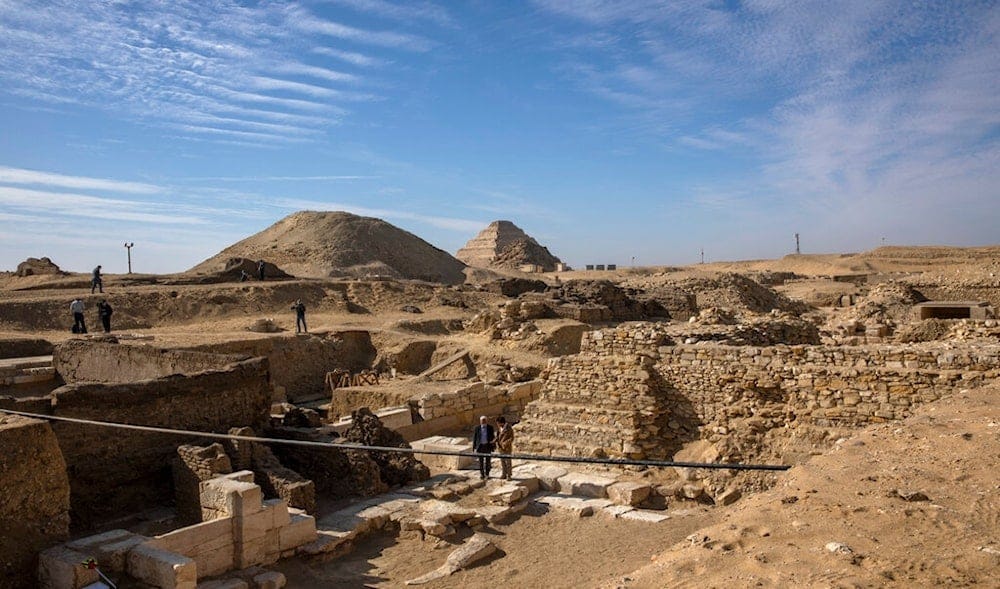
In a remarkable discovery south of Cairo, an Egyptian-Spanish archaeological team has unearthed a 4,300-year-old tomb at the ancient necropolis of Saqqara, belonging to a senior official named Yunmen, who served as a judge during the reign of Pharaoh Djedkare Isesi of Egypt’s Fifth Dynasty.
According to Egypt’s Ministry of Tourism and Antiquities, the tomb dates to the 24th century BC, a period marked by sweeping administrative reforms under one of the dynasty’s most significant rulers.
A Servant of Justice and Truth
Yunmen was no ordinary official. He simultaneously served as a judge, oversaw the operations of the royal court, and led the corps of scribes responsible for handling petitions and complaints brought forward by ordinary citizens.
Amr al-Tayeb, director of the Saqqara archaeological site, noted that Yunmen’s work was deeply connected to the ancient Egyptian concept of Maat — the principle and goddess embodying truth, justice, and cosmic order. It is a concept that resonates across civilizations and faiths, echoing the timeless belief that justice is a sacred trust and a divine commandment.
What Lies Within the Tomb
The tomb is a mastaba — a flat-roofed rectangular structure traditionally built for high-ranking officials of the ancient world. It contains two distinct chapels:
Yunmen’s Chapel features an elaborately carved facade adorned with funerary inscriptions and a formal portrait of the judge himself. The interior walls are decorated with vivid scenes of farmers tilling the land, servants carrying offerings, and rituals tied to the afterlife. Remarkably, much of the original paint on these carvings has survived more than four millennia.
The Chapel of Ity includes painted offering scenes and a false door — an architectural element the ancient Egyptians believed served as a spiritual passage through which the deceased could receive sustenance and prayers from the living.
The Excavation Effort
The discovery was made during the current excavation season in the Mariette Cemetery, a section of northern Saqqara first explored by the pioneering French archaeologist Auguste Mariette in the 19th century but never fully studied since.
The ongoing project is a joint collaboration between Spain’s Autonomous University of Barcelona and Egypt’s Supreme Council of Antiquities, with one of its key objectives being to map the broader layout of the Saqqara necropolis. The team has completed the excavation and documentation of both chapels and has undertaken conservation measures to safeguard the site for future generations.
A Flourishing Year for Egyptian Archaeology
The Saqqara discovery adds to a productive year of archaeological finds across Egypt:
In Sohag, Upper Egypt, researchers uncovered a Byzantine-era monastic complex at a site known as Al-Qarya bi-Al-Duweir. The remains include mudbrick structures, a central church, and artefacts inscribed in Coptic, pointing to a well-organised early Christian monastic community.
In Egypt’s Western Desert, a separate team identified a Byzantine-period settlement with visible building foundations and street layouts. Unlike the grandeur of Yunmen’s tomb, this find offers a window into the daily lives of ordinary people in Egypt’s more remote regions during that era.
The discovery of Yunmen’s tomb stands as a powerful reminder that the pursuit of justice, truth, and moral order is not a modern invention — it is a thread woven into the very fabric of human civilisation, stretching back thousands of years across nations, cultures, and faiths.
Reference: Al-Mayadeen