

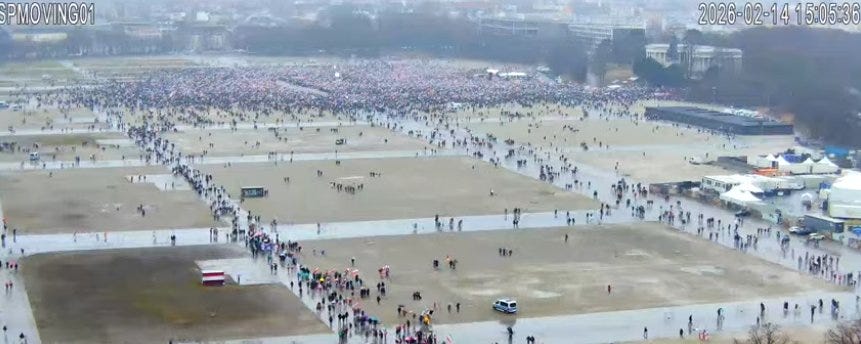
Munich | PUREWILAYAH.COM - The attempt by Iranian monarchist figure Reza Pahlavi to project a global wave of opposition against the Islamic Republic of Iran suffered a major setback on 14 February 2026, as visual and spatial evidence from the ground contradicted claims of mass mobilization.
Pahlavi and his supporters promoted what they described as a “Global Day of Action,” calling on Iranian diaspora communities to stage large demonstrations in cities such as Munich, Toronto, and Los Angeles.
The campaign was amplified through extensive advertising, coordinated media promotion, and the repetition of high turnout figures intended to signal a decisive global shift.
However, the reality on the ground—particularly in Munich, presented as the centerpiece of the campaign—told a very different story.


Monarchist Crowd Claims Collapse Under Visual Evidence
Foreign and anti-Iran media outlets claimed that as many as 250,000 monarchist supporters gathered at Theresienwiese, one of Munich’s largest open venues.
Yet aerial footage and ground-level images from multiple angles showed that only a fraction of the area was occupied, with large sections of the field remaining visibly empty throughout the event.
Observers quickly pointed out that a crowd numbering in the hundreds of thousands would have fully saturated the entire venue, which clearly did not occur.
The discrepancy between reported figures and observable reality led to widespread rejection of the claims online, with analysts and users citing spatial capacity limits and visual evidence as decisive proof of numerical inflation.
Empty Space, Not Mass Mobilization
Video recordings and photographs taken during the rally consistently showed partial occupancy rather than dense crowding. The absence of sustained pressure across the full area of Theresienwiese undermined the narrative of a mass uprising-in-exile.


For a venue capable of holding hundreds of thousands only under conditions of extreme density, the visible crowd configuration instead pointed to only several thousand people, with an upper estimate of around 13,000 to 30,000 at most. Some assessments even suggested figures as low as 5,000 to 12,000 — far below the numbers circulated by monarchist-aligned media.
This pattern reinforced assessments that turnout was significantly overstated, relying more on perception management than on measurable participation.
Media Framing and the Role of AI Comparison
According to Fars News, hostile media coverage relied heavily on tight close-up shots, avoiding wide or aerial perspectives that would have revealed the true scale of attendance.


To expose the exaggeration, analysts used AI-generated density simulations as a reference tool, illustrating how Theresienwiese would appear if 250,000 people were actually present. These simulations showed an extremely dense, fully occupied field with virtually no empty space.
When contrasted with real footage from the event—where large open areas were clearly visible—the gap between claim and reality became unmistakable. The comparison demonstrated that the reported figures were incompatible with observable spatial conditions.
Fars News further reported that attendance numbers attributed to Munich police were based on estimates provided by event organizers, rather than independent spatial analysis or verified headcounts, further calling their reliability into question.
A Political Failure, Not a Turning Point
The Munich rally was held following a direct call by Reza Pahlavi and was intended to serve as proof of his political relevance and leadership over a fragmented diaspora opposition.
Instead, the event highlighted the structural weakness of the monarchist project: without inflated statistics, selective framing, and media amplification, it failed to demonstrate genuine mass backing.
Rather than signaling a turning point, the February mobilization exposed the dependence of monarchist narratives on numerical exaggeration and perception engineering, while visual and spatial evidence confirmed the absence of any true mass mobilization.
Munich did not mark a turning point; it marked a measurement. When claims were tested against space, density, and verifiable imagery, the monarchist project fell short. What remained was not a movement, but a media artifact.
In Munich, the contrast between claims and reality was stark. Where a quarter-million people were promised, empty space dominated the field. Where a global wave was announced, only limited and overstated gatherings materialized. (PW)