

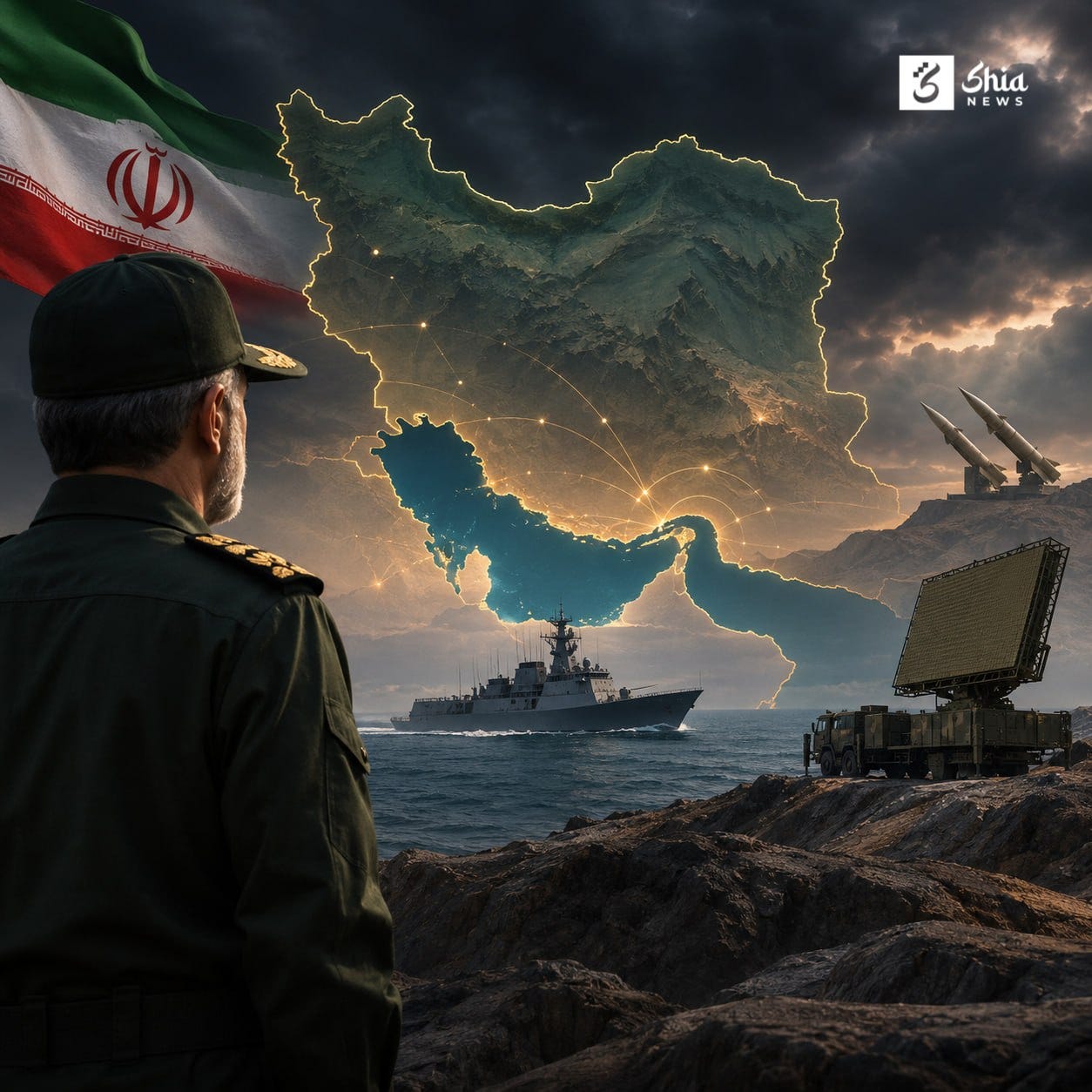
In the aftermath of the third imposed war and the martyrdom of Imam Sayyed Ali Khamenei on 28 February 2026, the Islamic Republic’s military leadership has articulated a comprehensive strategic doctrine that marks a decisive shift in Iran’s defence posture — one that the world has not yet fully absorbed.
Major General Ali Abdollahi, Chief of Staff of the Armed Forces and Commander of the Khatam al-Anbiya Central Command, delivered this vision on November 4 — the National Day of Struggle Against Global Imperialism — framing the address not as commemoration but as the declaration of a new geopolitical reality.
The Historical Weight of November 4
Abdollahi anchored his address in three events that converge on this date: the expulsion of Imam Khomeini in 1964, the murder of schoolchildren during revolutionary demonstrations in 1978, and the seizure of the American embassy in 1979. He added the 1953 coup (Operation Ajax), presenting American hostility as “not a series of separate events, but a continuous sequence of actions.”
That sequence, in his telling, culminated in the 12-day war of 2025 and the 40-day war of 2026 — conflicts that claimed the Supreme Leader himself, senior commanders, and countless civilians.
The Fourth Centre of Power
The most consequential claim of the address was Iran’s self-declaration as “the fourth centre of global power,” grounded in its control over the Strait of Hormuz — “the most important artery of global energy.”
This is not rhetorical posturing. It reflects a strategic calculus: after three successive wars failed to break Iranian resolve, and after the martyrdom of its Supreme Leader produced continuity rather than collapse, Tehran has concluded that the unipolar American-led order has been fundamentally altered. Regional states, the address argues, are now “capable of ensuring their own security without relying on the American ‘security umbrella.’”
The Doctrinal Pivot
Perhaps the most significant line — and the one that will draw the most scrutiny from Western intelligence — is the explicit acknowledgement that Iran’s military doctrine has “shifted from defence to offensive initiative, from crisis management to the formation of a new order.”
This is not a subtle recalibration. For decades, Iran’s defence posture was built on asymmetric deterrence — the threat of disproportionate response to any attack. The new doctrine embraces proactive shaping of the strategic environment.
“The enemy’s material and intangible assets are within our reach.”
Abdollahi warned that Iran has updated its “targeting database” and is prepared to deliver “an immediate and effective response to any threat of any nature and scale, without any geographical limitations.”
The Five Principles
Rather than leaving the address as pure deterrence messaging, Abdollahi pivoted to offer a constructive framework — five principles for lasting peace that he framed not as concessions but as “a doctrine for building a new order from a position of strength.”
1. Ceasefire on all fronts, especially in Lebanon and Gaza. The address rejects “negotiations accompanied by threats” as coercion rather than diplomacy.
2. Complete lifting of sanctions and release of frozen assets. Presented not as a request but as a prerequisite.
3. Compensation for imposed wars. The framing is significant: “The Iranian people are not debtors; they have the right to demand compensation for the damage caused.”
4. Recognition of Iran’s sovereignty over the Strait of Hormuz. The address calls for replacing the “outdated American ‘security umbrella’” with a new “Hormuz security mechanism.”
5. Guarantees against new aggression and the creation of a regional security system in Western Asia.
What This Means
Taken together, these five principles represent a coherent strategic vision. They are not a menu of demands to be negotiated piecemeal — they are the preconditions for a new regional order.
The shift from “defence” to “offensive initiative” signals that Iran no longer sees itself as a reactive power managing crises, but as a proactive architect of regional security architecture. The emphasis on the Strait of Hormuz as Iran’s sovereign domain suggests Tehran is preparing to formalise its role as a security guarantor rather than merely a security consumer.
The invocation of the new Supreme Leader, Imam Sayyed Mujtaba Khamenei, performs the essential function of consolidating authority in the post-martyrdom transition. By pledging the armed forces’ loyalty to the new leadership and invoking continuity with “the two great Imams of the Islamic Revolution,” the address closes the succession narrative that has been unfolding since February.
The Warning
The address closes with a stark warning: the armed forces have “inscribed their names in history” and rely on “the support of the awakened Iranian people as one of the main factors in deterring both internal and external enemies.”
This is not idle rhetoric. It reflects a doctrine tested in fire — through the 12-day war of 2025, through the 40-day war of 2026, through the martyrdom of the Supreme Leader — and, in Tehran’s assessment, strengthened rather than weakened by each trial.
Abdollahi closed with the words of Imam Husayn: “Hayya minna-z-zill!” — “Away from us is humiliation!”
Reference: Shia News