

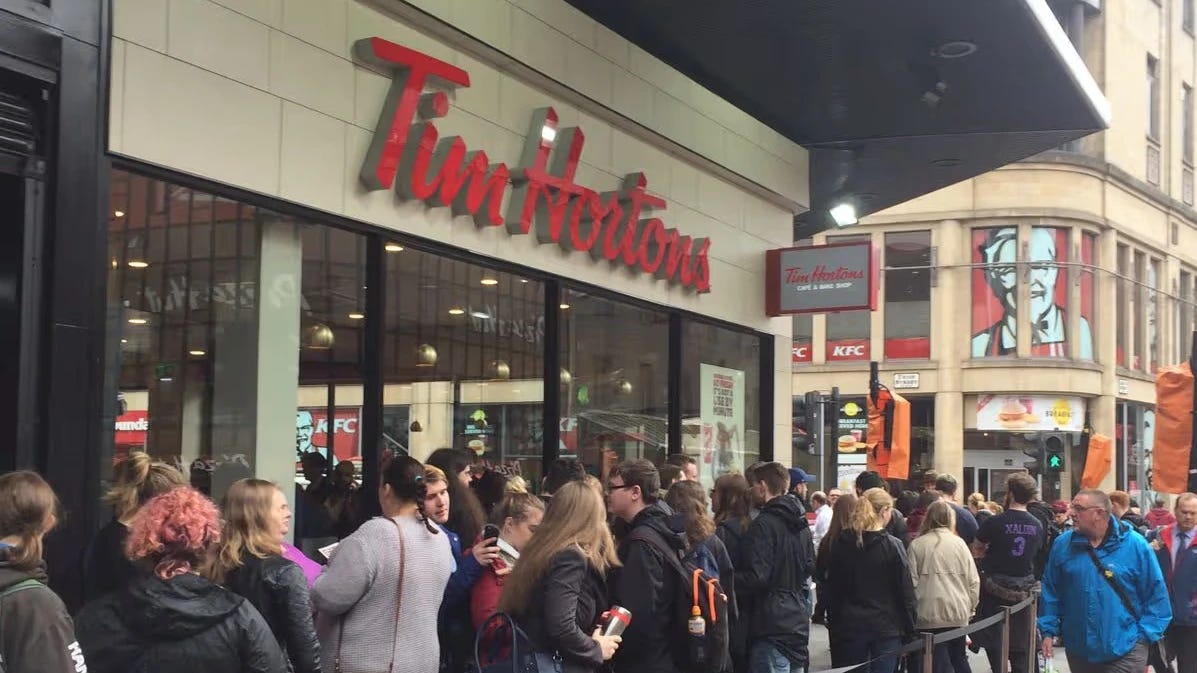
CANADA - Canadians ordering a morning coffee through the Tim Hortons app were unknowingly feeding data to a company born of the same Israeli intelligence unit that generated assassination lists in Gaza and helped orchestrate the pager terror attack in Lebanon, according to a new investigation.
The probe, published on 17 November by Canadians for Justice and Peace in the Middle East (CJPME) and reported by The Cradle, found that the Canadian coffee chain handed sensitive customer data to Forter, an Israeli cybertech firm founded by veterans of Unit 8200, the Israeli army’s notorious intelligence division.
“Canadians ordering coffee should not have their unique and sensitive user data shared with an Israeli cybertech company whose infrastructure was built by alumni of a foreign military intelligence agency engaged in human rights violations,” said CJPME Vice President Michael Bueckert, demanding the chain cut ties with the firm immediately.
Forter hardly hides its lineage. The company openly touts that its machine-learning technology is “enhanced by [...] Israeli military intelligence,” which it uses to compile identity databases on shoppers, the report notes.
CJPME identified Forter through the University of Calgary researcher behind an earlier CBC report that flagged the app’s data-sharing practices without naming the recipient company. Experts told the broadcaster the transfers “seem quite excessive” and were “beyond the pale.”
The unit behind the unit
Unit 8200 sits at the core of Israel’s mass surveillance of Palestinians, controlling the interception and analysis of communications for Aman, the army’s Military Intelligence Directorate.
In September 2025, Microsoft terminated the unit’s usage agreement after revelations by The Guardian, +972 Magazine, and Local Call that it had stored millions of intercepted phone calls from Palestinians in Gaza and the occupied West Bank on Azure servers in Europe. Sources within the unit confirmed the recordings were used to identify bombing targets in Gaza.
In May, Microsoft removed the head of its Israeli branch after an internal review exposed additional Israeli military units using its systems in breach of its terms — with Unit 8200 revealed to be merely the “tip of the iceberg.”
The unit’s fingerprints are also on one of the most brazen terror operations against Lebanese civilians in recent years. Unit 8200 was involved in the September 2024 pager attack across Lebanon, which killed 42 people, including two children, and wounded more than 3,500 — an operation that turned everyday civilian devices into weapons.
It also developed Lavender, the AI system the Israeli army used to mark tens of thousands of Palestinians in Gaza as suspects for assassination with minimal human oversight, according to a 2024 investigation by +972 Magazine and Local Call. Intelligence officers told both outlets that in the opening weeks of the genocide, the army authorised up to 20 civilian deaths for every junior target Lavender flagged, and more than 100 for a single senior Hamas official.
Surveillance goes mainstream
The Tim Hortons revelations expose an uncomfortable reality: the same surveillance machinery that hunts Palestinians across occupied territory and detonated pagers in Lebanese streets is embedded, through alumni networks and corporate partnerships, in the ordinary apps Western consumers use every day.
A coffee loyalty program is a long way from a bombing target list — but the infrastructure, the personnel, and the doctrine of total data collection are the same. CJPME is calling on Tim Hortons to sever the relationship immediately, warning that the company’s ties to a unit overseeing the mass surveillance of Palestinians raise “significant ethical issues” and cybersecurity alarm bells.
For a chain that markets itself as a fixture of Canadian daily life, the question now is why that daily life was quietly feeding a foreign military intelligence pipeline at all.
Reference: The Cradle