

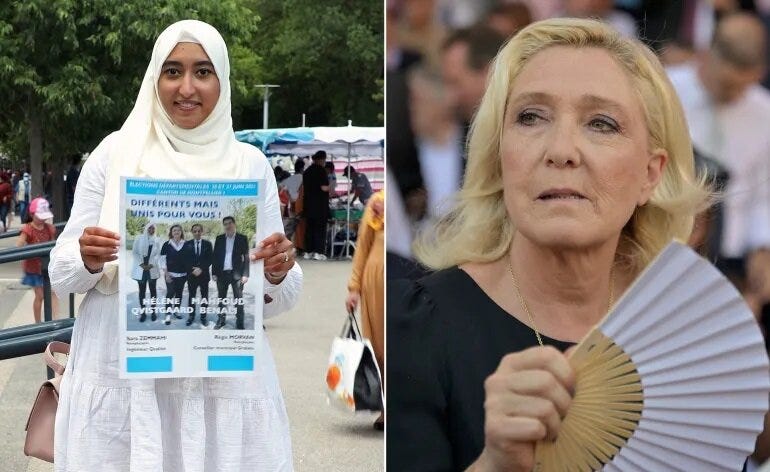
Months before the 2027 presidential election, France’s far-right National Rally (RN) has once again placed the hijab at the centre of the country’s political battlefield — this time with a proposal to fine women who wear the veil in public.
Jean-Philippe Tanguy, an RN MP and one of Marine Le Pen’s closest aides, announced on Sunday, August 30, that the party intends to fine women for wearing the Islamic hijab in public spaces if Le Pen wins the presidency. French newspaper Libération quoted Tanguy as saying the decision has been “finalised” within the party, claiming the hijab in France has “gotten out of control” and framing the move as part of a fight against “Islamist ideology.”
The proposal immediately ignited a storm of backlash.
Government spokesperson Maud Bregeon voiced “clear doubts” about the measure’s constitutionality, warning that any debate over religious symbols in public inevitably raises the question of equal treatment across faiths.
The left was swift in its condemnation. Jean-Luc Mélenchon branded the plan “vile,” insisting that French secularism (laïcité) must guarantee freedom of conscience — not ban citizens from expressing their faith in public. La France Insoumise lawmaker Danièle Obono echoed the sentiment, stressing that punishing women for the hijab betrays secularism’s very purpose as a shield for religious freedom.
The controversy has also exposed fractures within the far-right camp itself. While Le Pen continues to champion a hijab ban as a long-standing campaign promise, party president Jordan Bardella has publicly questioned its practicality, describing a total street ban as “complex.” According to L’Express, the party is considering bypassing political and legal obstacles by taking the issue to a public referendum should Le Pen take power.
Legal experts say the plan faces steep hurdles. Vincent Brengarth, a lawyer at the Paris Bar, wrote on Mediapart that a blanket hijab ban carries a serious risk of being ruled unconstitutional, as it would restrict freedom of conscience, belief, and religious expression — rights protected by both the French Constitution and the European Convention on Human Rights.
For Le Pen, this is familiar territory. In 2012 she proposed banning the hijab and other overt religious symbols in public services, later extending the call to all public spaces — including the Jewish kippah — a stance that drew criticism even from within the right.
As the election season heats up, critics warn that Muslim women’s bodies and beliefs are once again being turned into campaign ammunition — and that the true cost of France’s “hijab war” will be borne by the women simply trying to live their faith in public.
Reference: ABNA24