

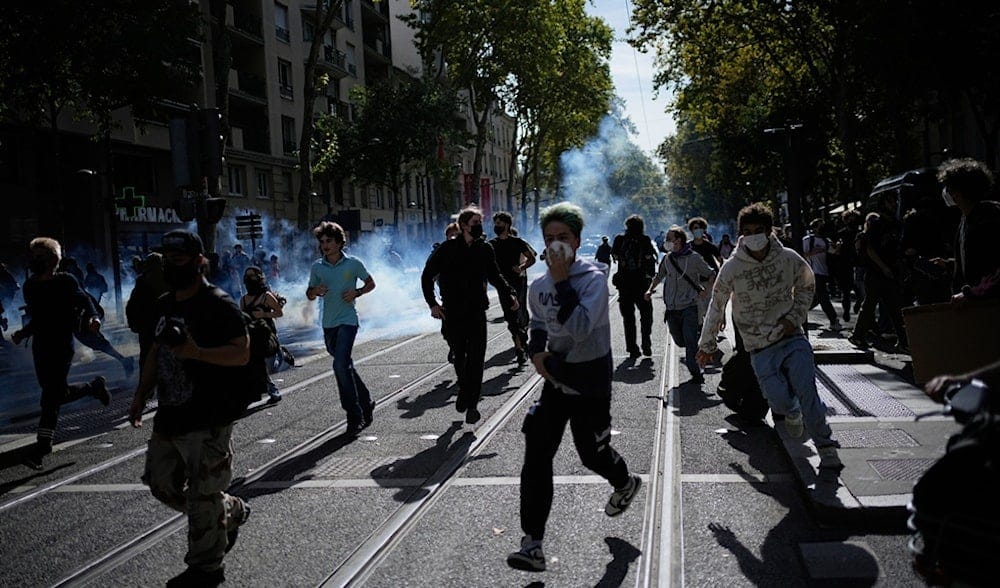
Paris – A wave of student protests has swept across France, forcing the government to hold emergency crisis meetings and push hundreds of schools to shift classes online. The demonstrations, driven by deep grievances over deteriorating educational conditions, severe teacher shortages, and overcrowded classrooms, have escalated into violent clashes with riot police and widespread acts of vandalism.
According to the French Education Ministry, the unrest has severely disrupted at least 564 of the country’s 3,700 high schools (lycées), with nearly 400 schools forced to close their doors completely. The movement, which initially began in the Paris region last month, has now spread nationwide, with blockades also reported at around 30 university campuses in major cities like Paris and Marseille.
Demands for Better Conditions
The protests have been fuelled by students’ frustrations with long timetables, unliveable temperatures during recent heatwaves, and crumbling infrastructure. “There are 35 of us per classroom. With 35°C in summer, it’s unbearable. There aren’t enough toilets, and there are water leaks in some rooms,” a 17-year-old student in Strasbourg told AFP. “The building is falling apart... There is zero budget, zero resources.”
In Caen, 16-year-old Maelle stated that students were protesting “against this government that doesn’t invest in heating, air conditioning, or teachers’ salaries.” The demonstrations have also coincided with rising living costs and an inflation rate of 2.4%, adding to the broader social and economic tensions gripping the country just months ahead of the presidential election.
Escalating Violence and Mass Arrests
As the demonstrations have intensified, clashes between students and security forces have become increasingly violent. Protesters have set fire to rubbish bins, damaged public infrastructure, and reportedly attempted arson inside school buildings. In one severe incident in the eastern city of Belfort, a police officer was surrounded, kicked, and beaten by a group of youths, leaving him unconscious. In Marseille, a school principal and his deputy were reportedly splashed with petrol at a protest site.
The French Interior Ministry reported that nearly 3,000 lycée students—90 percent of whom are minors—have been taken into police custody since the movement began. Over 300 police officers, alongside dozens of teachers, firefighters, and pupils, have sustained injuries. In response to the unrest, riot police have been heavily deployed, and authorities have launched internal investigations into accusations of excessive force used against protesting students.
Political Fallout
The escalating crisis has prompted Prime Minister Sébastien Lecornu to convene a crisis cabinet meeting, ordering ministers to cancel travel plans as his office warned that the “upsurge in violence makes it virtually impossible to maintain the continuity of public education.”
The unrest has also taken on a sharp political dimension. The French government has accused the hard-left France Unbowed (LFI) party of orchestrating the protests to destabilise the state ahead of the elections. LFI leaders, including Jean-Luc Mélenchon, have vehemently denied the allegations, dismissing them as “conspiratorial thinking” while maintaining that their party advocates for non-violent methods of struggle.
Meanwhile, Justice Minister Gérald Darmanin has demanded that prosecutors hold parents financially liable for the damages caused by their protesting children, urging them to pay for the extensive repairs required at vandalised schools. As the standoff continues, France remains gripped by uncertainty over the future of its public education system and the widening social divide.
Reference: Al-Mayadeen | PressTv