

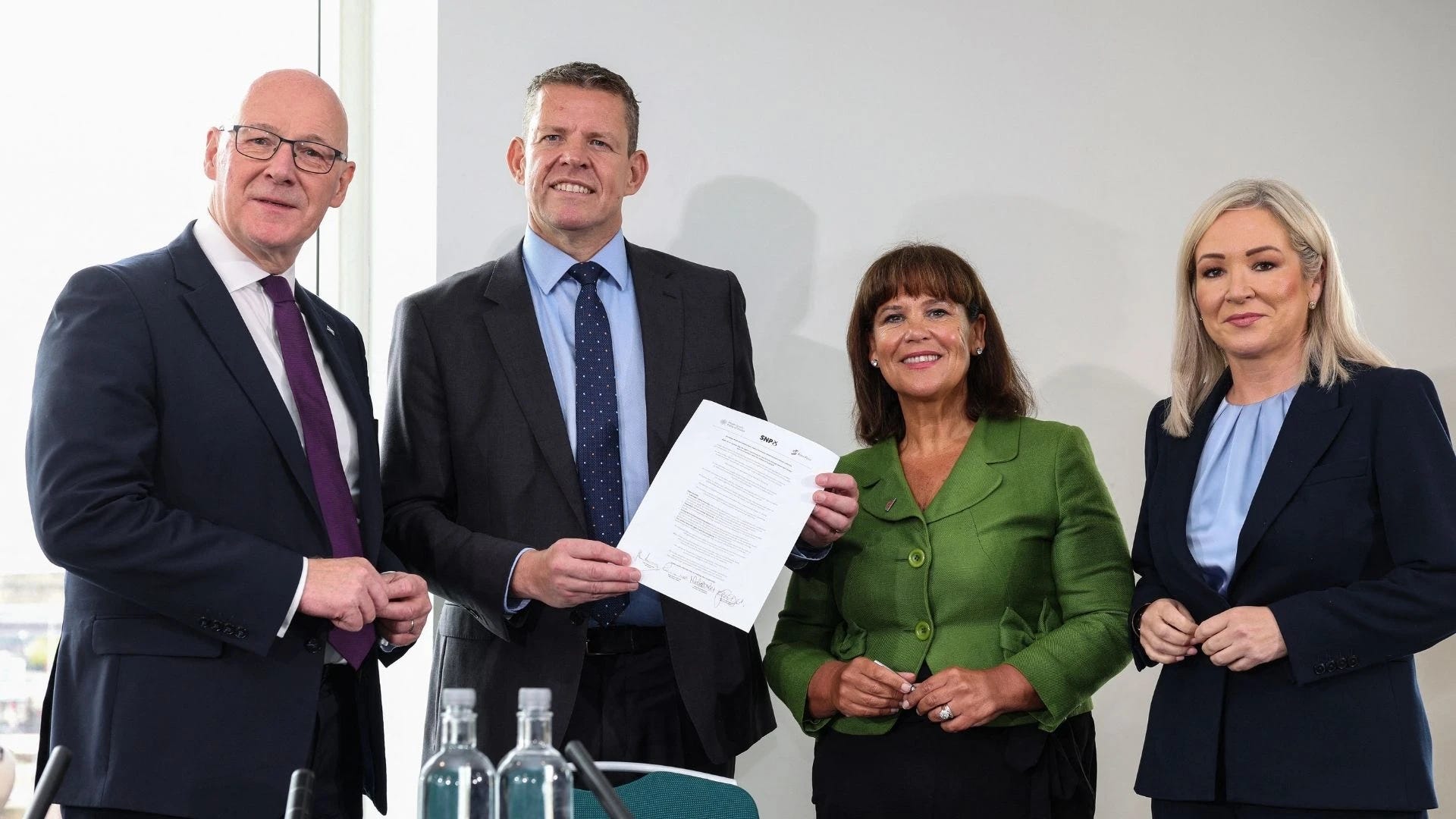
In a historic blow to London’s centralised authority, the leaders of Scotland, Wales, and Northern Ireland have signed a joint declaration asserting their nations’ unalienable right to self-determination. The landmark agreement, signed on Monday in Cardiff, signals a coordinated push for constitutional change that could ultimately dismantle the United Kingdom.
The unified front was forged by Scottish First Minister John Swinney (Scottish National Party), Welsh First Minister Rhun ap Iorwerth (Plaid Cymru), and Northern Irish First Minister Michelle O’Neill (Sinn Féin). Together, they issued a direct challenge to the British establishment, declaring that “no Westminster government has the right to block democracy or undermine the principle that our people will decide their own future.”
For decades, London has wielded absolute veto power over the constitutional fates of its devolved nations. The newly signed pact seeks to strip Westminster of this authority, demanding that the British government “prepare for, plan and facilitate constitutional change” rather than indefinitely obstruct it. While the declaration acknowledges that each nation will pursue independence in its own time and manner, the collective message is clear: the era of London dictating the terms of the union is over.
A Turning Point for the Nations
The momentum behind this historic alliance is driven by shifting political landscapes across the British Isles. For Wales, the signing marks the culmination of a seismic political shift. Rhun ap Iorwerth, whose Plaid Cymru recently ousted the entrenched Welsh Labour Party to take power for the first time, described the moment as a definitive “turning point for Wales.”
Meanwhile, in Northern Ireland, First Minister Michelle O’Neill has been aggressively championing a border poll for Irish reunification. Reaffirming the disconnect between the Celtic nations and the British capital, O’Neill stated that the best interests of the Irish people “have never been served by those in Westminster.” She emphasized that “change is happening right across these islands,” urging the nations to be fully prepared for the constitutional shifts on the horizon.
Scottish First Minister John Swinney echoed this sentiment, calling the Cardiff summit a “pivotal moment” that has “changed forever” the political fabric of the UK. “The people of Scotland, Wales, and Ireland have a right to self-determination,” Swinney asserted. “They are entitled to decide on their own future.”
Rejecting Westminster, Looking to Europe
Beyond the immediate question of independence, the declaration outlines a clear geopolitical pivot. The allied leaders explicitly stated their vision for their independent nations to rejoin the European Union. Framing Brexit as a catastrophic policy imposed by Westminster that severely damaged their respective economies, the pact argues for the restoration of closer European ties.
As the British state grapples with internal fragmentation and the loss of its imperial cohesion, the Cardiff Declaration stands as a definitive milestone. What was once a fragmented aspiration for independence has now coalesced into a unified, cross-border strategy, leaving Westminster facing the very real prospect of its own dissolution.
Reference: The Cradle