

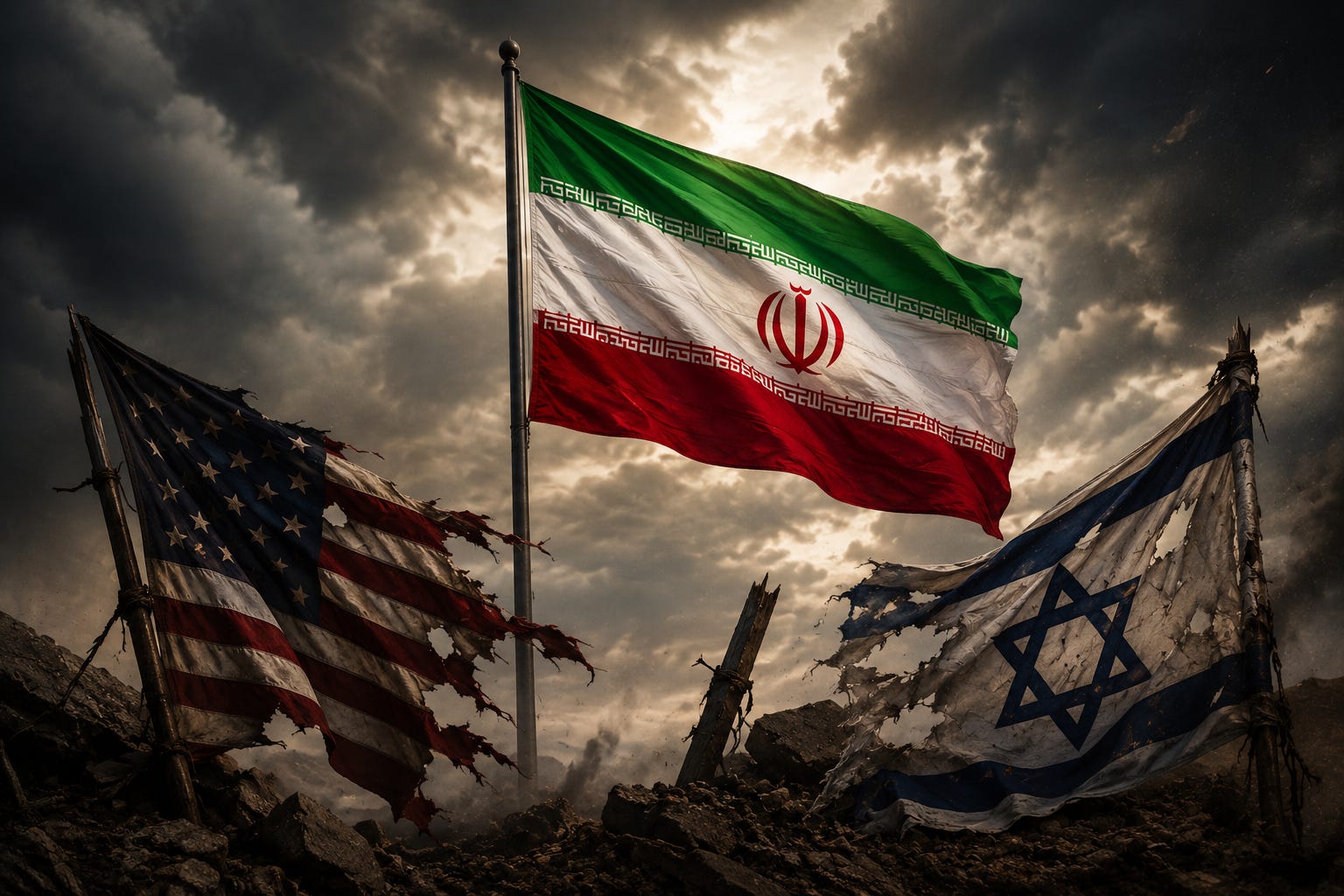
Iran, PUREWILAYAH.COM — The United States and Israel committed four major intelligence and strategic miscalculations during their 40-day war against Iran, leading to the failure of a campaign that had been designed to topple the Islamic Republic within weeks.
In a detailed video analysis, Amal Shbeeb, a journalist with the Arabic service of Tasnim News Agency, examined why the intelligence assessments of Washington and Tel Aviv proved detached from the realities of Iranian society, state structure, and geopolitical depth.
At the outset of the U.S.-Israeli aggression on March 1, 2026 (9 Esfand 1404 in the Iranian calendar), President Donald Trump and Israeli Prime Minister Benjamin Netanyahu publicly projected that the Islamic Republic would collapse within a matter of weeks.
Instead, despite the martyrdom of Ayatullah Sayyed Ali Khamenei in the opening hours of the assault, Iran avoided internal disintegration and emerged from the war more cohesive and militarily determined than before.
Betting on Internal Collapse
According to the analysis, Washington and Tel Aviv believed that a combination of large-scale military attacks, crippling sanctions, and psychological warfare would ignite widespread unrest and ultimately produce a popular uprising aimed at overthrowing the Islamic Republic.
That calculation, however, rested on a profound misunderstanding of Iran’s political culture and the relationship between the state and its people.
Rather than triggering collapse, the external assault strengthened national solidarity and renewed support for the country’s foundational institutions.
First Miscalculation: Mistaking Anger for Rebellion
The first error was assuming that public frustration over domestic challenges would translate into a revolt against the Islamic Republic.
Shbeeb noted that while many Iranians were dissatisfied with specific economic and political issues, their grievances did not amount to a rejection of the state itself.
When the country came under direct foreign attack, those differences receded and were replaced by a shared commitment to defend Iran’s sovereignty and independence.
Second Miscalculation: Ignoring Historical Legitimacy
The second error was underestimating the deep historical legitimacy of the Islamic Revolution.
Unlike regimes created through military coups or imposed by outside powers, the Islamic Republic emerged from a mass popular movement that has shaped Iran’s national identity for more than four decades.
For millions of Iranians, the Revolution remains inseparable from resistance to colonial domination and foreign coercion.
Third Miscalculation: Overestimating the Power of Sanctions
The third and, according to the analysis, most misguided assumption was that economic sanctions could bring the system to an end.
Iran has lived under sanctions since 1979 and has developed a deeply rooted culture of self-reliance and what Iranian officials describe as the “Resistance Economy.”
This model has enabled the country to build domestic capabilities across strategic sectors, including defense industries, medicine, heavy manufacturing, and advanced science.
Fourth Miscalculation: Misreading National Unity
The fourth mistake was believing that external pressure would fracture Iranian society.
The opposite occurred.
The war reinforced national cohesion and rallied the population around core principles of independence, dignity, and resistance.
Shbeeb argued that foreign pressure did not weaken the bond between state and society; it redefined and strengthened it.
A State Built on Institutions, Not Individuals
A central factor in Iran’s endurance was the institutional nature of the Islamic Republic.
The analysis stressed that Iran is not a political system dependent on a single individual but a complex network of interlocking institutions capable of maintaining continuity under the most severe conditions.
This institutional depth prevented the leadership decapitation strategy from achieving its intended objective.
Strategic Depth and the Resistance Axis
Shbeeb also emphasized that Iran does not stand in isolation.
Its strategic depth extends through close relations with Russia, China, and allied resistance movements in Lebanon, Yemen, Iraq, and Palestine.
These partnerships significantly enhanced Tehran’s ability to absorb pressure and sustain a prolonged confrontation.
Strategic Patience Prevails
The final and perhaps most decisive element identified in the analysis was Iran’s doctrine of strategic patience.
Iranian decision-makers, Shbeeb said, understand that political figures such as Trump and Netanyahu are temporary, while the Islamic Republic’s strategic vision is built over decades.
In such a contest, the side with greater endurance ultimately prevails.
Iran Chose the Long Game
According to the report, Trump gambled on a rapid collapse of the Islamic Republic, while Iran prepared for a long war of attrition.
The result was a clear strategic reversal.
Rather than disintegrating under military assault and economic warfare, Iran endured, adapted, and emerged stronger than before.
The analysis concluded that the United States and Israel failed because they fundamentally misunderstood the resilience of a nation that knows precisely when and how to resist. (PW)